Whole-house water filtration for a villa well: how the system should be designed
There is no best filter. There is a system that fits one well, one villa and its busiest half-hour of the day. Most of the problems we fix in Samui plant rooms are design problems, not equipment problems.
October 3, 2026 · 9 min read
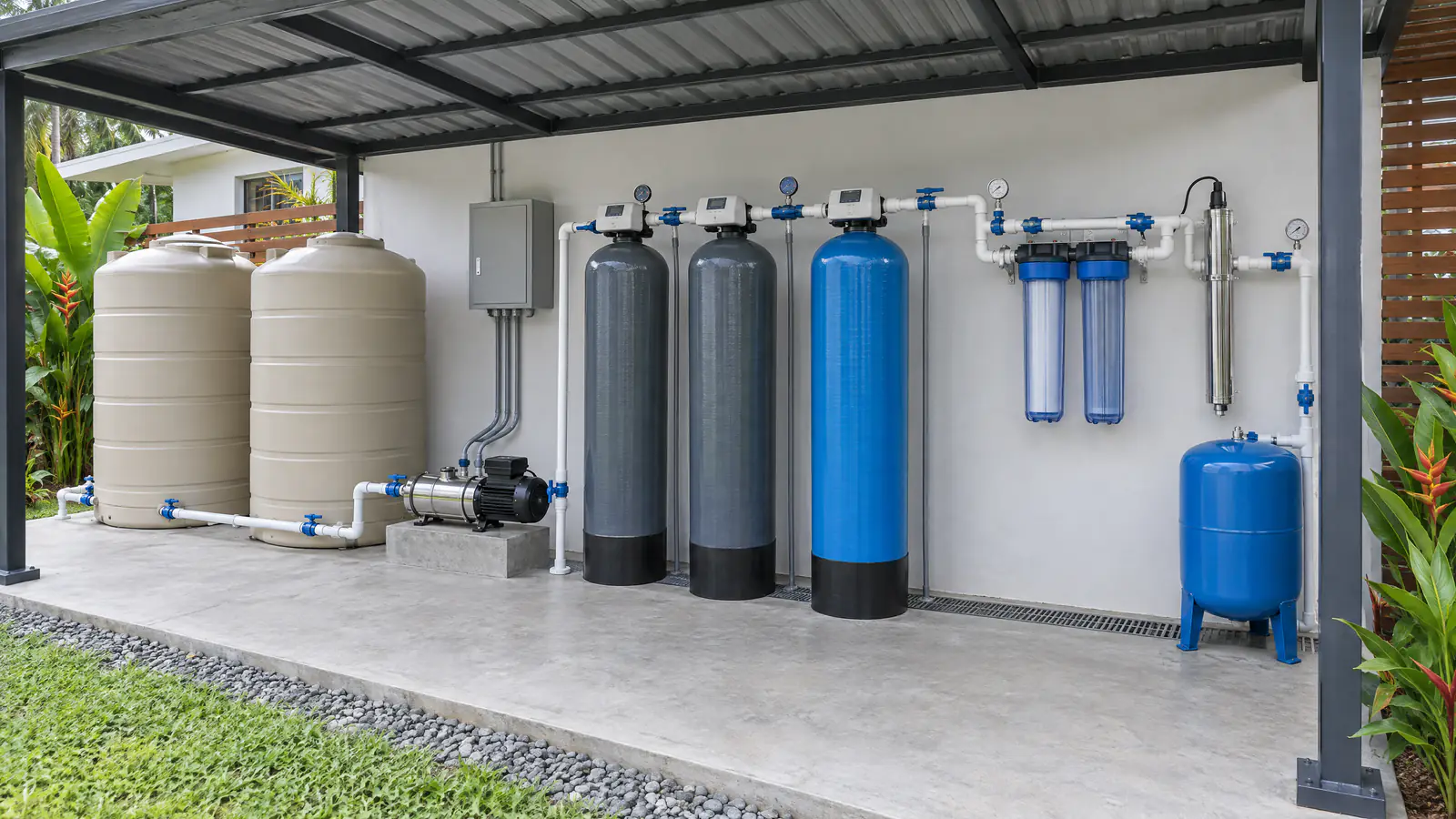
A whole-house water filtration system for a villa on a deep well is a small treatment plant: a chain of stages, each sized for the water and the flow, with a pump that can push through all of them and somewhere for the backwash to go. Choose the stages from a catalogue and the system fails in one of a few predictable ways. Showers lose pressure, iron breaks through, or the filters never get cleaned. This guide covers the design principles, so you can judge a proposal whoever writes it.
Why there is no universal best filter
Two villas a kilometre apart can need completely different equipment. One well carries dissolved iron, the next is hard but clean, a third near the beach is turning brackish. Demand differs as much as chemistry: a two-bedroom house and a six-bedroom villa with a pool and staff quarters are different design problems even on identical water. Space, shade and drainage differ too. A system that suits one property is, at best, a starting point for the next.
Start from two numbers: the water analysis and the peak flow
The laboratory water analysis decides which stages the system needs. Peak flow decides how big they must be. Peak flow is not daily consumption. It is the flow when the most taps run at once, typically the morning, when several showers, the kitchen and the laundry overlap. Every stage in the chain must pass that flow without starving the showers, and media filters must also stay within the flow their bed is rated for. Push water through a media bed faster than its rating and iron and sediment break through, however good the media is.
This is why a household jug or an under-sink cartridge, perfectly good at one tap, can't feed a villa. It isn't low quality. It was built for a fraction of the flow.
A typical treatment sequence
Treatment workflow
From the well to the villa, stage by stage
1Deep well
2Raw water tank
3Pump
4Sediment
5Treatment
6Storage / pressure
7Villa
Whole house / Drinking point
Actual treatment configuration depends on the water analysis
This is a common arrangement, not a universal one. Stages are added, removed or reordered to suit the test results, the well's yield and the villa's peak demand.
01 · Deep well
The well pump fills storage gently
Pumped at a rate the well can sustain, not at the rate the house uses water.
02 · Raw water tank
Raw water storage
A buffer between the well and the house. Often also where dissolved iron starts to oxidise before filtration.
03 · Pump
Booster pump
Sized to push peak flow through every stage and still deliver good pressure at the furthest shower.
04 · Sediment
Sediment and particle removal
The first stage, protecting everything after it from sand and silt.
05 · Treatment
Treatment stages from the analysis
Iron and manganese removal, carbon, softening: only what the results call for.
06 · Storage / pressure
Disinfection and pressure
UV as the last stage before use where needed, and a pressure tank to keep the pump from cycling.
07 · Villa
The villa supply
Treated water for showers, kitchen, laundry and pool top-up.
Whole-house water
Clean, stain-free, microbiologically safe washing water at every tap.
Drinking-water treatment where required
Reverse osmosis or a dedicated stage at the kitchen tap, only if the analysis calls for it.
Some systems filter on the way into the raw tank instead, and some low-yield wells need the tank before any media filter so backwashing has enough flow. Order follows the analysis and the site.
What each stage does, and how it is sized
Sediment and sand
A backwashing media filter or a cartridge stage catches particles before they reach anything finer. It should be sized to peak flow and to how much sediment arrives. Heavy, ongoing sand is a symptom to fix at the well rather than something to filter forever; see sand or cloudy water from a deep well.
Iron and manganese
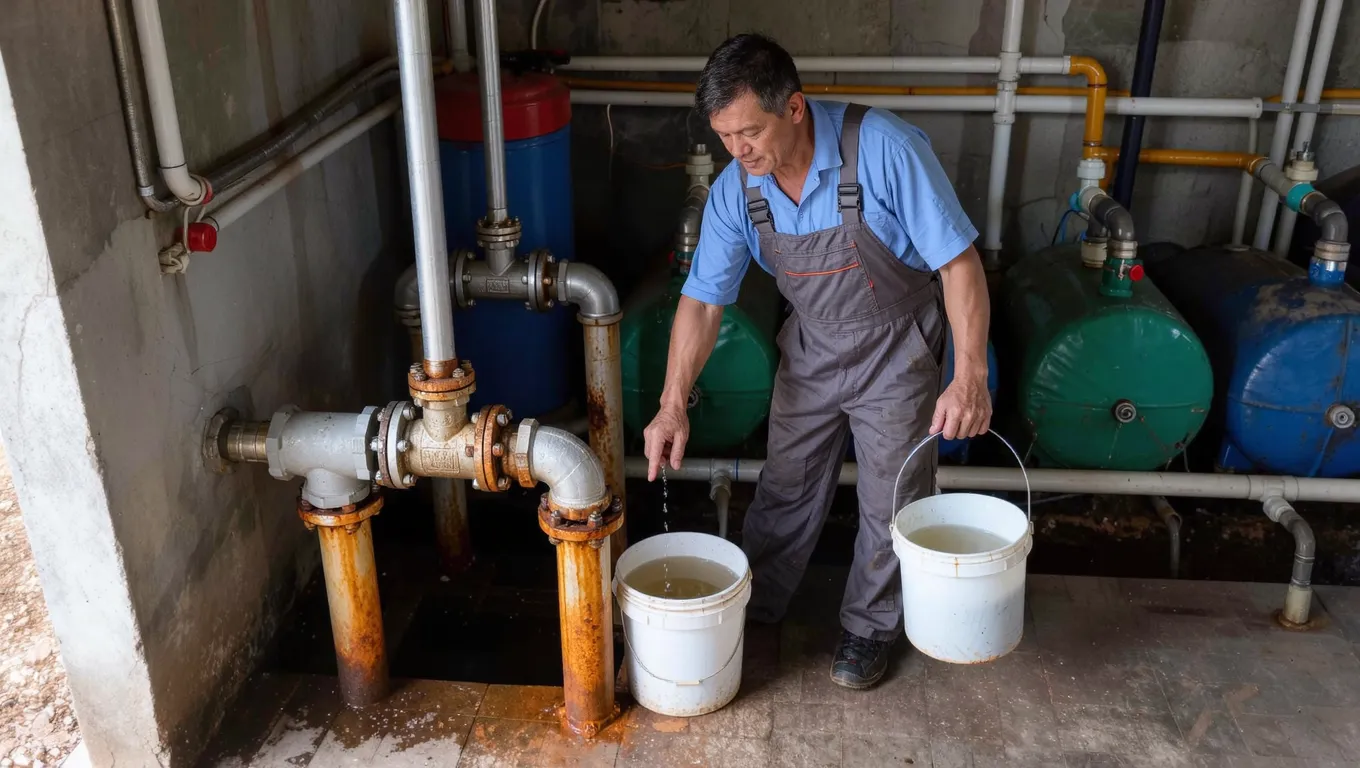
Dissolved iron and manganese pass straight through ordinary filters. They need oxidation (air, contact time or a chemical oxidant) followed by a media bed that traps the result, with pH inside the range the media works in. These vessels need generous sizing and regular backwashing, because what they catch builds up fast. The chemistry is explained in brown or orange well water.
Activated carbon
Carbon improves taste and odour and removes some organic compounds and chlorine. It does nothing for bacteria, hardness or salt, and a large carbon bed that sits unused can become a home for bacteria, so it belongs where the analysis justifies it.
Softening
An ion-exchange softener removes the calcium and magnesium behind scale on heaters, glass and fittings. It needs salt for regeneration and a drain for the brine, and the drinking-water line is usually taken off before it.
UV disinfection
UV inactivates bacteria as water passes the lamp, but only in clear water, so it always comes after sediment and iron removal. It leaves nothing behind in the pipes. That is why it sits last, after the storage tank, close to where the water is used.
Reverse osmosis, and where it belongs
RO removes dissolved salts, nitrate and most other contaminants, and rejects a stream of concentrate to drain as it does. At a kitchen tap that is a compact, efficient way to make drinking water from brackish or mineral-heavy water. For a whole villa it means a large plant, a lot of waste water and high upkeep. It is justified only where the analysis leaves no alternative, as can happen with a coastal well turning salty.
Where the tanks and pumps go
Two layouts cover most villas. In the first, the well pump pushes water through the filters into storage, and a booster pump feeds the house. In the second, the well fills a raw tank and the booster pump drives water through the filters and on to the house. The second is often the better fit on Samui. A low-yield well can fill the tank slowly at a rate it sustains, while the booster supplies the strong flow that backwashing a media vessel needs, something many wells can't provide on their own. Either way, UV goes after the last storage the water sees.
The plant itself needs shade, ventilation, a floor that drains, and room to service everything: space to lift a vessel head, change a cartridge and pull a UV lamp without dismantling the pipework. Plant areas tucked into a hot cupboard with no drain are where electronics fail and maintenance stops. Our overview of how a villa water system works shows how each part depends on the one before it.
Pressure loss: the hidden cost of every stage
Every vessel, cartridge and valve costs some pressure, and the loss grows as cartridges load and media fills with what it has caught. Add enough stages to an undersized booster pump and the furthest shower runs weak even when the system is new. Design starts with the pressure the house needs at the furthest outlet, adds the loss through each stage at peak flow (dirty, not clean), and only then picks the pump. When pressure fades later, a loaded filter is one of the first things to check; see low water pressure in a villa.
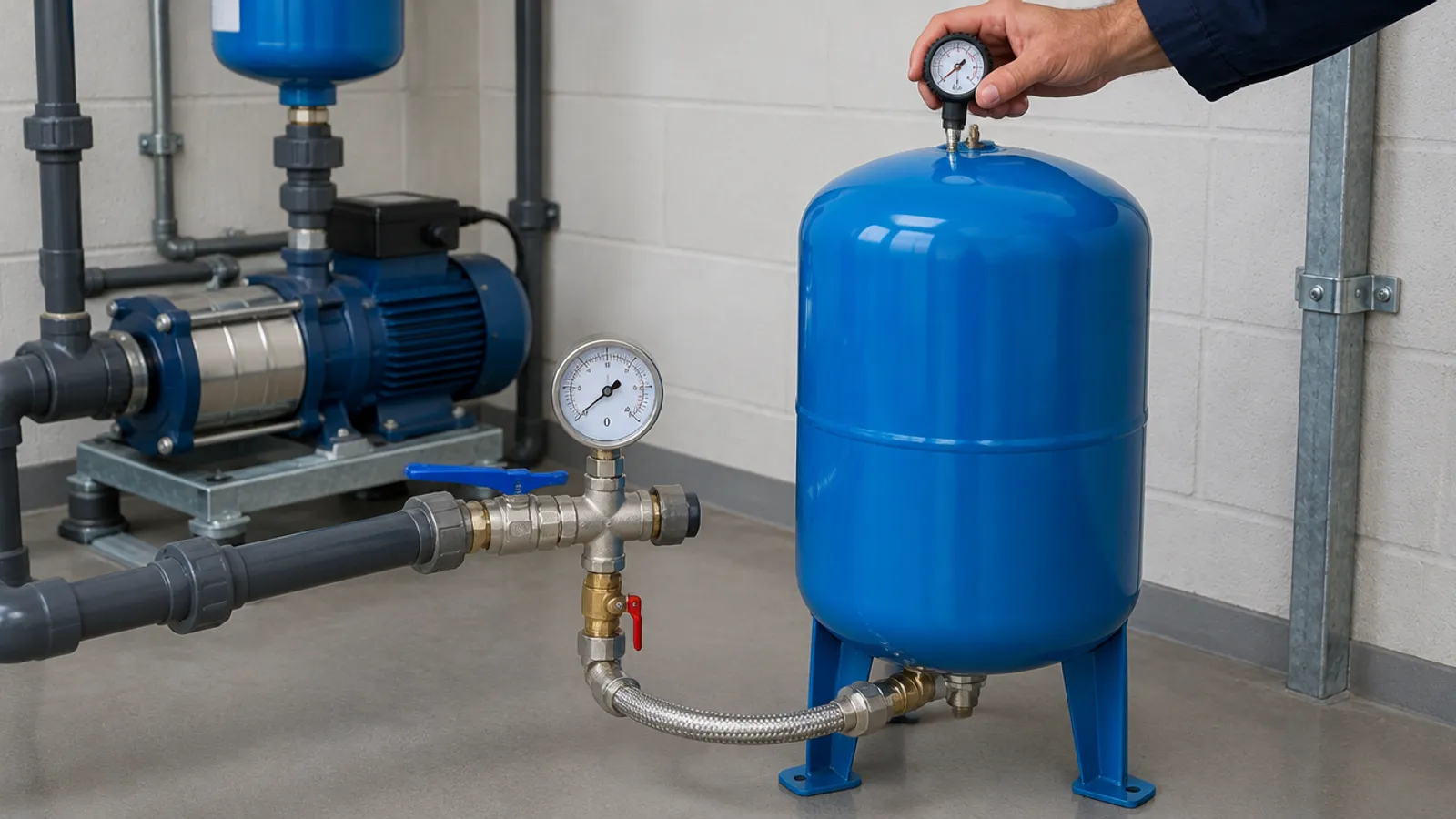
Fit a pressure gauge before and after each stage. The difference between the two readings tells you when a cartridge is due, before anyone notices at the shower. The pressure tank and pump settings then keep delivery steady, and a pump sized to the well and the house keeps the whole chain fed.
Backwash, drainage and bypass
A three-valve bypass: inlet and outlet valves (blue) isolate the vessel, the bypass valve (red) keeps the house supplied during service. Gauges either side show the pressure drop across the stage.
Backwash flow. Media vessels clean themselves by reversing flow for several minutes at a rate higher than normal service. The pump or tank must supply it, or the bed never really gets clean.
A drain that can take it. Backwash and softener brine need a drain sized for the flow and for what it carries. Plan it at the start, not after the first backwash floods the plant area.
Staggered timing. Automatic valves are usually set to backwash at night, one vessel at a time, so the house isn't left without water and the drain isn't overwhelmed.
Bypass valves around each stage, and one around the whole plant, so any part can be serviced while the villa still has water.
Sampling taps before and after the system, so a retest can show what each stage actually removes.
Maintenance designed in from the start
Treatment degrades quietly. Cartridges are changed on pressure drop, not on a date picked at random. Media is replaced after a service life that depends on the water. Softeners need salt. UV lamps lose output and are replaced on schedule, with the quartz sleeve cleaned. RO membranes and pre-filters have their own intervals. A plant with no service log and no owner for that log will stop treating within a year or two, while still looking busy. Our maintenance schedule for a villa well includes the treatment stages for that reason.
Common design mistakes
Installing treatment before analysing the water, then discovering it removes the wrong thing.
Buying small household filters for a large villa: fine at one tap, starved at peak flow.
Sizing for daily volume rather than peak flow, so showers drop off every morning.
No allowance for pressure loss, leaving the booster pump unable to push through a loaded system.
Media vessels with no backwash flow or no drain, which therefore never clean properly.
UV before the sediment and iron stages, where cloudy water shields bacteria from the light.
No bypass valves, so any service means a dry house.
Equipment crammed into a hot, unventilated cupboard with no floor drain.
How big should a whole-house filter be for a villa?
Big enough to pass the villa's peak flow within the rated flow of each stage, with the pressure loss covered by the pump. That comes from the number of bathrooms and outlets used at once, not from the floor area or the daily volume.
Do I need a raw water tank before the filters?
Often it helps. A tank lets a modest well fill storage gently, gives dissolved iron time to oxidise, and lets the booster pump supply the strong flow that backwashing needs. Whether it is required depends on the well's yield and the treatment.
How often should a media filter backwash?
It is set from the water's iron and sediment load and the volume used, often every few days for a typical villa, more often on heavy iron. A gauge showing rising pressure loss between backwashes means the interval is too long.