Deep Well Drilling · 2025
Villa, Maenam, Koh Samui
85 m well, 8 m³/day tested yield
View projectKoh Samui · Thailand
Deep well drilling and complete water systems for villas, developments and resorts across Koh Samui.
From depth to surface
Clean water is already there, held in the rock deep beneath your land. Our work is the engineering in between — finding the aquifer, reaching it, and lifting its water to your tap, reliably, year after year.
Fixed quotes · Written warranty · Samui-based crew
Why Deep Well Samui
A water system is only as reliable as its weakest component. We take responsibility for the whole chain — survey, drilling, pumping, storage and filtration — under one contract and one warranty.
Every well starts with the geology, not the sales pitch. We size casing, pumps and storage from measured data — depth, yield and water chemistry.
Equipment selected for Samui's heat, humidity and salt air, installed to survive storm season and power fluctuations.
Written warranty, documented handover and scheduled maintenance. When something needs attention, you call the people who built it.
Services
Nine services covering the full life of a water system — building new ones, diagnosing old ones and keeping both running. One contractor, one warranty, one number to call.
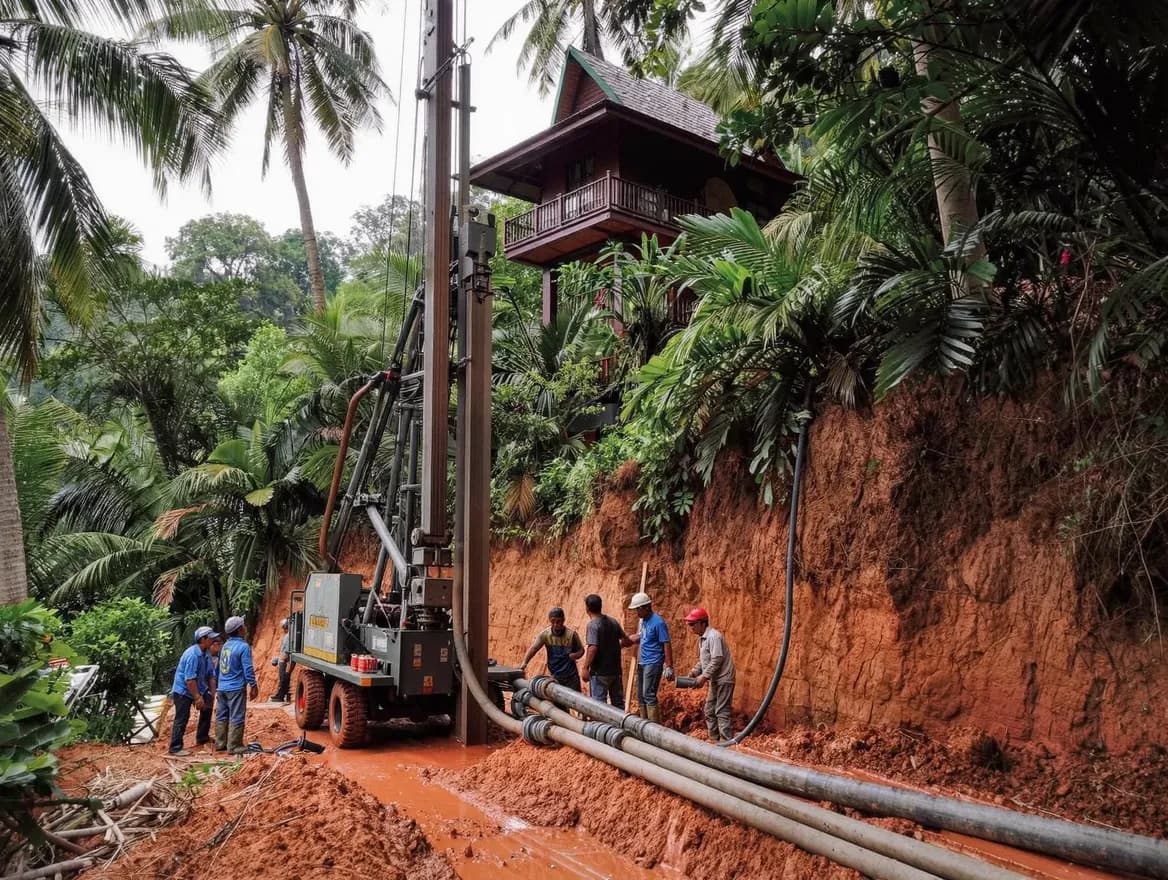
Rotary drilling through granite and compacted sediment to a confirmed aquifer. Every borehole is cased, gravel-packed and sealed at the surface so contamination stays out and yield stays stable.
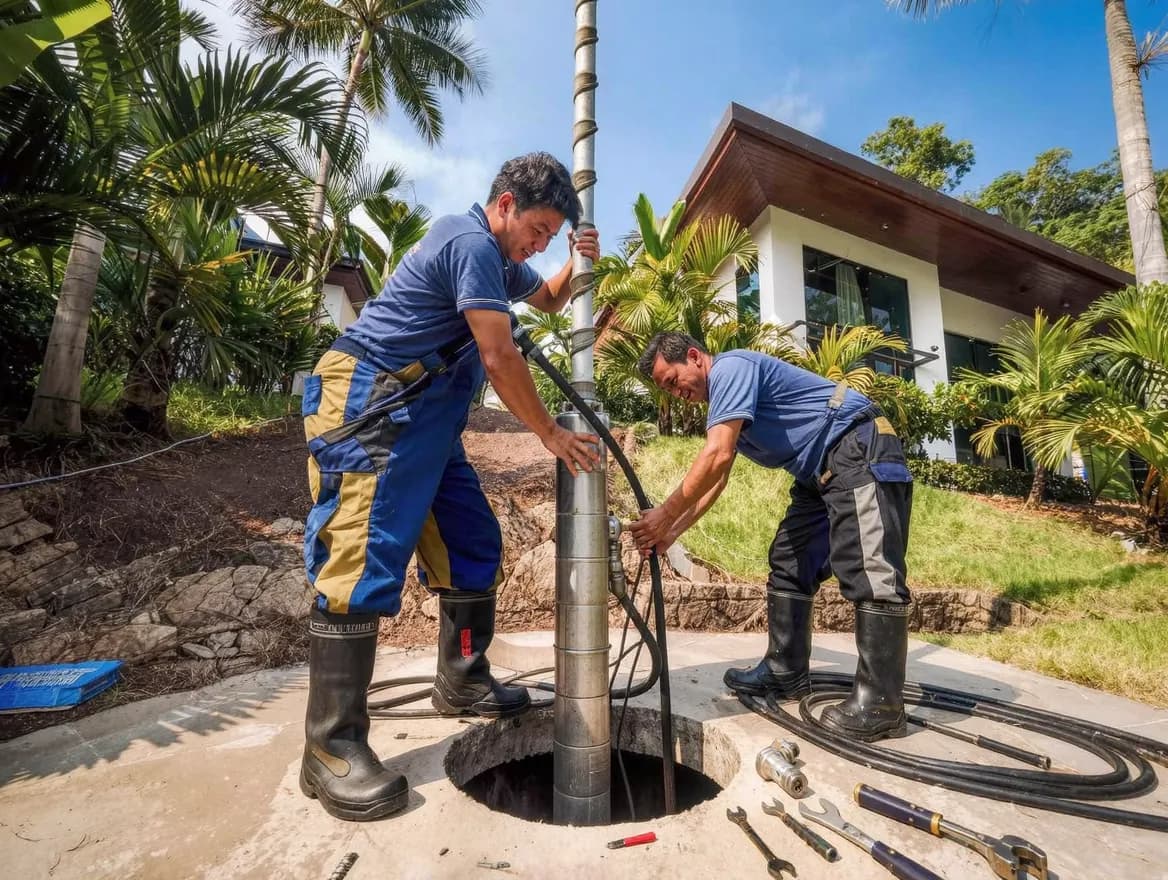
Submersible pumps selected from measured well yield, total head and your peak demand — installed with dry-run protection, surge arrest and correctly sized cabling.
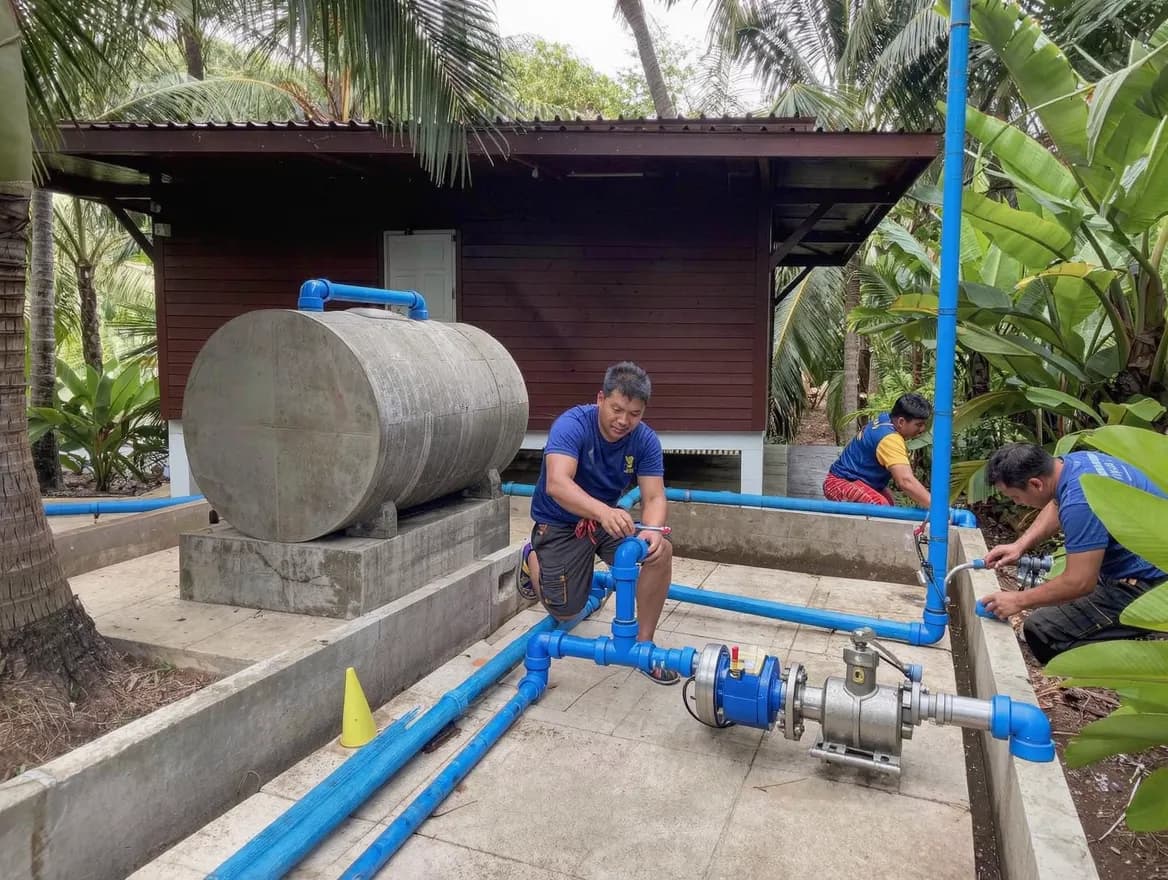
Storage sized to your daily consumption and tied into the well and house plumbing with float control, non-return valves and clean, serviceable pipe routing.
Treatment designed from a laboratory analysis of your well water — sediment, iron and manganese removal, hardness control and disinfection, staged only as far as your water actually needs.
Measured flow-rate testing, static and drawdown level checks, casing and wellhead condition review, and an audit of the installed equipment — documented in a written report.
Failure diagnosis first: yield, electrical supply and pipework are checked before a new pump is specified, so the replacement fixes the cause instead of repeating it.
Scheduled visits covering pump performance, controls, tank cleaning and filter changes — with a written condition log after every visit, so small issues surface before they stop the water.
Flow and pressure measured stage by stage — well, pump, storage, filtration and distribution — to locate exactly where performance is being lost.
Structured fault-finding when the water stops: power, controls, pump and well are checked in order, with temporary supply options while any parts are sourced.
The system
Five stages between the aquifer and your tap. Each one is sized and specified for your property — these are the components we design, install and maintain.
Cased borehole · 30–120 m
A drilled and cased borehole reaching a stable aquifer below the seasonal water table, sealed against surface contamination.
Sized to yield & demand
A stainless pump set deep in the well lifts water on demand, with dry-run and surge protection.
1–2 days of reserve
Ground or underground storage buffers peak demand and keeps water available during power cuts and maintenance.
Staged, chemistry-matched
Sediment, media and fine filtration matched to the lab analysis of your water — down to drinking quality if required.
Constant-pressure delivery
Booster pump and pressure control deliver stable flow to every outlet, from garden irrigation to rooftop showers.
What a complete installation is made of — every part specified in your quote by name.
Local engineering
An island system is not a mainland system. A design that works in a Bangkok suburb fails on a hillside in Maenam — these are the factors we engineer for on every Samui project.
Occupancy peaks in high season exactly when rainfall stops. Systems are sized for the December peak, not the yearly average.
Hillside plots add tens of metres of vertical lift. Every metre changes the pump specification and the pipe pressure rating.
Well depth, elevation and pipe friction combine into total head — the single number that decides whether showers are strong or disappointing.
Tanks sized from your real daily demand, so power cuts and pump service windows never mean dry taps.
Water chemistry differs from one side of the island to the other. Treatment follows the laboratory analysis, not a standard package.
Wellheads, tanks and filters placed where a technician can actually reach them — a detail that decides service costs for decades.
Float switches, bypass lines and protection electronics, so one failed component degrades the system instead of stopping it.
Due diligence
Before we commit to a design — and before you commit to a price — these eight points are checked on site.
Geology, groundwater history and access for the drilling rig.
Bedrooms, pool, garden and occupancy converted into daily cubic metres.
Elevation, foundations and distance from the well and the house.
The shortest serviceable runs with the fewest pressure losses.
Available capacity, cable sizing and protection for pump loads.
Target setting depth against expected drawdown and total lift.
Can every component be reached, serviced and replaced?
What the water analysis says your treatment actually requires.
Process
Ten fixed steps in four phases. Each one ends with something you can see, measure or sign — no vague middle where the project drifts.
We walk the plot, review rig access, check what's known about neighbouring wells, and identify a drilling location that suits both the geology and your site plan.
Bedrooms, bathrooms, pool, garden and occupancy are converted into a daily demand figure in cubic metres — the number every later decision is sized against.
Target depth, casing diameter and material, drilling method and a fixed, itemised quote — agreed in writing before the rig mobilises.
The borehole is drilled to the planned aquifer and yield is measured on site. If the geology differs from expectation, you hear it from us before we proceed — not after.
Casing is installed and the annulus sealed so surface water and contaminants cannot migrate down into the aquifer. This step decides how long the well lives.
The pump is specified from measured yield and calculated head, set at the correct depth, and protected against dry running and voltage fluctuation.
Buried pipe runs, cabling, controls and switchgear — specified for tropical conditions: heat, storm rain and an electrical supply that isn't always polite.
Storage and treatment are plumbed in and the chain is balanced end to end, so every stage sees the flow it was designed for.
Flow rate, pressure and water quality are tested against the plan — witnessed with you and recorded in the handover pack.
You receive the documentation, warranty terms and a service schedule matched to your system — plus a direct line to the crew that built it.
Free site assessment · No obligation
Why it matters
Koh Samui's mains network wasn't built for the island's growth. For properties in the hills, at the end of a soi, or hosting paying guests, water independence is infrastructure — not a luxury.
From December to April, reservoir levels drop and mains pressure falls first in elevated and remote areas — exactly where most villas are built.
Many hillside plots and new developments have no municipal connection at all, or one too weak to run a household reliably.
Trucked water is expensive per cubic metre, depends on road access, and turns every dry spell into a logistics problem.
For rental villas and boutique resorts, one waterless morning costs more in reviews and refunds than a well costs in years of operation.
Who we work with
Different properties fail in different ways. The system is engineered around how yours is actually used — not around a standard package.
A family home needs quiet reliability: stable pressure, clean water and a system you never have to think about.
Focus · Comfort and water quality
Guests notice water before anything else. Rental systems are sized for full occupancy and backed by fast service response.
Focus · Uptime during bookings
Multiple buildings, laundry, pool and kitchen loads — resort systems are staged, monitored and serviced on a schedule.
Focus · Capacity and monitoring
Shared wells, central storage and metered distribution — designed into the master plan from day one, not retrofitted.
Focus · Infrastructure planning
Weak pressure, failing pumps, murky water — we diagnose what's there and fix the cause, keeping whatever still works.
Focus · Diagnosis before replacement
Where we work
From Bophut's coast to the hillside estates of Plai Laem, each part of Samui has its own water conditions. See how we approach the main areas.
Projects · Koh Samui
A few recent jobs — each names its place, its service and its measurable outcome.
FAQ
Straight answers to the questions villa owners, buyers and project managers ask first. Anything else — just ask.
If your villa depends on mains water that weakens in high season, on tanker deliveries, or on a shallow well that dries out, a deep well is usually the most reliable long-term answer. If your situation doesn't need one, we'll say so at the site assessment — drilling a well nobody needs helps neither of us.
On Koh Samui, most wells reach between 30 and 120 metres depending on location and geology. We drill to a stable aquifer below the seasonal water table — not just to the first water we hit — and confirm the target depth during the site survey.
Yes. A correctly sized system supplies bathrooms, kitchen, laundry, pool top-up and irrigation. The key word is sized: we calculate your daily demand first, then specify the well, pump and storage to meet it with reserve — rather than hoping one standard setup fits every property.
Almost always at least basic filtration. Well water on Samui varies street by street — some sources need only sediment removal, others carry iron, manganese or hardness. A laboratory analysis tells us exactly which stages your water needs, so you don't pay for treatment it doesn't.
With storage in the system, a pump failure doesn't mean instantly dry taps — the tank keeps you supplied while we diagnose and repair. We identify the cause (electrical, hydraulic or wear) and replace only what actually failed. Systems on a maintenance plan rarely reach that point without warning.
Yes. We measure the yield, check static and drawdown water levels, review casing and wellhead condition, and audit the installed equipment — then hand you a written report. Owners order this before buying a property with a well, or after years of running one without records.
From two measured numbers: what the well can deliver, and what your property demands at peak. Combined with the vertical lift and pipe losses, they define the duty point the pump must meet. Oversized pumps short-cycle and fail early; undersized ones never satisfy — sizing is most of the job.
Your location, the plot size if known, your current water source, and what the property is or will be — bedrooms, pool, garden, expected occupancy. Photos help. If an existing well has any documents, even partial ones, have them ready.
Groundwater use in Thailand is regulated, and requirements depend on well depth and usage. We advise on what applies to your property and handle the documentation as part of the project.
Cost depends on depth, yield and the equipment your property needs, so we quote after the free site assessment. Quotes are fixed and itemised — the price we agree is the price you pay.
Contact
Tell us about your property and the water problem you're solving. We'll visit, explain what's realistic for your location, and give you a fixed, itemised quote — including a straight answer if a deep well isn't the right solution.
Send us your project details and we'll get back to you.
Serving Koh Samui