Service · Koh Samui
Water Filtration Systems on Koh Samui
Well water on Samui varies street by street — clear on one plot, iron-stained on the next. We design filtration from a laboratory analysis of your specific water, stage by stage, so you treat what's actually there and skip what isn't.
Useful to send: a recent water-test report if you have one, or what you are seeing: stains, smell, cloudiness or scale.
Who this service is for
- Families who want water they can trust at every tap
- Rental villas and resorts where guests drink, cook and bathe
- Owners fighting stains, odours or scale from untreated well water
- Anyone quoted a 'standard' filter package without a water test
How it fits together
Test first, then treat in order
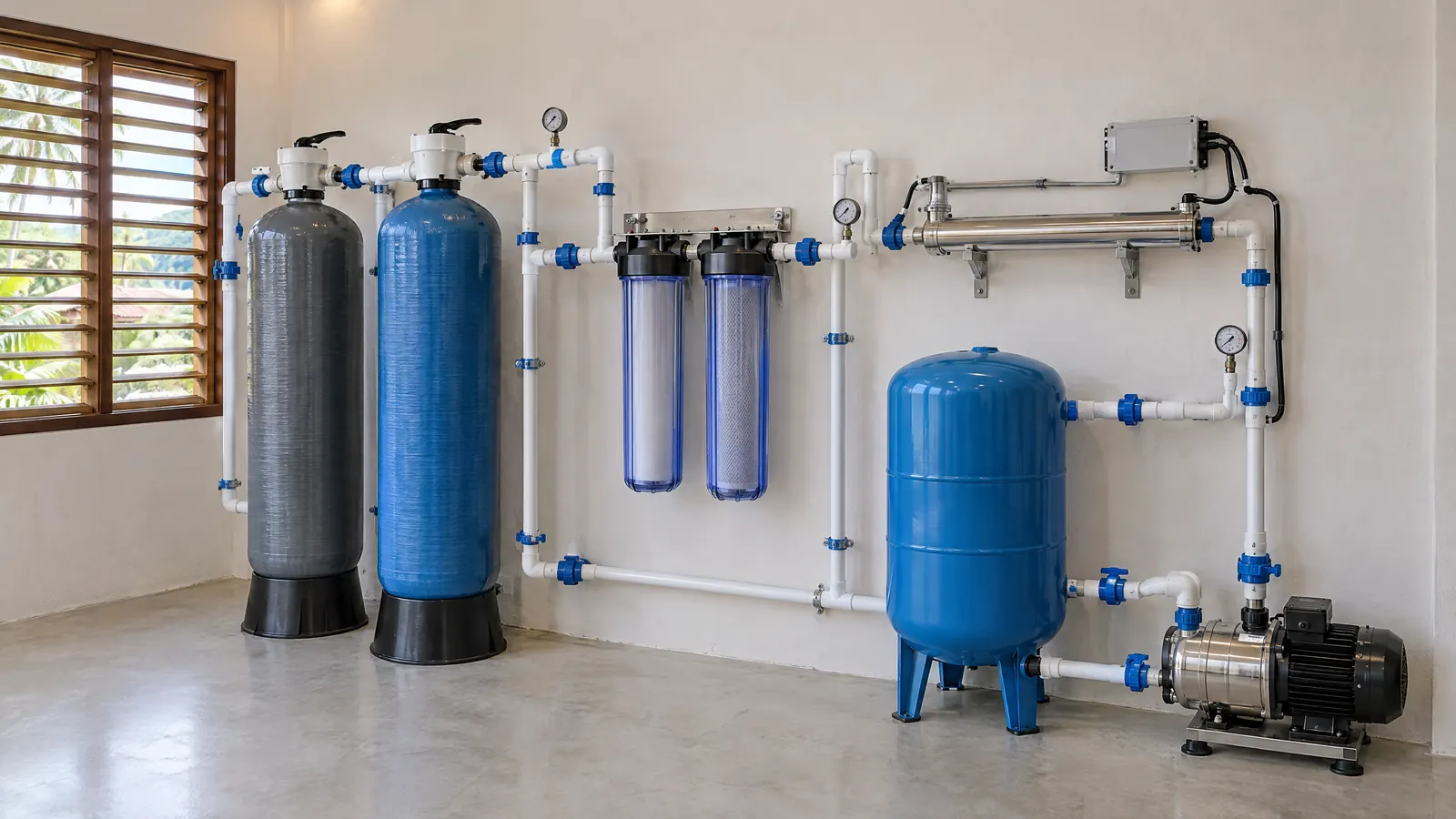
Treatment works when each stage removes one thing, in the right sequence, at the villa's real flow.
Laboratory test
Iron, manganese, hardness, salinity, pH, turbidity and bacteria, from a sample taken before any filter.
Remove what was found
Sediment first, then iron and manganese, then hardness, each stage sized to the peak flow.
Clean storage
Treated water kept in a covered, cleanable tank that nothing untreated enters.
Pressure
A booster sized with the filters' pressure loss included, so the top floor stays strong.
House and drinking point
Disinfection or a point-of-use unit where the water is drunk, and a retest to confirm.
Service · Koh Samui
Common symptoms & problems
Filters bought before testing
Equipment that treats problems your water doesn't have — while missing the ones it does.
Iron staining
Dissolved iron is invisible until it oxidises on tiles and laundry. It needs the right media, not a finer cartridge.
Odour
Usually biological or sulfur-related, and solvable — but only after the analysis says which it is.
Scale on fixtures and heaters
Hardness shortens the life of water heaters and pumps. Softening pays for itself in equipment life.
Filters nobody changes
An expired filter can be worse than none. Every system leaves with a realistic maintenance schedule.
Service · Koh Samui
What we design treatment around
Raw water sample
Taken correctly and sent for laboratory analysis.
Flow rate
The volume the system has to treat at peak demand.
Existing plumbing
Where treatment fits and how it will be serviced.
Intended use
Drinking, cooking, bathing or irrigation — each sets a different target.
Space & power
Room and supply for the treatment stages.
Service · Koh Samui
What the service includes
Laboratory water analysis
A sample from your well, tested for the parameters that decide treatment — before any equipment is proposed.
Staged system design
Only the stages your analysis calls for: no more, no less.
Sediment & media filtration
Particles and turbidity removed ahead of finer stages.
Iron & manganese removal
The most common Samui complaint — orange stains and metallic taste — treated at the source.
Hardness control & disinfection
Softening where scale is the issue; UV or chlorination where microbiology requires it.
Verification & maintenance schedule
A retest after installation, and a filter-change schedule your system actually needs.
How it works
Sample & analyse
Water is sampled correctly and tested in a laboratory — the design foundation.
Design the stages
Treatment matched to the analysis and your consumption, quoted item by item.
Install
Stages plumbed in a serviceable arrangement with bypass for maintenance.
Verify with a retest
Treated water is tested against the raw analysis, so results are documented rather than assumed.
Maintain
Cartridges, media and lamps changed on a schedule matched to your usage.
Service · Koh Samui
Important technical considerations
- Treatment must follow the laboratory analysis — the same “standard filter” does not suit every well.
- Clear water isn't necessarily safe water; iron, hardness and microbiology are invisible in a glass.
- Each contaminant needs the right media or stage — a finer cartridge won't remove dissolved iron.
- Filters have a service life, and an expired filter can be worse than none.
- Water chemistry varies across the island, so a neighbour's result doesn't apply to your well.
Service · Koh Samui
What affects cost & timeline
- What the analysis calls for — sediment removal costs far less than iron plus hardness plus disinfection.
- Flow rate and the number of treatment stages.
- Space, plumbing and bypass arrangements for servicing.
- Ongoing media and cartridge replacement.
Site conditions vary from plot to plot, so we quote a fixed, itemised price after the site assessment — never a fixed figure beforehand.
Before you decide
Guides from the field
Before buying any filter, these explain what to test and what each result means for treatment.
Frequently asked questions
Will my well water be drinkable?
With the right stages, well water can usually be treated to drinking quality — but we only say that about your well after the laboratory analysis, and we verify with a retest after installation. No honest answer exists before the data.
My water looks clear. Do I still need filtration?
Possibly — clarity isn't safety. Dissolved iron, hardness and microbiology are all invisible in a glass. The analysis is inexpensive compared to guessing wrong in either direction.
How often do filters need changing?
It depends on your water and your consumption — that's why the maintenance schedule is designed per system rather than copied from a brochure. Typical intervals range from months for sediment cartridges to years for media beds.
What does a filtration system cost?
It follows the analysis: water that only needs sediment removal costs far less to treat than water with iron and hardness. The quote is fixed and itemised once we know what your water needs.
Can filtration make salty well water usable?
Only reverse osmosis removes salt, and it is costly to run, wastes a share of the water as brine and needs a drain for it. Before treating salinity we look at the cause: on a coastal plot, overpumping or a well set too deep can be drawing the salt in, and fixing that is cheaper than treating it.
Where does the backwash water from the filters go?
Media filters and softeners periodically flush to waste, and that water needs a proper drain sized for the flow, not the garden or the septic tank. We plan the drain, the bypass and the service access with the system rather than finding a corner for them afterwards.
Send your test results, or tell us what the water is doing
A recent laboratory report is ideal; stains, smell, cloudiness or scale are enough to start. Where there is no test, we sample first and design the stages from the results.
Send water details