Service · Koh Samui
Water Pump Installation on Koh Samui
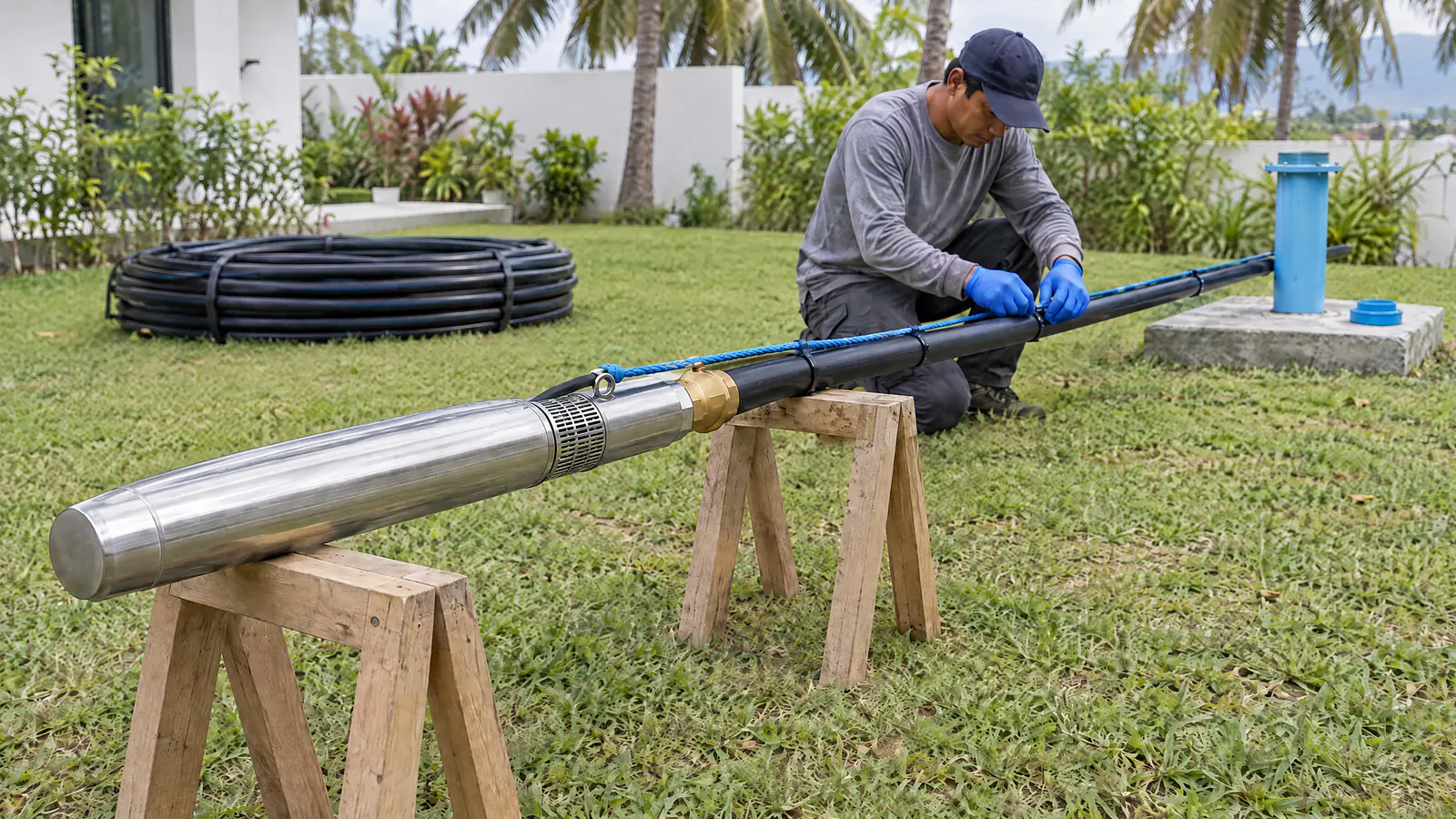
A pump is only right if it matches both the well and the house. We install submersible and booster pumps sized from measured yield, calculated head and your real peak demand — wired and protected for island electrical conditions.
Useful to send: what the pump is doing (or not doing), the well depth if you know it, and a photo of the pump's control box or nameplate.
Who this service is for
- Freshly drilled wells that need equipment
- Villas with weak showers or pressure that drops at peak hours
- Properties on hillsides where vertical lift defeats standard pumps
- Owners replacing pumps that burn out or short-cycle
How it fits together
Two pumps, two jobs
Most villas need a well pump and a house pump. They are sized from different numbers and should never do each other's job.
Well pump
Lifts water from the bore at the rate the well can sustain, set below the dry-season pumping level.
Storage tank
The buffer between the well's steady rate and the house's busiest ten minutes.
Booster pump
Sized to the villa's peak flow and the head to the highest shower, filter losses included.
Pressure control
A switch and pressure vessel, or variable speed for constant pressure.
Protection
Dry-run, overload and surge protection on both pumps, recorded at commissioning.
Service · Koh Samui
Common symptoms & problems
Oversized pumps short-cycle and die
A pump too big for the well switches constantly, wears fast and fails early. Bigger is not safer.
Undersized pumps never satisfy
If the duty point was guessed, the last bathroom on the top floor loses. Sizing is calculation, not preference.
No dry-run protection
In late dry season, water levels fall. Without protection, the pump runs dry once and that's usually the end of it.
Island electricity is not polite
Voltage swings and outages kill unprotected motors. Surge protection is standard in our installations.
Service · Koh Samui
What we measure before choosing a pump
Well yield
What the borehole actually delivers, measured on site.
Water levels
Static and drawdown behaviour while the well is pumped.
Total head
Vertical lift plus pipe friction to the highest outlet.
Electrical supply
Available capacity, cable runs and protection for the load.
Existing equipment
Condition and sizing of any current pump and controls.
Demand profile
Your real peak draw across the whole property.
Service · Koh Samui
What the service includes
Yield & demand assessment
What the well delivers and what the property draws at peak — the two numbers everything else follows.
Pump selection at the duty point
Flow, head and efficiency matched — not the nearest model on the shelf.
Installation at the correct depth
Set against expected drawdown so the pump stays submerged through dry season.
Dry-run & surge protection
Protection electronics that shut the pump down before a dry well or a voltage spike destroys it.
Control box & wiring
Cable sized for the load and distance, switchgear specified for heat and humidity.
Commissioning & flow test
Measured flow and pressure at handover, documented.
How it works
Measure
Well yield, water levels, existing pipework and the property's peak demand.
Specify
Pump, cable, controls and protection — itemised in a fixed quote.
Install
Pump set at the right depth, wired and mounted for serviceability.
Protect
Dry-run, surge and thermal protection configured and tested.
Test & hand over
Flow and pressure verified against the specification, with documentation.
Service · Koh Samui
Important technical considerations
- Sizing is a calculation from measured yield, head and demand — not the property's size alone.
- Oversized pumps short-cycle and wear out early; undersized pumps never satisfy.
- Island voltage swings and outages damage unprotected motors, so surge and dry-run protection matter.
- Setting depth must allow for seasonal drawdown so the pump stays submerged.
- Every well and property differs — figures from one site don't transfer to another.
Service · Koh Samui
What affects cost & timeline
- The pump specification (flow and head) your duty point requires.
- Well depth and the pump's setting depth.
- Cable runs, controls and switchgear.
- Whether a failure diagnosis is needed before replacement.
Site conditions vary from plot to plot, so we quote a fixed, itemised price after the site assessment — never a fixed figure beforehand.
Before you decide
Guides from the field
If you are deciding what to replace, or why the last pump failed, start with these.
Frequently asked questions
How do you size a pump?
From measured well yield, the vertical lift from pump depth to the highest outlet, pipe friction losses, and your peak demand. Together they define the duty point the pump must meet. We size from these numbers, not from the house's size alone.
Can you replace just the pump and keep everything else?
Often yes — after a diagnosis. If the previous pump died because of the well, wiring or controls, replacing it alone repeats the failure. We check the cause first, then replace what actually needs replacing.
How long does installation take?
Often within a day once the equipment is on site; deeper wells and complex controls take longer. Your quote includes the expected timeline.
Do you work with all pump brands?
Yes — we install, service and replace pumps of any brand, and we'll tell you plainly when a cheaper unit is good enough and when it isn't.
My pump has stopped. Does it need replacing?
Not necessarily. A tripped control, a lost pressure-vessel charge, a leaking check valve or a falling water level all look like a dead pump. We check power, controls, the pressure system, the water level and the cable insulation first, and only pull the pump when the readings point down the hole.
Should the well pump feed the house directly?
Usually not. Feeding taps straight from the well pump makes it start on every draw, ties house pressure to the water level in the bore and pulls the well down with small uses. A storage tank and a separate booster pump let each pump run at its own job.
Tell us what the pump is doing
Symptoms, the well depth and the pump details if you have them; a photo of the nameplate or control box helps. We diagnose before we replace, and size any new pump from measurements.
Describe the pump problem