Why a well or villa pump keeps cycling: diagnose the controls before blaming the pump
A pump that keeps starting and stopping is usually obeying its controls exactly. The question is what those controls are reacting to: a vessel that has lost its air, a leak, a valve letting water back, a setting, or a tank level. Which one depends on how the system is built and on the pattern of the cycling.
September 13, 2026 · 9 min read
A pump does not decide to start. Something tells it to: a pressure switch that sees pressure fall below its setting, an electronic controller that sees pressure drop or flow begin, or a level switch that sees the tank go down. When a pump cycles too often, it is nearly always doing exactly what that signal says. So the useful question is not whether the pump is broken but what keeps sending the signal. On Koh Samui villas the answer is found in the vessel, the valves, the pipework and the settings far more often than in the motor.
First: which pump, and which kind of system?
"The pump keeps turning on" can describe three quite different set-ups, and the diagnosis is different in each.
A well pump that fills a storage tank. It is switched by a float or level switch in the tank, and usually protected by a dry-run relay. Cycling here is about tank level and the well.
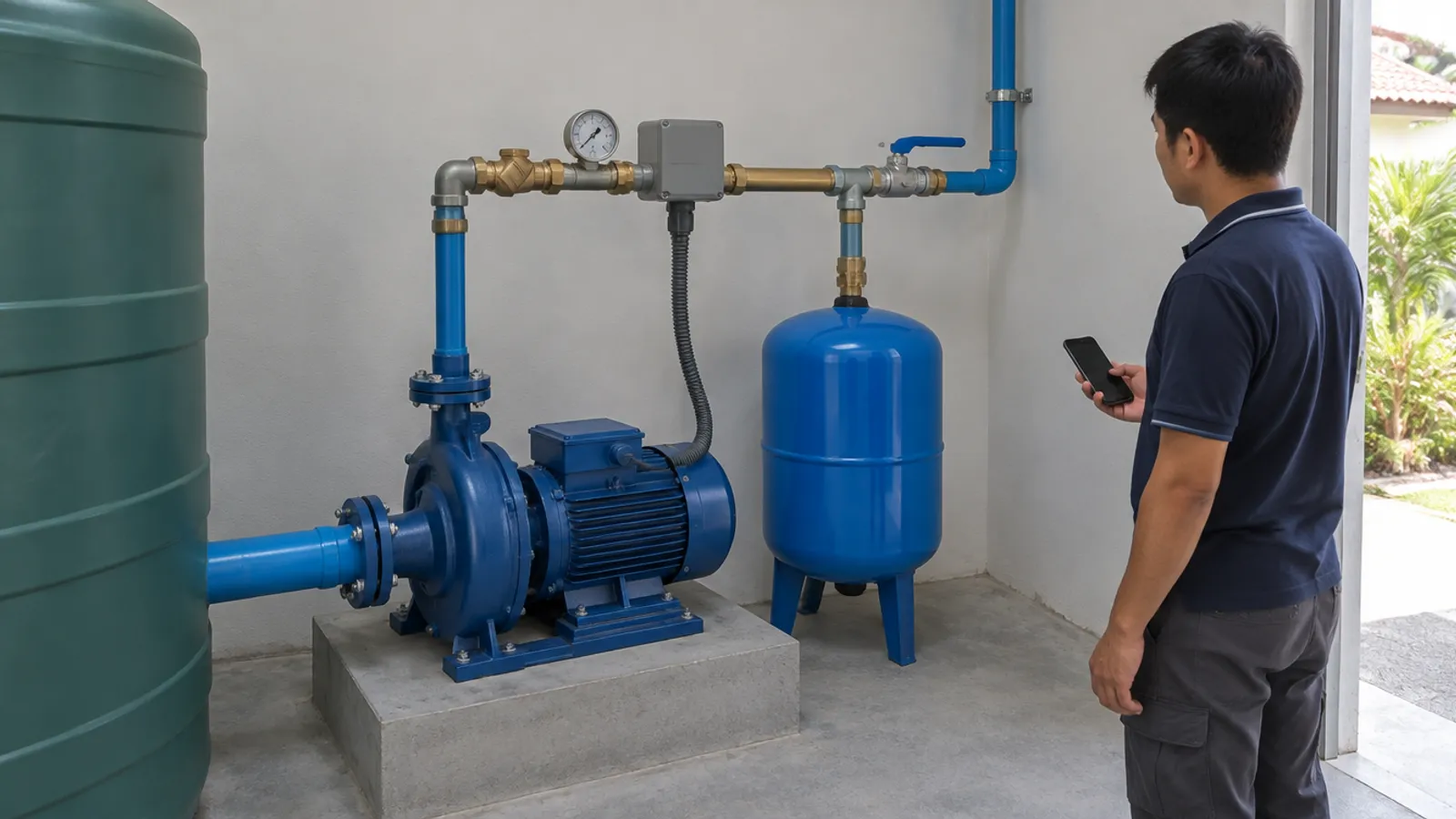
A fixed-speed pump with a pressure switch and a pressure vessel. This is the classic villa booster, and sometimes a well pump feeding the house directly. Cycling here is about pressure: the vessel, the switch and leaks.
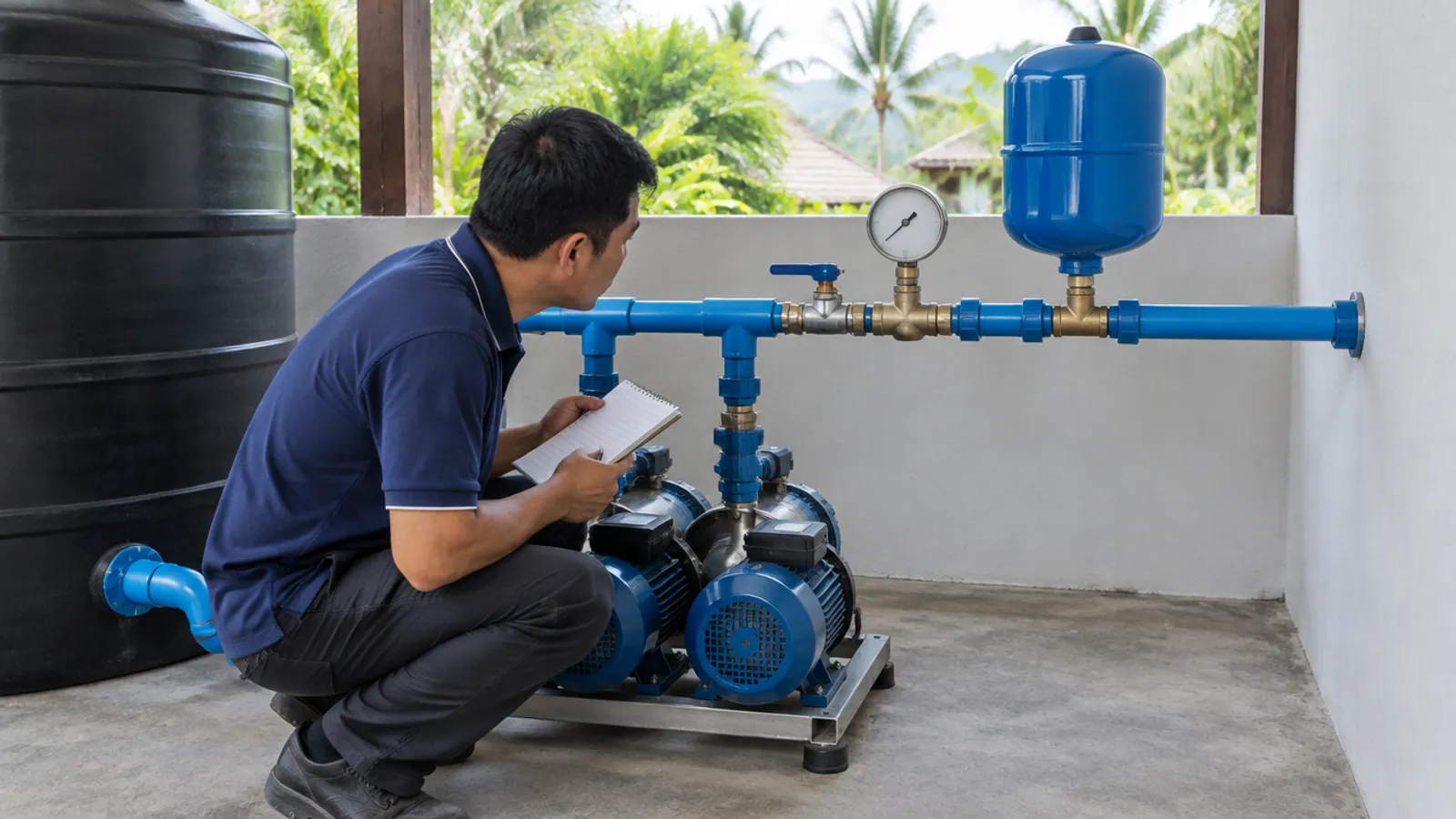
A variable-speed booster with an electronic controller. It ramps up and down rather than switching hard on and off, and it is meant to stop when nothing is drawn. Cycling here looks like repeated ramping or restarts with no demand.
Diagnosis
Pump cycling: where to look first
Answer from what you can see and hear: the taps, the gauge, the tank and the pump starting. Nothing here needs a control panel opened.
1
Does it start when no water is being used at all?
Every tap, toilet, irrigation line and pool fill closed, and nobody using water.
If yes
Pressure is escaping or water is flowing back: look for a leak or a check valve that does not hold.
If no
It is reacting to real use: carry on down.
2
Is it a fixed-speed pump with a pressure vessel?
It runs at full speed whenever it runs, with a pressure switch on the pipe and a small tank beside it.
If yes
Short runs during normal use point to the vessel's air charge or the switch band.
If no
Variable-speed and tank-fill systems follow the questions below.
3
Is it a variable-speed booster that keeps ramping up and down?
The motor speeds up and slows down repeatedly, or restarts every so often, with little or no use.
If yes
A small leak, a tiny demand below the controller's stop point, its settings, or its small vessel.
If no
Steady running when water is used is normal for this kind of pump.
4
Is it the well pump refilling the storage tank again and again?
The well pump starts, runs briefly, stops, and soon starts again.
If yes
The level switch band, the float, or dry-run protection tripping and resetting as the well draws down.
If no
The cycling is on the house side of the tank.
5
Does it happen only with very small draws?
A dripping tap, a toilet cistern refilling, an ice maker, drip irrigation.
If yes
A demand smaller than the pump's minimum steady flow: a vessel and settings can absorb it.
If no
Back to the vessel and controls: a technician should measure them.
Likely area
Leak or check valve
Pressure bleeding away through a fixture, a buried pipe, irrigation or a valve letting water run back.
Pressure vessel
Lost air charge, a ruptured bladder, or a vessel too small for the pump.
Switch or controller
Too narrow a pressure band, wrong stop settings, or a worn or misreading sensor.
Tiny demand
A draw too small for the pump to serve steadily, which it meets in short bursts.
Source and tank control
Level switches set too close, or a well that draws down and trips the protection.
Pressure switches, controllers and pump panels carry mains voltage. Observing is safe; adjusting them is a technician's job.
Reading the pattern
It starts every few seconds while a tap is running
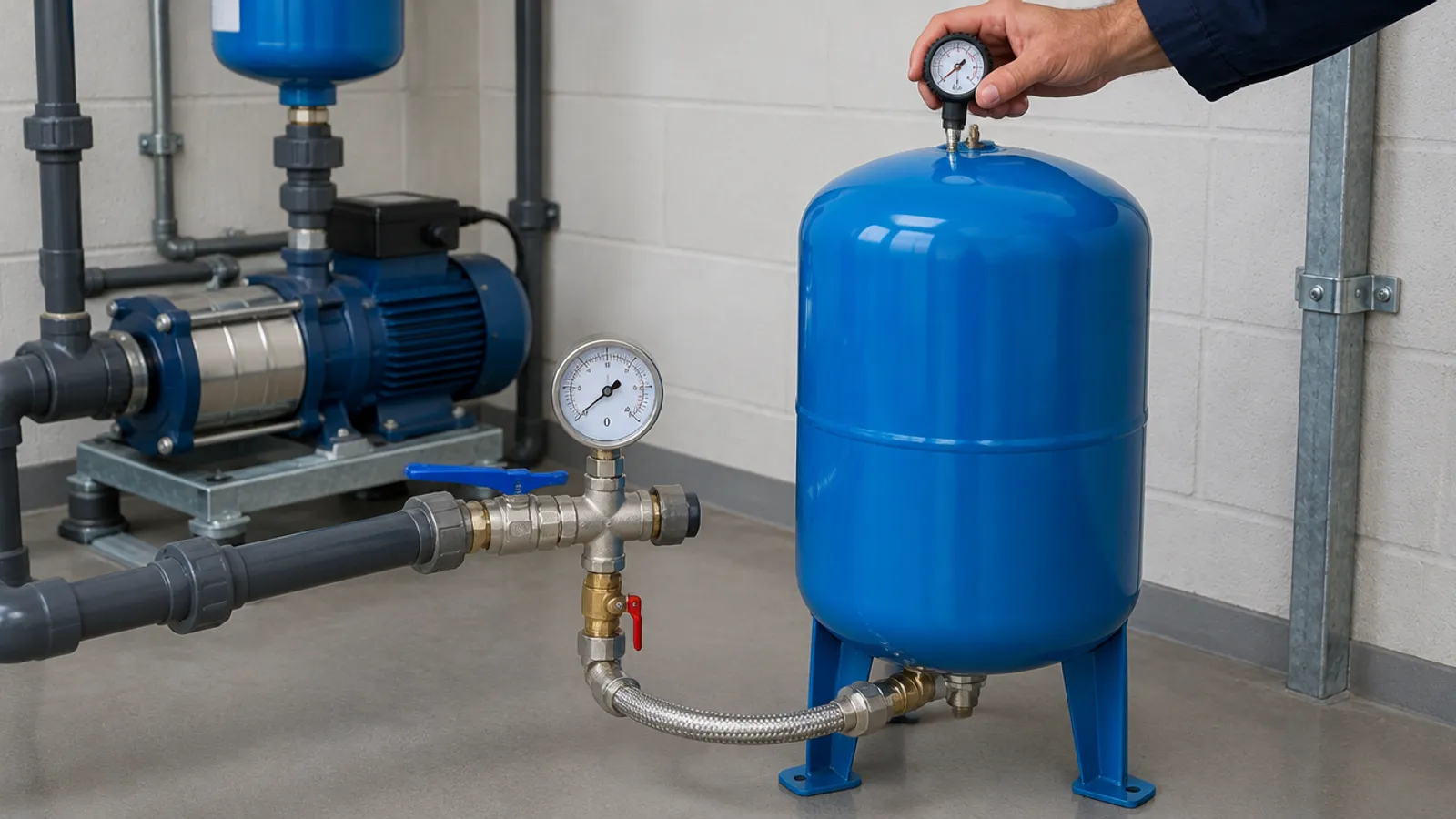
On a fixed-speed system, a pump that clicks on, runs a few seconds, stops and starts again while someone showers has lost its buffer. The pressure vessel is supposed to hold a volume of water under pressure so that the pump runs long enough each time. When its air charge has leaked away, or its bladder has torn and it has filled with water, there is almost nothing to buffer and the switch reaches its cut-out within seconds. A switch set with too narrow a gap between cut-in and cut-out does something similar. Our guide to what a pressure tank does explains the vessel in detail.
It starts briefly with every tap closed
If the pump wakes up every few minutes, or a few times an hour, when nothing is open, pressure is leaving the system somewhere. The usual places are a toilet cistern whose fill valve never quite closes, a dripping tap or outdoor hose, an irrigation valve that lets by, a leak in buried pipe, or a check valve that lets water run back into the tank or down the well. A useful clue: if the pressure gauge falls steadily with everything closed, and stops falling when the valve after the pump is shut, the leak is on the house side.
It chatters: rapid on-off in quick succession
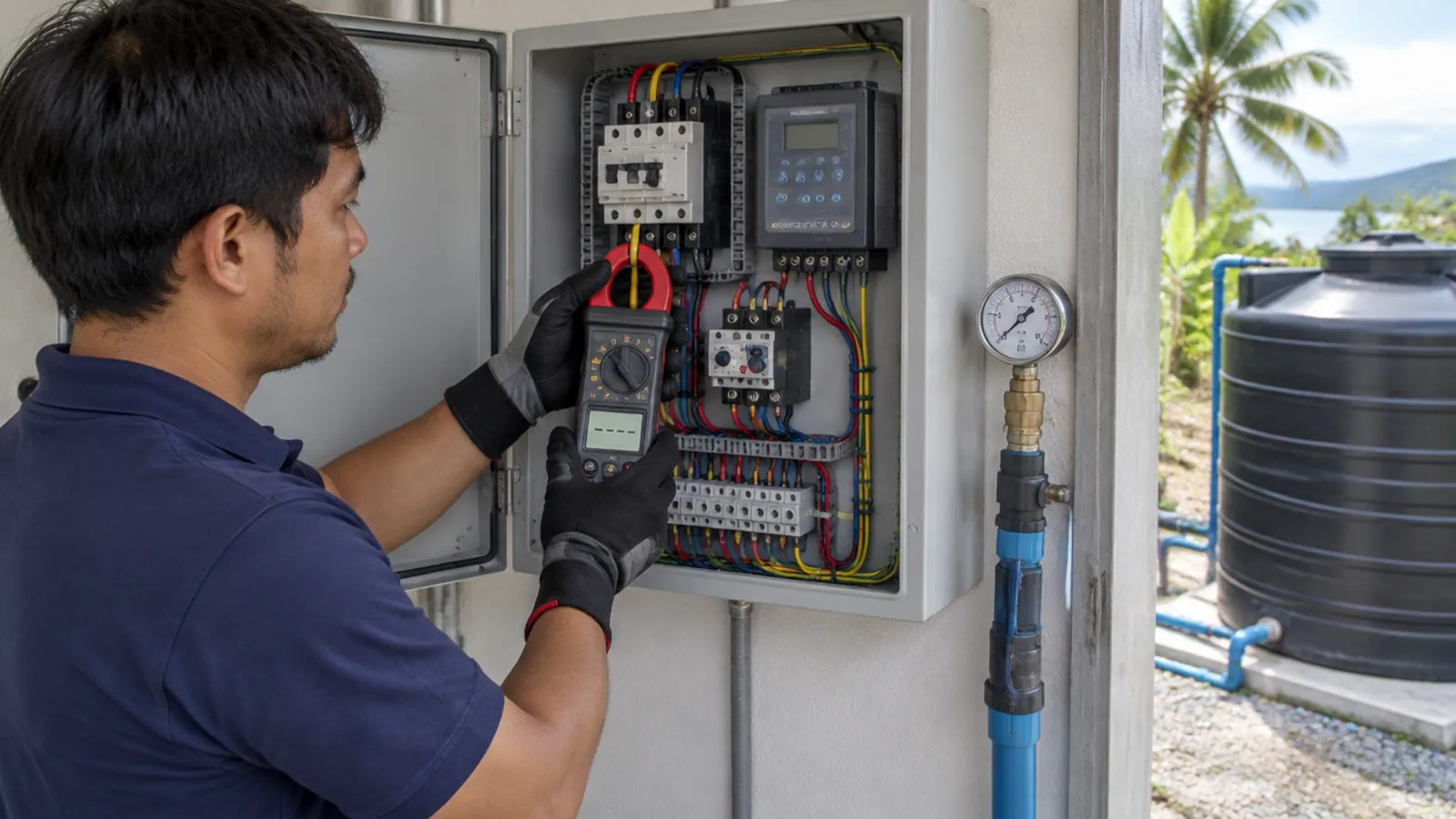
Very fast on-off switching, sometimes with a clicking or buzzing from the switch or the panel, points to a waterlogged vessel, a switch sensing a pressure spike right next to the pump, or an electrical fault in the starter. This is the pattern that wears contacts and motors fastest, and the electrical side of it is not something to investigate with the cover off. Note when it happens and call it in.
The well pump keeps restarting to fill the tank
In a tank-fill system the well pump is switched by the tank level, not by house pressure. If it runs for a minute, stops and starts again, either the level switch has been set with too small a band between start and stop, or the float valve is controlling the flow in a way the switch cannot follow. Another common pattern is protection doing its job: the pump draws the well down to its intake, the dry-run relay trips, the level recovers, the relay resets and the pump starts again. That is a sign the pump is outrunning the bore, which our guide to how well yield is measured explains.
A variable-speed booster keeps ramping
A variable-speed booster should hold pressure while water is used and then stop when demand ends. If it keeps spinning up for a few seconds and stopping with nothing open, it is usually answering a small leak or a check valve that does not hold. If it never quite settles during small draws, the demand may be below what the controller can serve steadily, its stop settings may need adjusting, or the small vessel fitted with it may have lost its charge. These systems are covered in our guide to choosing a booster pump.
It cycles only with tiny draws
A pump sized for a villa's showers cannot run steadily to supply a dripping tap or a drip-irrigation line using a fraction of its flow. It fills the system quickly, stops, and repeats. A correctly charged vessel stretches the gaps; fixing the drip removes the cause; and on irrigation, a timer that runs the zones in one longer session helps more than anything at the pump.
Why rapid cycling is worth fixing quickly
Starting is the hardest moment in a motor's life. Each start draws several times the running current, heats the windings, and strikes the switch or contactor contacts. Motors are designed for a limited number of starts an hour, and a pump that cycles every few seconds blows far past it. The pipework suffers too: each hard stop sends a pressure surge through the system. None of this fails on the first day, which is why cycling is often lived with until a motor, a switch or a capacitor gives out.
What you can safely check
Close every tap and outlet and watch whether the pump still starts, and how often.
Listen for running water: cisterns, outdoor taps, irrigation valves, a pool fill.
Watch the pressure gauge with everything closed. A steady fall means pressure is leaving somewhere.
Time the runs during one ordinary shower: a few seconds on and off is the vessel-and-switch pattern.
Note whether the well pump or the booster is the one cycling, and whether the tank is full.
Leave the vessel's air valve, the pressure switch and the control panel alone. Checking an air charge correctly needs the pump isolated and the water side emptied first, and the switch sits on a live circuit. Write down what you saw; it narrows the visit.
What a technician checks
With the pump safely isolated, a technician drains the water side of the vessel and measures its air pre-charge against the switch's cut-in, checks the bladder, and tests whether the check valve holds pressure. The switch or controller settings are compared with the pump and the house, leaks are traced by isolating sections of the system, and the motor's starting and running current are measured. For a tank-fill system, the level switch band and the dry-run protection are checked against how the well behaves. Only when all of that is sound does the pump itself come under suspicion, as our guide to signs a pump may be failing explains.
If your pump keeps starting, tell our pump team how often it starts, whether it does so with every tap closed, and whether it is the well pump or the booster. Those three answers usually point to the cause before anyone arrives.
Common questions
Does cycling mean the pump itself is broken?
Rarely. A pump that starts too often is usually responding to its controls: a vessel without its air charge, a leak, a check valve that does not hold, a narrow switch setting or a tank-level control. Cycling does shorten the pump's life, so it is worth fixing quickly.
Why does the well pump keep restarting to fill the tank?
Either the tank's level switch has too small a gap between start and stop, or the pump is drawing the well down faster than it refills, tripping the dry-run protection, which then resets and starts the pump again.
Is it safe to keep using water while the pump is cycling?
Usually yes for a short while, but every start wears the motor and the switch. Fix any obvious leak, avoid tiny continuous draws, and have the vessel and controls checked soon rather than living with it.