What a pressure tank actually does in a villa water system, and how to tell when it is too small or faulty
The small steel tank beside the booster pump is not a water store. It is a cushion of compressed air that lets the pump rest between starts. When the cushion goes, the pump starts on every draw and the pressure jumps. This guide explains how the vessel works, what it needs, and how to recognise one that has failed.
September 13, 2026 · 9 min read
Two kinds of tank sit in most villa plant rooms, and they are often confused because both hold water. The large storage tank holds the villa's supply at atmospheric pressure. The small pressure tank, more accurately a pressure vessel, holds very little water but holds it under pressure, against a charge of compressed air. One is about how much water the house has. The other is about how the pump behaves when someone opens a tap.
Cross-section
Air, membrane, water: one vessel in three moments
Top row: the same vessel with the pump off, with the pump charging it, and while water is drawn. Bottom: why a storage tank is a different machine.
1
Air side
A sealed charge of air above the membrane. It compresses as water enters and pushes the water out again.
2
Bladder or diaphragm
The rubber membrane that keeps air and water apart, so the air is not slowly absorbed into the water.
3
Water side
The only part connected to the pipework. It fills while the pump runs and empties when a tap is opened.
4
Air valve
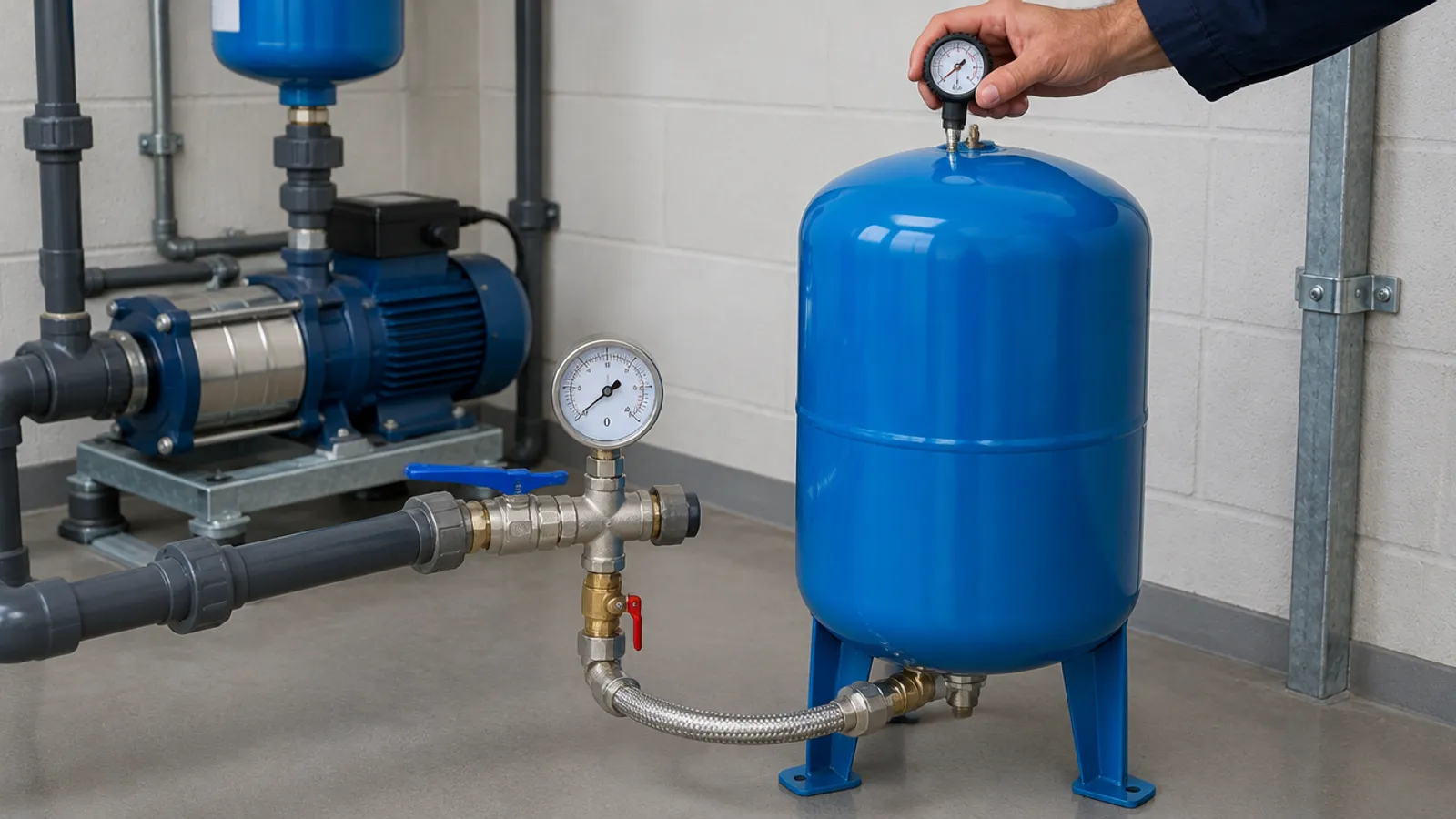
Where the pre-charge is measured and set, with the vessel isolated and its water side empty.
5
Water connection
A single port onto the pump's discharge line, ideally through an isolating valve with a drain.
6
Pump off, low pressure
Little water inside; the air has expanded to fill most of the vessel.
7
Pump running, charging
Water is pushed in and the air is squeezed into a smaller space until the switch stops the pump.
8
Demand, drawing down
A tap opens and the compressed air pushes stored water out, so the pump does not have to start at once.
9
Storage tank
Open to the atmosphere through a vent, holding volume rather than pressure.
10
Pressure vessel
Sealed, small, and only useful for its pressurised buffer.
Schematic, not to scale. Vessels differ in shape and in where their ports sit; the principle is the same.
Inside the vessel: air, membrane, water
A modern vessel is split in two by a rubber bladder or diaphragm. Above it is air, charged to a set pressure at the factory or on installation. Below it, or inside the bladder, is the water side, connected to the pipework. As the pump pushes water in, the air is compressed and its pressure rises with the system. When the pump stops and a tap opens, the compressed air pushes the water back out. The membrane matters because air in direct contact with water slowly dissolves into it; older plain steel tanks without one gradually fill with water and lose their cushion.
What it does for a fixed-speed pump
A fixed-speed pump is controlled by a pressure switch with two settings. At the lower one, the cut-in, the pump starts. At the upper one, the cut-out, it stops. Without a vessel, opening a single tap would drop the pressure below cut-in almost instantly and the pump would start; closing it would push the pressure to cut-out a moment later and the pump would stop. The vessel stores enough water between those two pressures to supply small draws on its own, and to make each run of the pump last long enough to be good for the motor. Fewer, longer runs are the whole point.
Usable water is a fraction of the label
A vessel's nominal size is its total internal volume, not the water it delivers. Much of the space is always taken by air, and the water that can be drawn between cut-out and cut-in, the drawdown, is often around a third of the nominal size or less, depending on the pressure band and the pre-charge. That is why a vessel that looks generous on paper can still let a pump start every minute during a shower, and why sizing is done from the drawdown the pump needs, not from the number on the label.
Pre-charge: why the air pressure matters
The air side is charged to a pressure set a little below the pump's cut-in. If the charge is too low, the vessel is half full of water before it starts doing anything useful and the drawdown shrinks. If it is too high, the membrane is pushed hard against the water port and the vessel barely takes water at all. The charge also leaks away slowly over the years, even through a sound membrane, which is why it belongs on a maintenance list. It is measured and adjusted only with the pump isolated and the vessel's water side drained, because a reading taken with system pressure on the water side says nothing about the air charge. That is a job for a technician, not something to try on a pressurised system.
Variable-speed systems still use a small vessel
A variable-speed booster holds pressure by changing its speed, so it does not need a large vessel to limit starts. It still usually has a small one. The vessel lets the pump stop when demand ends and supplies tiny draws such as a cistern refilling without waking the pump; it also softens pressure spikes when taps close quickly. A vessel that has lost its charge on a variable-speed set shows up as a pump that restarts every so often with nothing open, or never quite stops. The manufacturer specifies the size and pre-charge for the controller, and that is what should be followed.
Signs that a pressure tank is failing
The fixed-speed pump starts the moment a tap opens and stops again within seconds, a pattern that has got worse over time.
Pressure at the taps surges and sags in a rhythm with the pump.
A technician checking the air valve finds water rather than air: the bladder has torn.
The vessel sounds or feels full of water when tapped, all the way up.
Rust, weeping or a damp patch at the base or around the port.
The pump starts noticeably more often than it did when the system was new, with the same use.
Several of these also have other causes, such as a leak or a switch setting. Our guide to why a pump keeps cycling separates them by pattern, and our guide to low water pressure covers pressure lost on the way to the taps.
Too small, or just faulty?
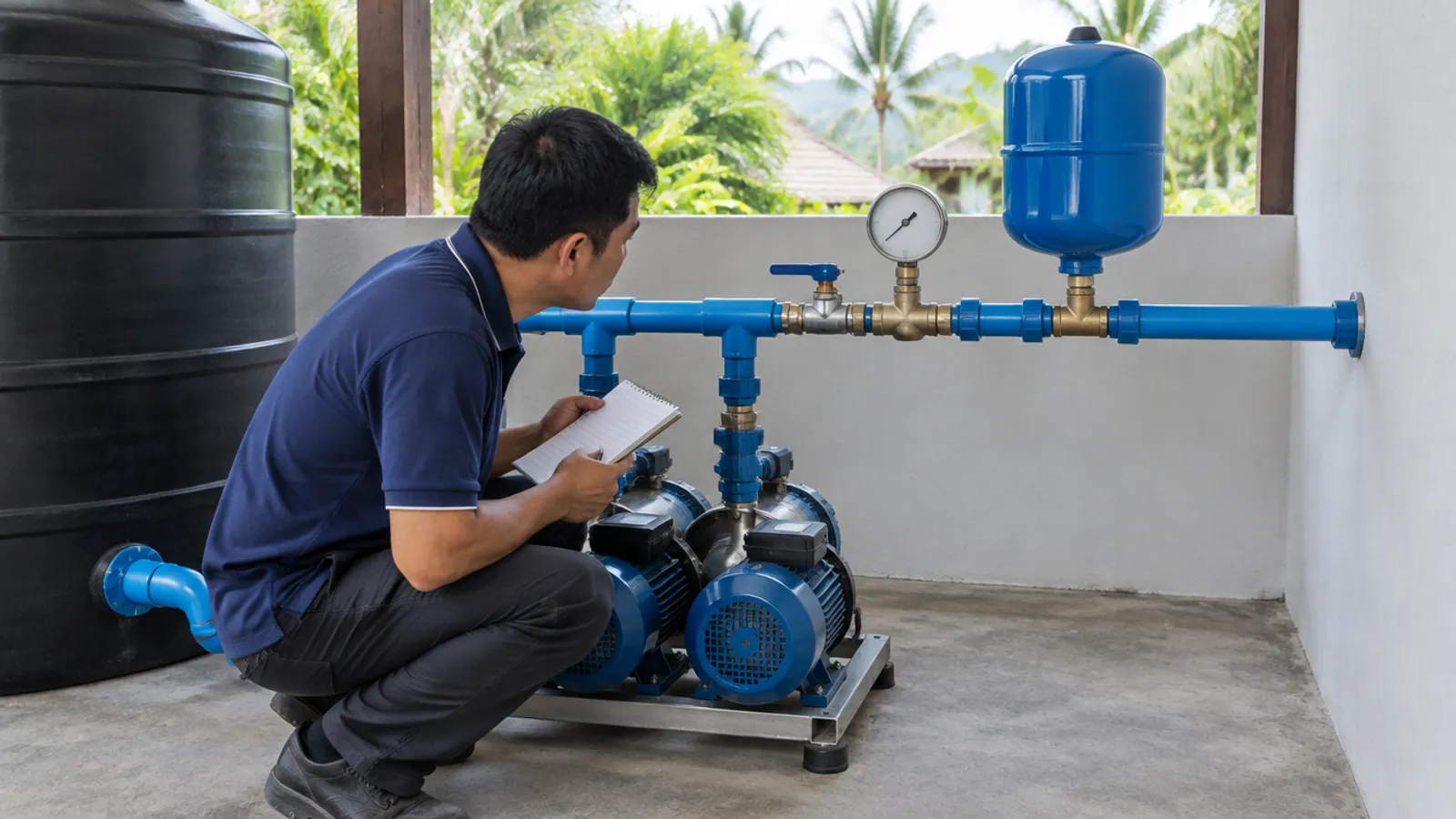
The two look similar and have different fixes. A vessel that is correctly charged but too small for the pump gives short runs that have always been short: the system was built that way. A vessel that has lost its charge, or whose bladder has failed, gives runs that have become shorter over months. If the history is unknown, the pre-charge and the condition of the bladder settle it. A faulty vessel is re-charged or replaced; an undersized one is replaced with the right size, or a second vessel is added alongside.
Where it goes and how it should be connected
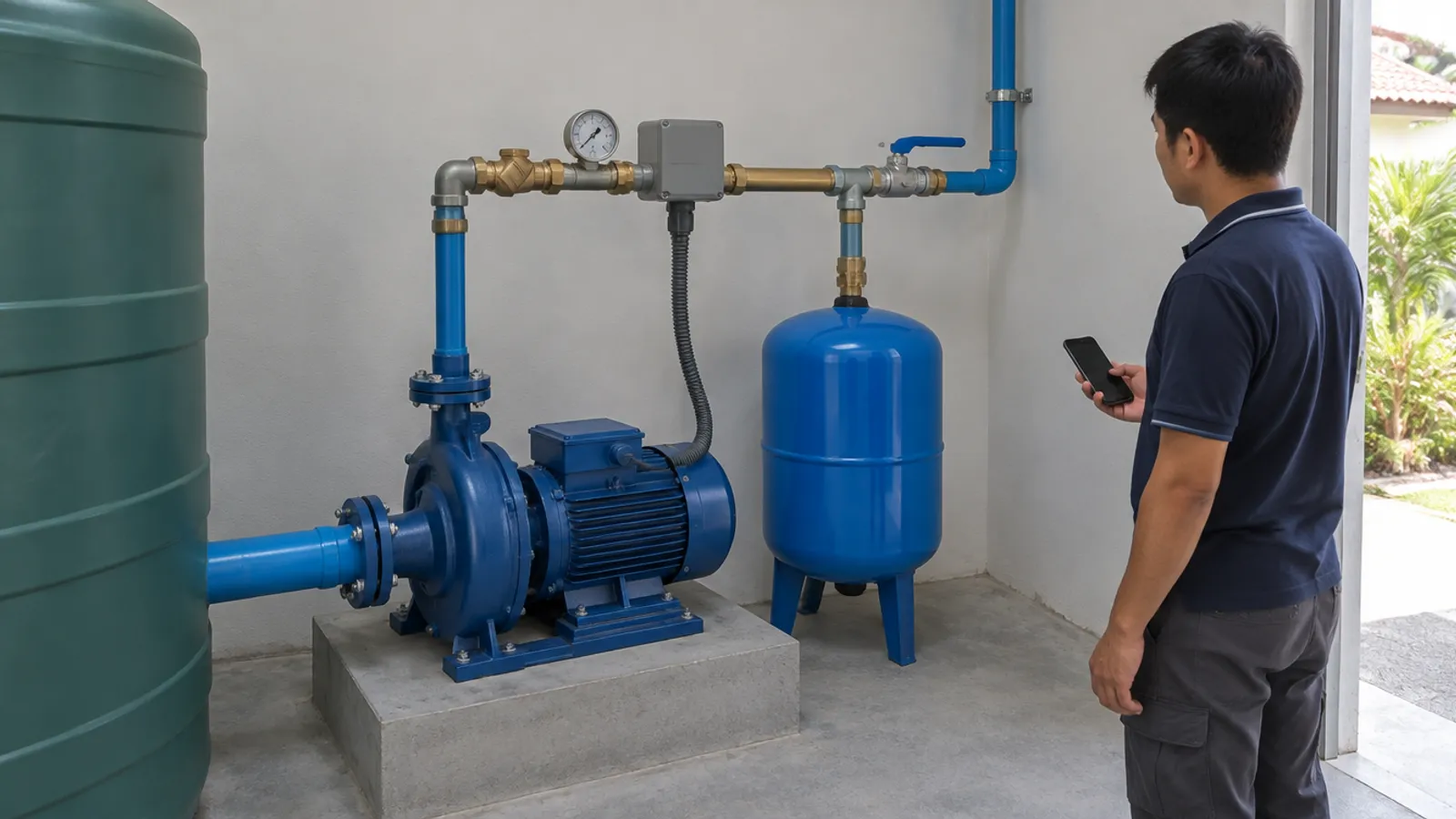
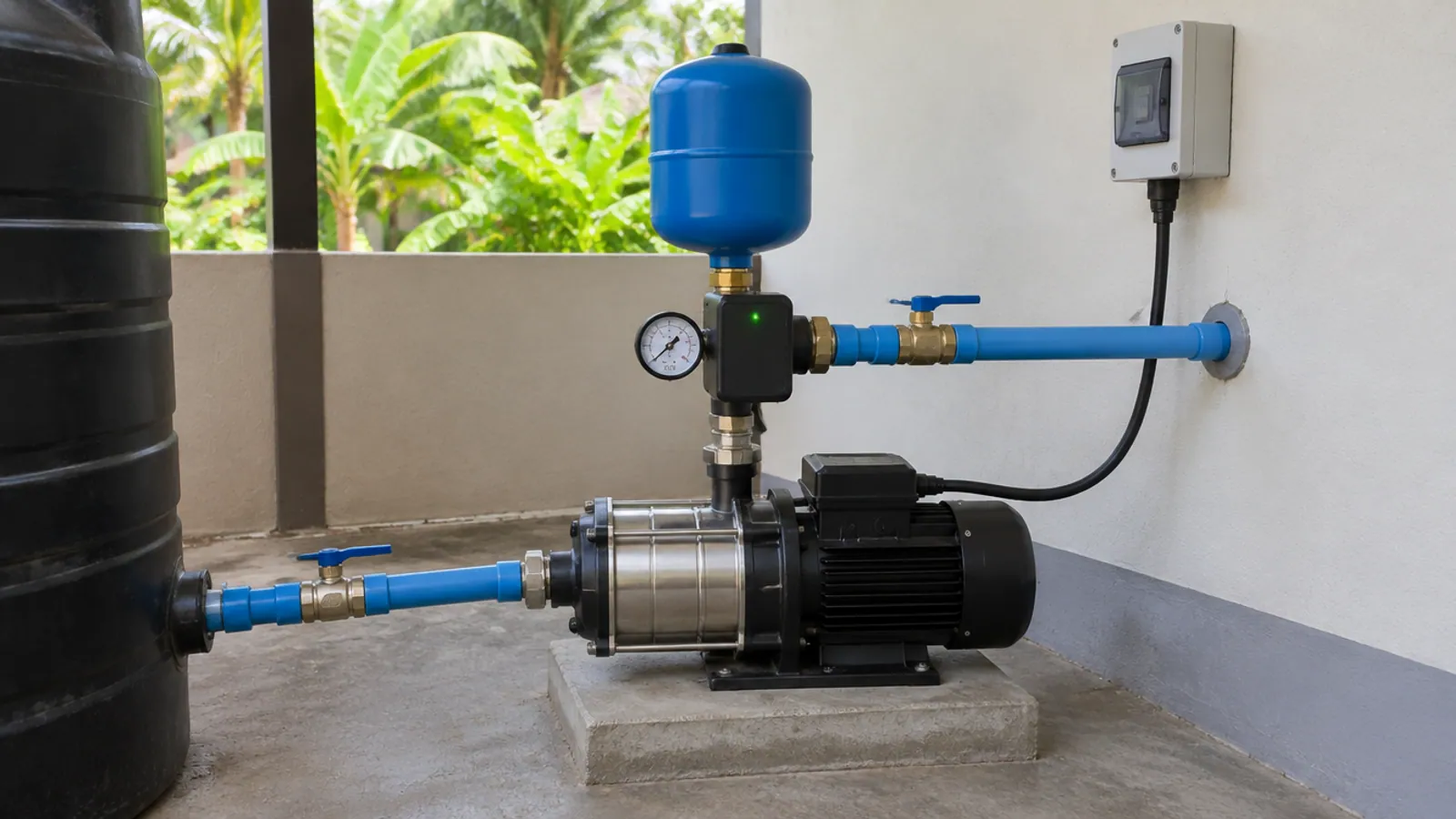
The vessel belongs on the pump's discharge side, after the check valve and close to the pressure switch, so that the switch senses the pressure the vessel holds rather than a surge at the pump outlet. A short connection through an isolating valve with a drain lets the vessel be serviced or replaced without draining the house. It should stand on a firm base, out of direct sun and with room around the air valve, and its port should never carry the weight of the pipework. In a system with storage, it sits after the booster, never on the storage tank side; how the tanks themselves are laid out is covered in our guide to villa storage tanks.
Why bigger is not automatically better
A larger vessel does give longer pump runs, up to a point. Beyond the size the pump and switch actually need, it adds cost, floor space and weight, holds more water standing still in a warm plant room, and changes nothing about the house's pressure or flow. On a variable-speed set it adds very little at all. The right size follows from the pump's flow, the switch band and how often the motor may start, and it is different for a fixed-speed pump, a variable-speed set and a well pump feeding a house directly. That is why the vessel should be chosen together with the pump, as our guide to choosing a booster pump describes.
If you suspect your pressure tank, send our pump team a photo of the vessel and its label, and tell us how often the pump starts during a shower. For a new villa, the vessel is chosen with the rest of the villa water system.
Common questions
Is a pressure tank the same as a storage tank?
No. A storage tank is vented and holds the villa's water at atmospheric pressure. A pressure tank is sealed, contains compressed air and holds only a few litres under pressure so the pump does not start on every draw.
Does a variable-speed pump still need a pressure vessel?
Usually a small one. It lets the pump stop when demand ends, covers tiny draws without restarting it and softens pressure spikes. The manufacturer of the controller specifies its size and pre-charge.
Why does a failed pressure tank make a pump start frequently?
Without its air cushion the vessel stores almost no water between the switch's cut-in and cut-out pressures, so any draw drops the pressure to cut-in at once and the pump starts, then reaches cut-out seconds later and stops.