Equipment
What size water tank does a villa on Koh Samui need?
The right tank is a buffer against the gaps in your supply — sized from how many people use the water and how long resupply really takes.
June 22, 2026 · 5 min read
Water Supply
Every villa has tanks and almost nobody designs them. They get bought by the litre, plumbed by whoever is on site and never opened again. This guide is about the part of storage that sizing leaves out: whether you need one tank or two, how several tanks should be connected, what the inlet, overflow and draw-off should look like, why big tanks still run dry, and how to keep the water in them clean.
November 5, 2026 · 10 min read
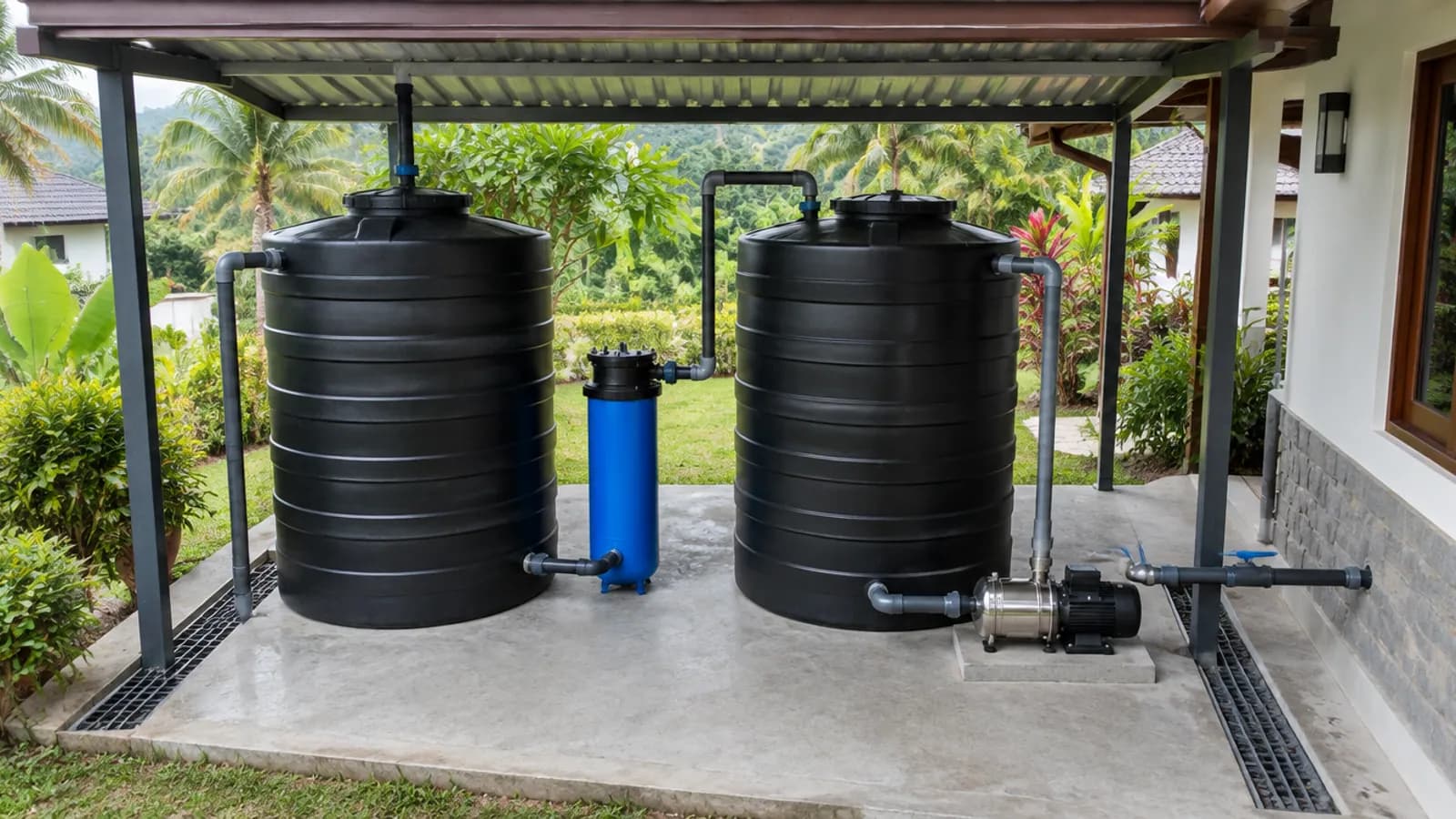
The storage tank is the most forgiving part of a villa water system, which is why it is the most neglected. It has no moving parts, it does not trip, and it hides its problems under a lid. Then the villa runs dry on a full-occupancy weekend with 6,000 litres of tanks on the slab, or the treated water starts tasting of the tank, or a float valve sticks and the well pump runs all night into the drain. How many litres you need is covered in our guide to storage tank size. This one is about what those litres are connected to.
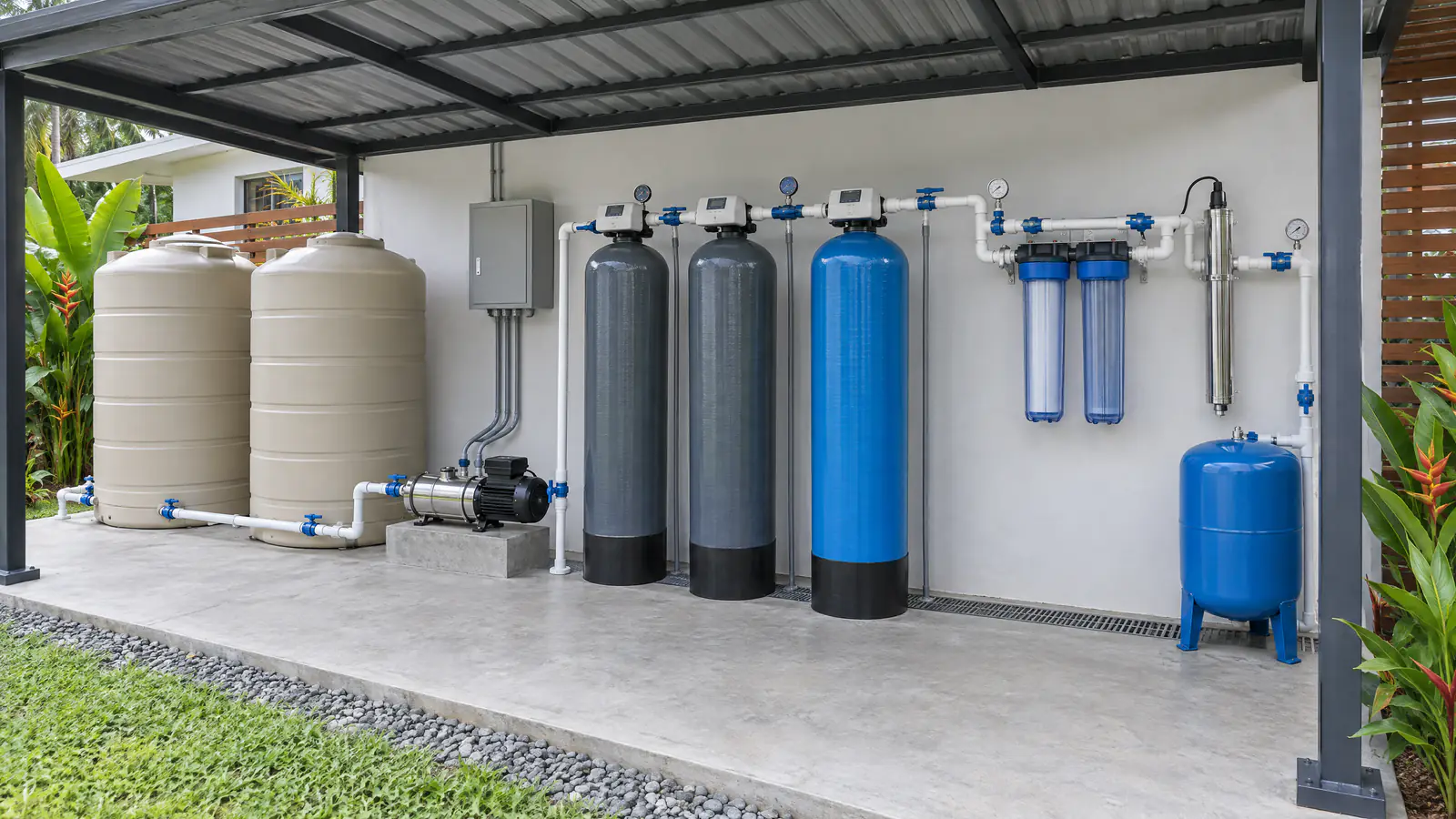
A single tank works when the well water needs little treatment: the well fills it, the booster draws from it, a cartridge or UV unit on the house line does the rest. The moment the water needs real treatment, two tanks earn their place. A raw-water tank receives the well water as it comes: it lets sediment settle, gives dissolved iron time to oxidise, and provides the steady, strong flow that a media filter needs to backwash, which a submersible pump in a bore cannot give. The treatment train draws from the raw tank and discharges into a treated-water tank, and the house booster draws only from that. The treated tank stays clean because nothing untreated enters it, and the house never sees raw water even if a filter is bypassed for service. When that split is worth it, and how the stages are sequenced, is in our guide to whole-house treatment design; whether treatment is needed at all starts with a water test.
Storage usually arrives in instalments: a second tank added when the first proved small, a third when the pool went in. How they are joined decides whether the villa has 6,000 litres or 2,000 litres with company. The arrangement that works is parallel on a bottom manifold: tanks of the same height standing on the same level, each with its own outlet near the base, joined by a common pipe at least as large as the booster's suction, with an isolating valve on each tank. Water seeks its own level, so the tanks fill and empty together as one volume, and any tank can be shut off and cleaned while the others carry the house.
The arrangements that fail are familiar. Tanks fed in series, the first overflowing into the second, leave the second stale and the first doing all the work. Tanks at different heights, or a small one beside a large one on a slab that is not level, mean the lower tank overflows while the higher one never fills, or the manifold drains the higher tank first and the pump draws air with litres still in the other. An interconnecting pipe of half-inch hose starves the booster at peak flow however full the tanks are. And tanks with no isolating valves cannot be cleaned without emptying the whole system.
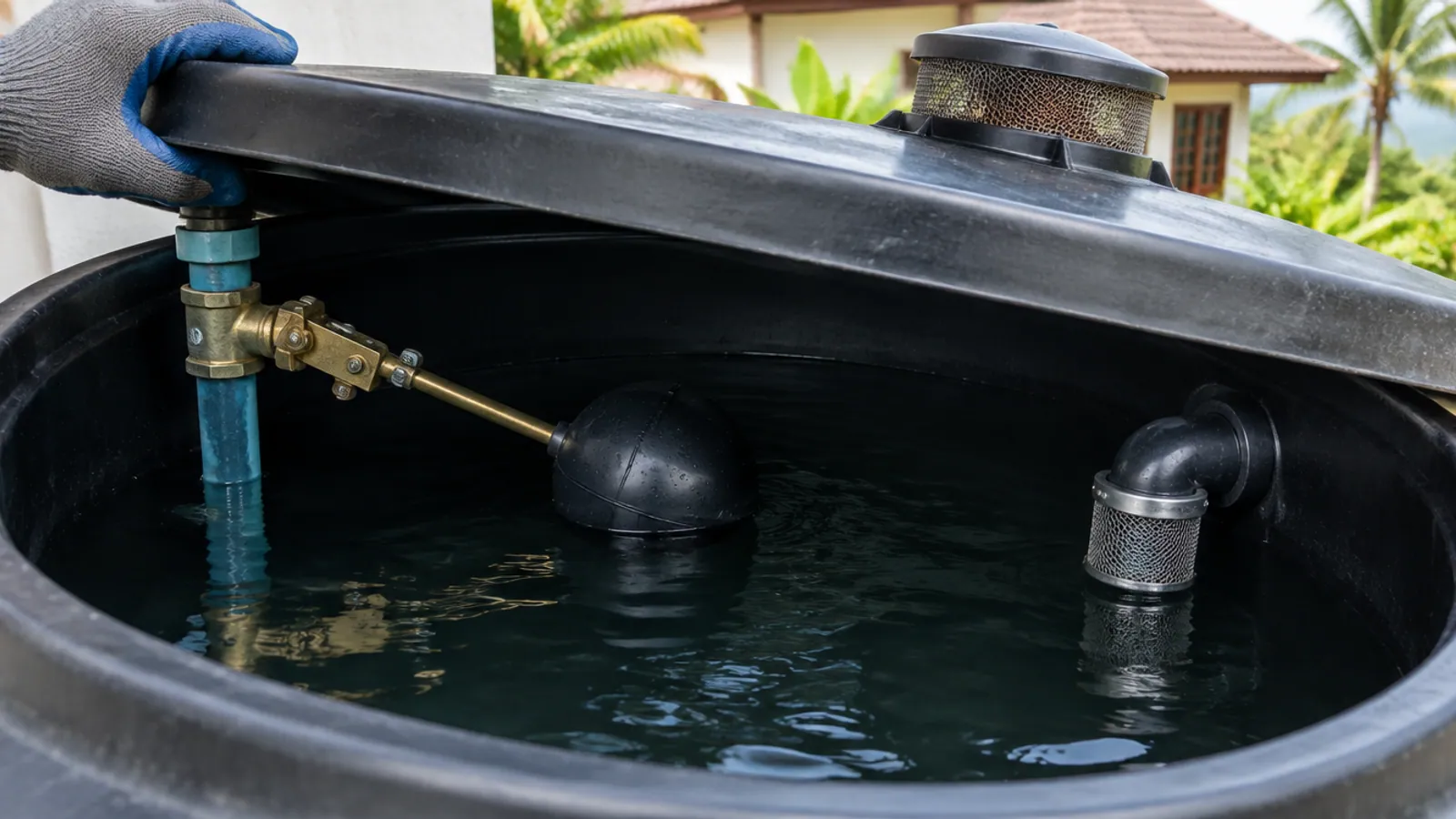
How water gets into the tank is a control decision. From a well, the submersible pump is usually switched by a float switch in the tank: on at a low level, off at a high level, with enough distance between them that the pump runs for a useful stretch rather than starting for every bucket. From mains or a delivery, a mechanical float valve on the inlet does the same job with no electricity. In both cases the inlet discharges above the highest water level through open air, an air gap, so that the tank's contents can never be drawn back into the supply; that principle and the two-source layout it belongs to are in our guide to running a well alongside mains water.
Four fittings decide whether a tank is a water store or a problem. The overflow must be at least as large as the inlet, so that a stuck float valve cannot fill the tank faster than it can empty, and it must be piped to a visible drain, not left to pour onto the ground beside the well, for the reasons in protecting a well from surface contamination. The vent lets air in and out as the level moves, is separate from the overflow, and is screened: an unscreened vent or overflow is a mosquito nursery and an entry for geckos and leaves. The draw-off to the booster sits 100 to 150 millimetres above the floor, so the pump takes clear water and the sediment stays where it settles. And a drain valve at the very bottom lets the tank be emptied and flushed without a bucket.
Storage schematic
Left: well → raw tank → treatment → treated tank → booster → house. Right: two tanks on a common bottom manifold with isolating valves, filling and emptying as one.
Receives well water as it comes; sediment settles and iron has time to oxidise before treatment.
Draws from the raw tank at the steady flow filters and backwash need, and discharges into the treated tank through an air gap.
Only treated water enters. The house booster draws from here and nothing else.
Discharges above the highest water level; a float switch runs the well pump between low and high level, or a float valve closes on a mains fill.
At least as large as the inlet, screened, and piped to a visible drain away from the wellhead.
Separate from the overflow; lets air move as the level changes and keeps insects out.
The booster's suction leaves 100–150 mm of still water below it; the drain valve empties the rest for cleaning.
Same height, same level, a manifold at least the booster's suction size, isolating valve on each tank.
A sight tube, gauge or sensor with an alarm: the only way to know the tank is actually full before the weekend.
The call usually starts with “but we have two big tanks”. The tanks are rarely the problem; what is in them is. The commonest cause is that the tanks were never full: a well that sustains 800 litres an hour cannot refill 6,000 litres overnight in the dry season when the house drew 4,000 of them during the day, and a float switch set to stop the pump at a conservative level never lets them fill anyway. The next is control: a float switch jammed by a cable, a float valve seized or blocked by grit on its seat, an inlet strainer choked. Then losses: a float valve passing water slowly through an overflow nobody can see, a leak on the manifold, a garden tap left on the house line. And finally measurement: nobody knew the level until the booster started drawing air. A tank you cannot see into, with no gauge or sensor and no alarm, is a tank that surprises you. The seasonal side of the first cause, a well that gives less exactly when the house wants more, is covered in how a deep well changes between seasons.
Stored water is still water, and still water in a warm place grows things. Light gets in through a thin or translucent tank wall and grows algae. Sediment settles to a layer on the floor that is stirred up every time the level drops to it. A biofilm forms at the waterline, where the surface is alternately wet and dry, and that is where bacteria concentrate. Insects breed in any opening that is not screened. The treated tank matters most, because nothing after it removes what grows inside it, which is why it is the one with the tightest lid, the darkest wall and the most regular cleaning.
Public-health guidance for small storage tanks commonly recommends inspection and cleaning every six to twelve months, and always after a contamination event: a flood, a dead animal, visible slime, a bad taste or a failed test. Cleaning means isolating and draining the tank, physically scrubbing the walls and floor with attention to the waterline, flushing the sediment out through the drain, disinfecting with a chlorine solution left to stand before being flushed to waste, and refilling. After a cleaning of the treated tank, or any event that prompted one, a laboratory test confirms the water is back to standard. Two practical cautions: a tank is a confined space, so nobody climbs in alone or without ventilation, and the disinfection flush must go to a drain and not to the garden or the septic system. Cleaning belongs on the same maintenance schedule as the pump and filters.
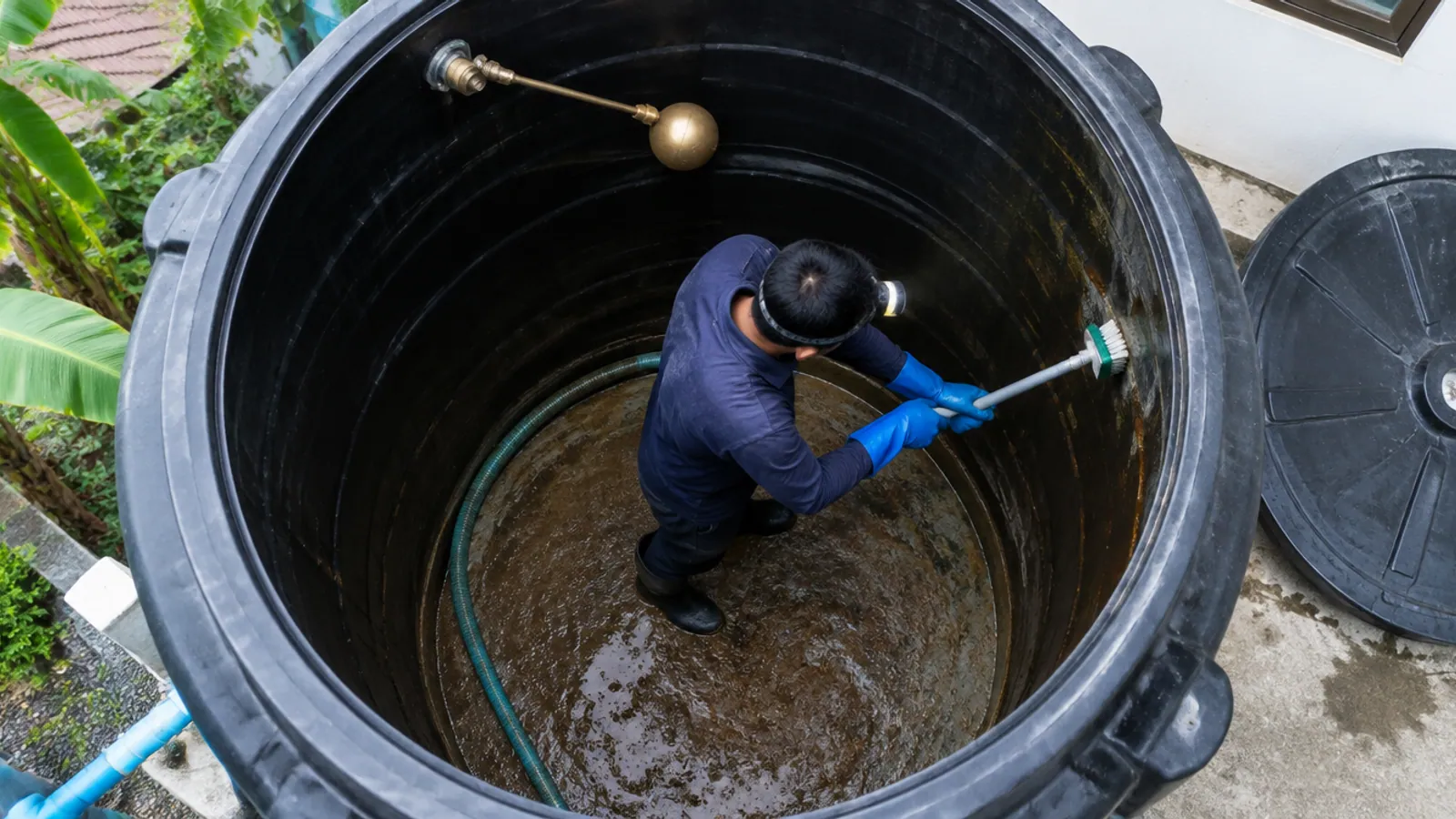
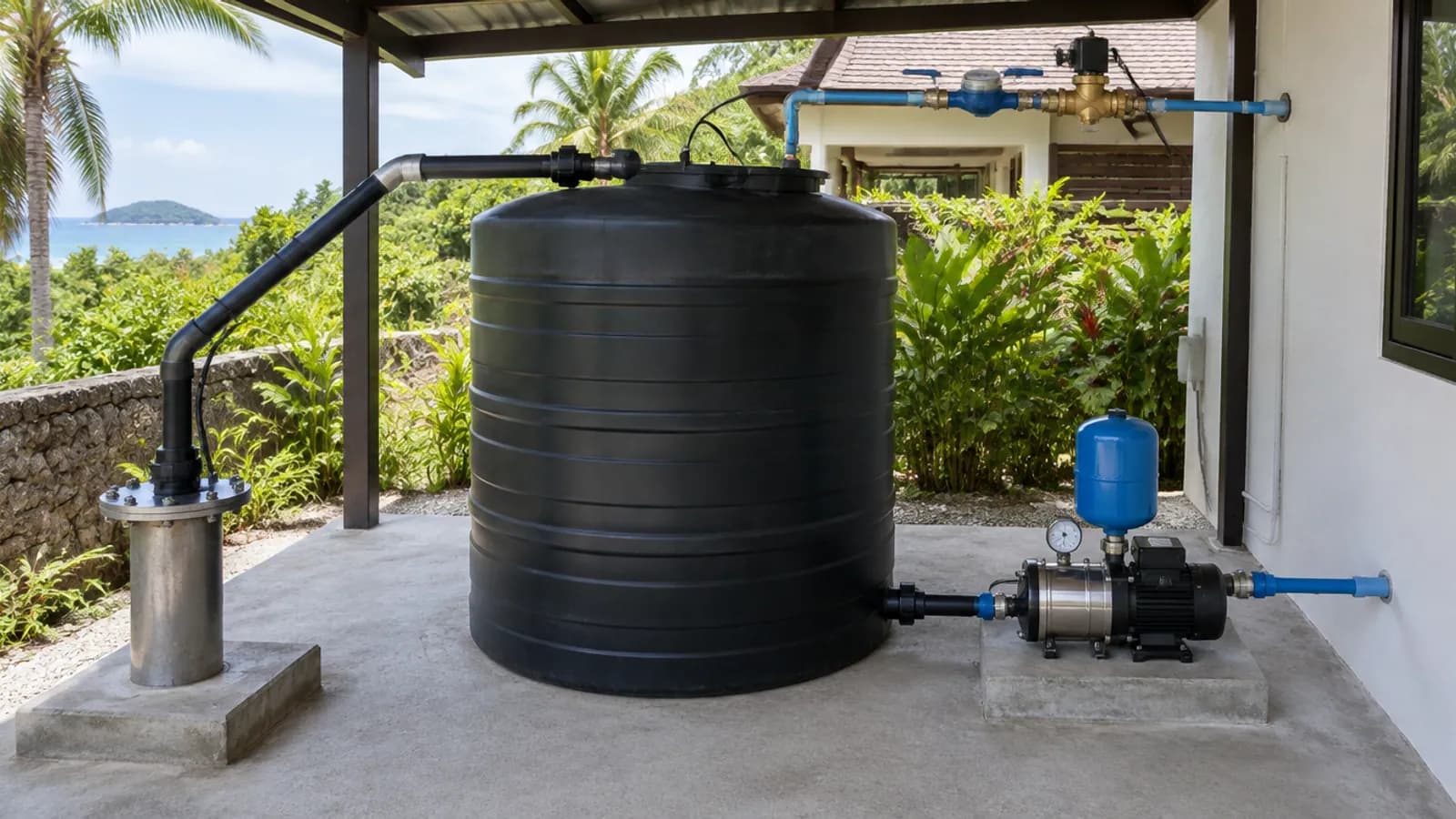
Opaque, dark polyethylene or lined concrete keeps light out; a translucent tank is an algae farm within a season. Shade and a roof keep the water cooler and the tank wall from degrading. A flat, level, load-bearing base matters more as tanks are added, because the manifold only works if they stand level. Leave room around and above each tank for a person to open it and clean it. Underground tanks save space and keep water cool, but they are harder to inspect, can take in groundwater through a cracked wall, and usually need a submersible booster inside them rather than a surface pump at the end of a long suction line; our guide to booster pumps covers that choice.
If your tanks never seem full, the water tastes of the tank, or you are adding storage, our villa water systems team assesses the layout, the controls and the hygiene together and sets the storage up to work as one volume.
Equipment
The right tank is a buffer against the gaps in your supply — sized from how many people use the water and how long resupply really takes.
June 22, 2026 · 5 min read
Water Supply
Plenty of villas on Koh Samui have a well and a mains connection. The question is not which one to keep — it is how to connect two sources so they back each other up without fighting, without contaminating anything, and without anyone having to be home to switch valves.
October 19, 2026 · 10 min read
Equipment
There is no best filter. There is a system that fits one well, one villa and its busiest half-hour of the day. Most of the problems we fix in Samui plant rooms are design problems, not equipment problems.
October 3, 2026 · 9 min read