Choosing a booster pump for a villa: flow, head, constant pressure, and why it is not the well pump
The submersible pump gets water out of the ground. The booster pump is the one that decides whether the top-floor shower is any good. They are sized by different numbers, fail for different reasons and should never be asked to do each other's job. This guide covers the house-side pump: the two figures that size it, fixed speed against constant pressure, twin sets, suction, protection and the mistakes we are called out to undo.
November 2, 2026 · 10 min read
Most pressure complaints we see in villas are not the well's fault. The bore produces, the tank is full, and the shower on the top floor is still feeble, because the pump between the tank and the taps was bought by horsepower, or by what the shop had, or because it was the same model the builder used on a bungalow. The booster is the most used machine on the property: it starts every time anyone opens a tap. Sizing it properly is a short calculation, and the difference between the right pump and the nearly right one is the difference between a system nobody thinks about and one that is replaced every few years.
Two pumps, two jobs
The well pump lifts water from the bore to the storage tank at whatever rate the bore can sustain. Its duty is set by the well: dynamic water level, yield and the height to the tank, which is why it is chosen from a pumping test. The booster pump takes water from the tank and delivers it to the house at whatever rate the house demands in its busiest ten minutes. Its duty is set by the building: how many outlets can run at once, how high the top one is, and what pressure a shower needs. The storage tank between them is what lets each pump do one job. Villas that try to feed the house straight from the submersible get the worst of both: a pump cycling on every tap, pressure that depends on the water level in the bore, and a well drawn down by a dishwasher. The reasons the tank should be the break between source and house are in how a villa water system works.
The two numbers: peak flow and total head
Flow is the volume the house can draw at once, not its daily use. Count what realistically runs together in high season: two or three showers at roughly 10 litres a minute each, a kitchen tap, a washing machine filling, perhaps a garden tap. A five-bathroom villa with six guests commonly lands between 30 and 40 litres a minute at peak, around 0.5 to 0.7 litres a second. Pool filling and irrigation are kept off this figure by giving them their own line; a pump sized to run sprinklers and showers together is oversized for everything else it does, which is the subject of our guide to garden irrigation from a well.
Head is the pressure the pump must produce, counted in metres. It is three things added up: the height from the water level in the tank to the highest outlet, the pressure you want at that outlet, and the losses on the way. A comfortable shower needs around 2 bar at the head, which is 20 metres; 3 bar is generous. Losses come from pipe length and diameter, bends, and above all from treatment: a sediment filter, an iron filter and a softener in series can take a bar between them when they are due for service, which is why the booster is sized with the treatment train's pressure loss included. A typical hillside villa works out at something like 8 metres of lift, 25 metres for the outlet and 7 to 10 metres of losses: a duty point of 35 litres a minute at 40 to 43 metres. The pump is then chosen so that its curve passes through that point in its efficient middle, not at the far right end where it is straining or the far left where it is doing almost nothing.
Fixed speed with a pressure tank
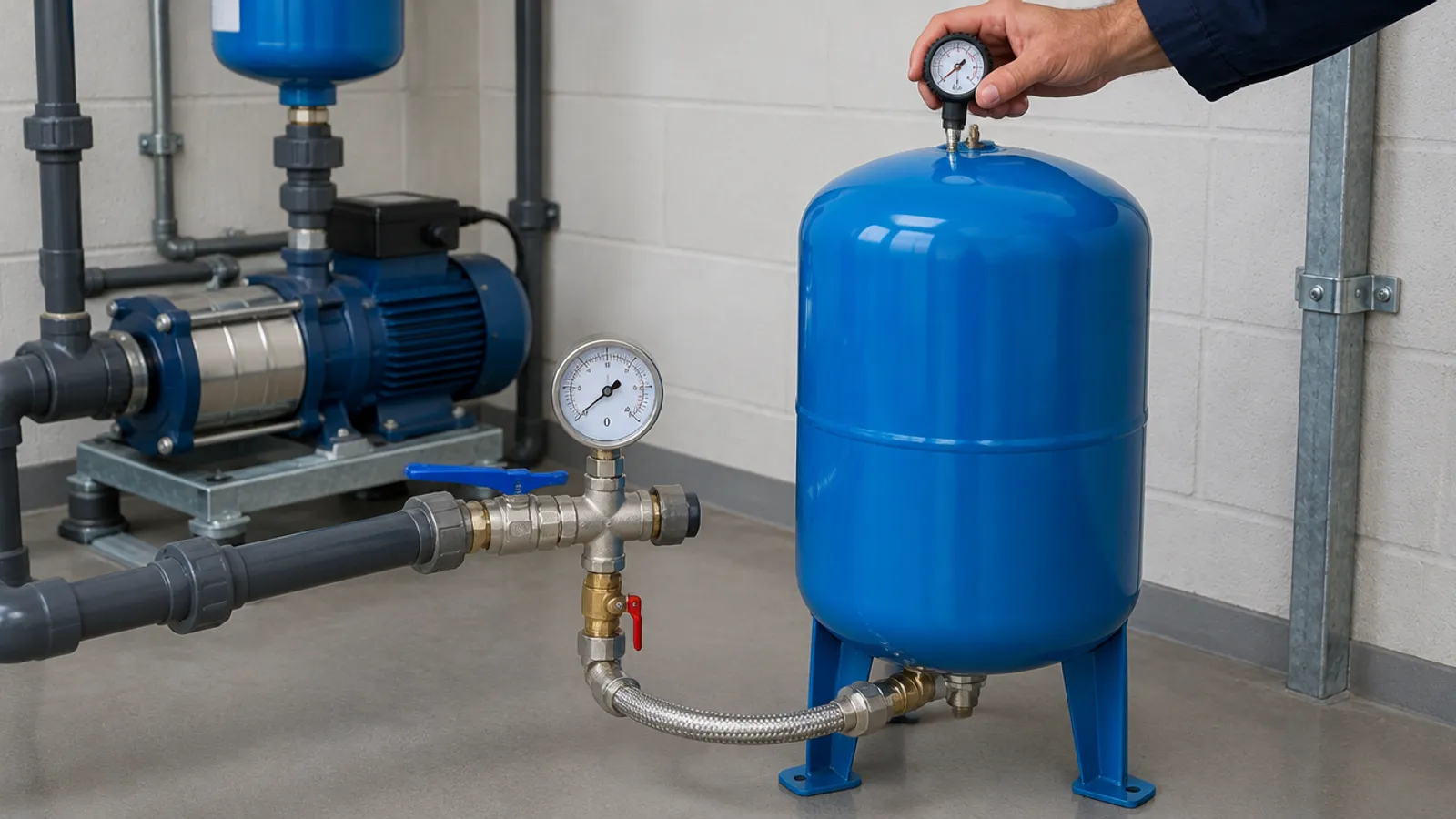
The traditional arrangement is a single-speed pump with a pressure switch and a pressure vessel. The switch starts the pump when pressure falls to a cut-in value, say 2 bar, and stops it at a cut-out, say 3.5 bar; the vessel's drawdown volume lets small draws be met without a start. It is simple, robust, cheap to buy and cheap to repair, and it tolerates the island's electrical supply reasonably well. Its drawbacks are the ones you feel in the shower: pressure wanders between the two switch settings as the pump cycles, and every start is a surge through the pipes. Get the vessel wrong and the pump short-cycles itself to death; our guides to pressure tanks and to pumps that keep turning on and off cover both.
Variable speed: constant pressure
A variable-speed set uses an inverter to change the pump's speed continuously so that the discharge pressure stays at one set value whether one tap or five are open. The pressure vessel shrinks to a few litres, starts are ramped rather than slammed, and at partial load the pump draws noticeably less power than a fixed-speed unit doing the same work. For a large villa with several bathrooms and guests who notice, it is the better experience. What it costs, apart from the price, is sensitivity: the electronics dislike the voltage swings and surges that island supply delivers, so a constant-pressure set belongs behind the same surge and voltage protection a well pump should have, and it should be a brand with a dealer on the island who can diagnose a controller, not only swap it.
Two ways to pressurise a house
Fixed speed with a pressure tank, or variable speed at constant pressure
Both draw from the storage tank and feed the same risers. They differ in how pressure is held between the outlets opening and closing.
1
Storage tank, flooded suction
The pump sits below the tank's water level, so the suction pipe is always full. Short, large-bore, with an isolating valve and a strainer.
2
Fixed-speed pump
Runs at full speed or not at all. Sized so its curve passes the duty point (peak flow at total head) in its efficient range.
3
Pressure switch and vessel
The switch starts the pump at cut-in and stops it at cut-out; the vessel's drawdown absorbs small draws. Pressure drifts between the two settings.
4
Non-return valve
Holds the pressure in the house side when the pump stops, so the pump does not restart because of backflow.
5
Variable-speed pump and controller
An inverter varies the speed to hold one set pressure as taps open and close. Soft start, lower part-load energy, quieter.
6
Small vessel
A few litres: enough to stop the controller hunting on a dripping tap, no longer a store of pressure.
7
Risers to the house
Height to the top outlet plus the pressure wanted there plus pipe and filter losses is the head the pump must make.
8
Dry-run protection
A float switch in the tank, or the controller's own sensing, stops either pump when the tank is empty. Both kinds are destroyed by running dry.
Either layout can also be built as a twin set: two pumps on a common manifold, alternating or assisting, so a failure does not leave the villa without water.
Twin sets for large villas and small resorts
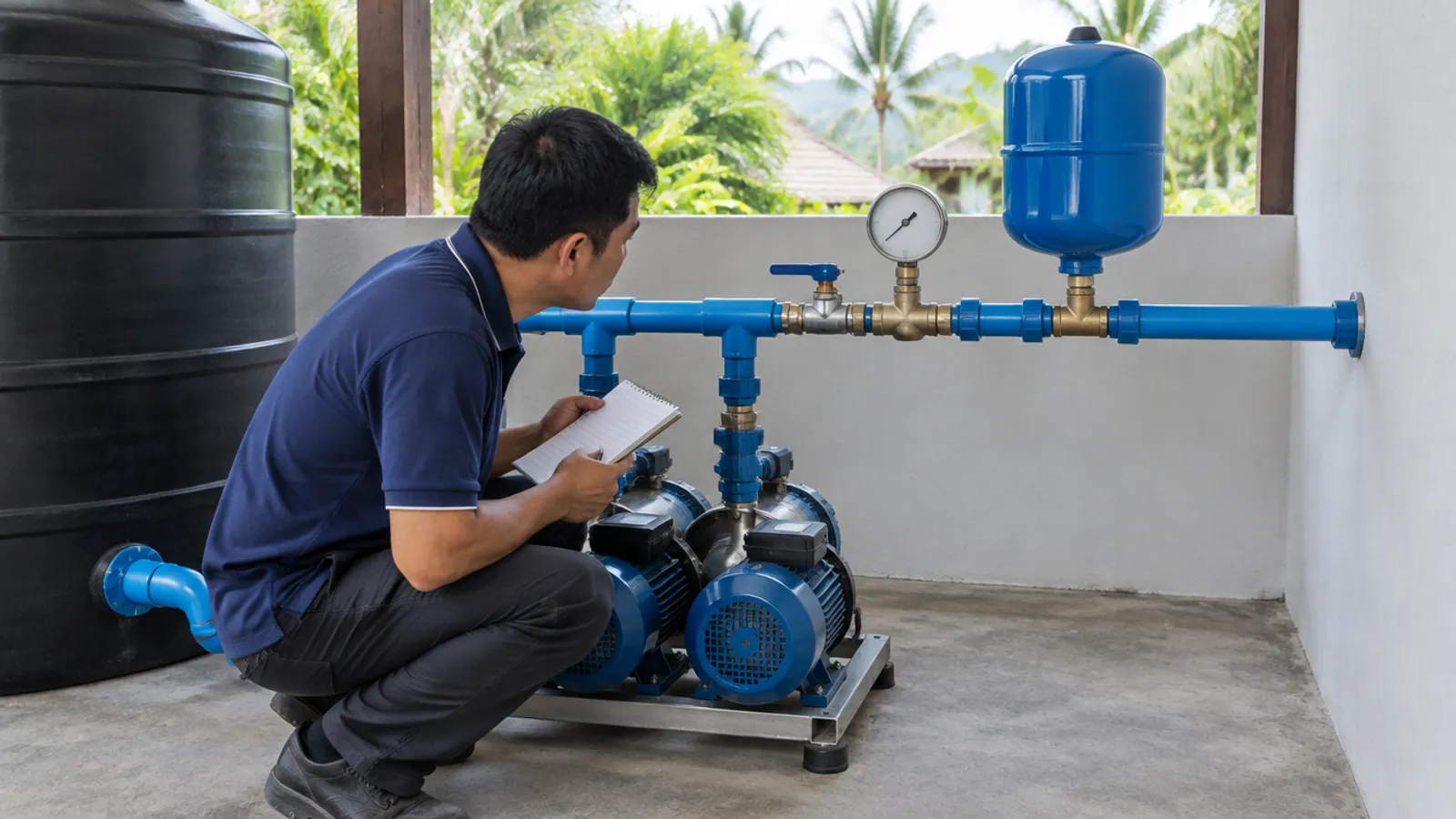
Above a certain size, one pump is a single point of failure for every shower on the property. A twin set puts two pumps on a common suction and discharge manifold under one controller, either as duty and standby, where the second starts only if the first fails or is being serviced, or as duty and assist, where the second joins in at peak demand. The controller alternates which pump leads so that both wear evenly. For a villa that rents at full occupancy, or a resort with a dozen rooms, the second pump is cheaper than the first lost booking. The planning side of that is in water for a villa development.
Suction: where the pump sits relative to the tank
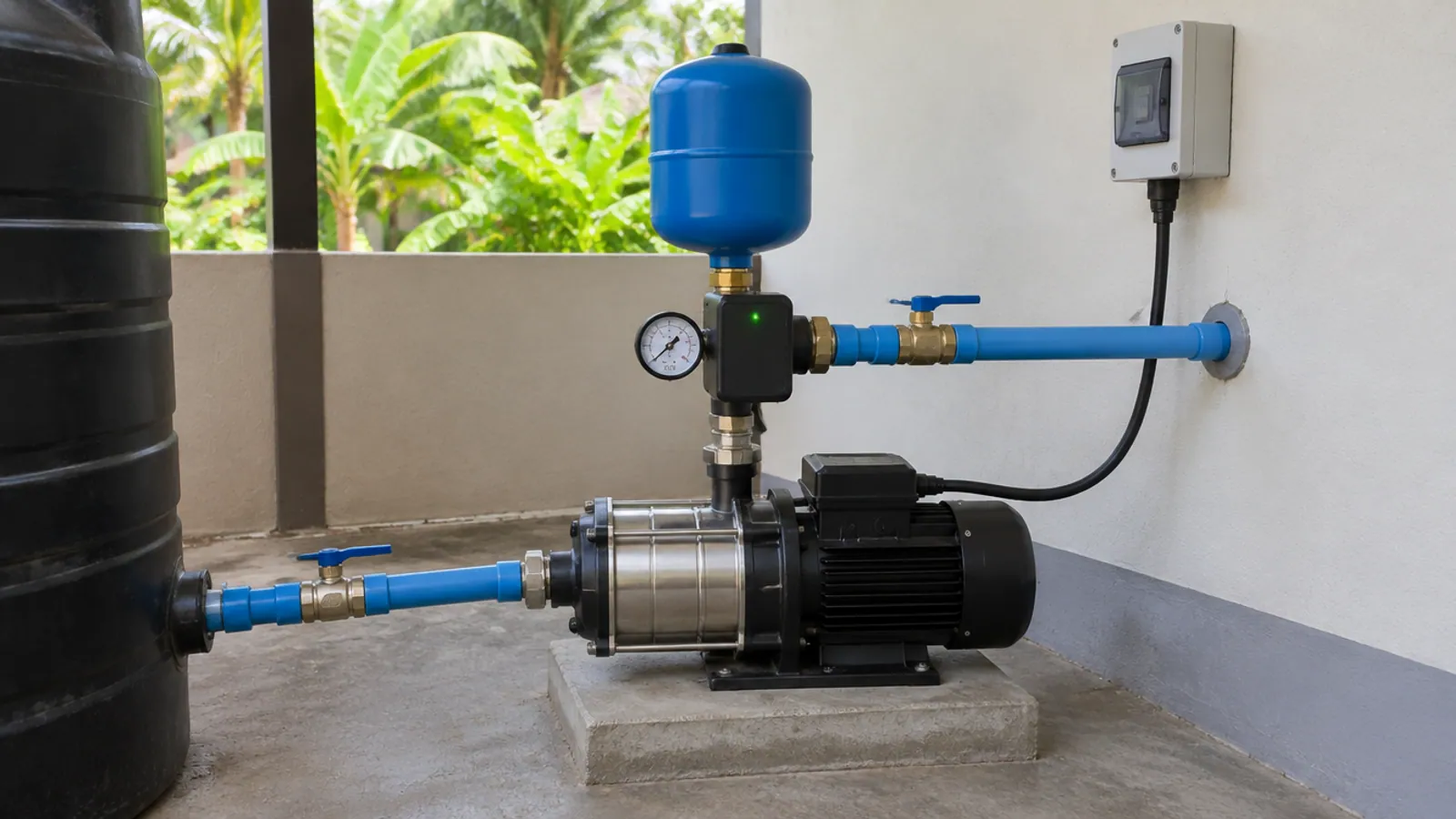
A booster pump is happiest with flooded suction: installed below the water level of the tank, so water flows into it by gravity and it never has to pull. That means an above-ground tank with the pump beside its base, a short and generously sized suction pipe with no high points to trap air, an isolating valve and a strainer. Ask a surface pump to lift from an underground tank instead and it needs a foot valve, priming, and a suction line that stays airtight for years; the lift it can manage is limited and shrinks with every metre of pipe and every bit of air. Where the tank has to be underground, a submersible booster sitting inside the tank, or a properly self-priming set, is the honest answer, not a surface pump at the end of a long thin pipe.
Protection the pump needs
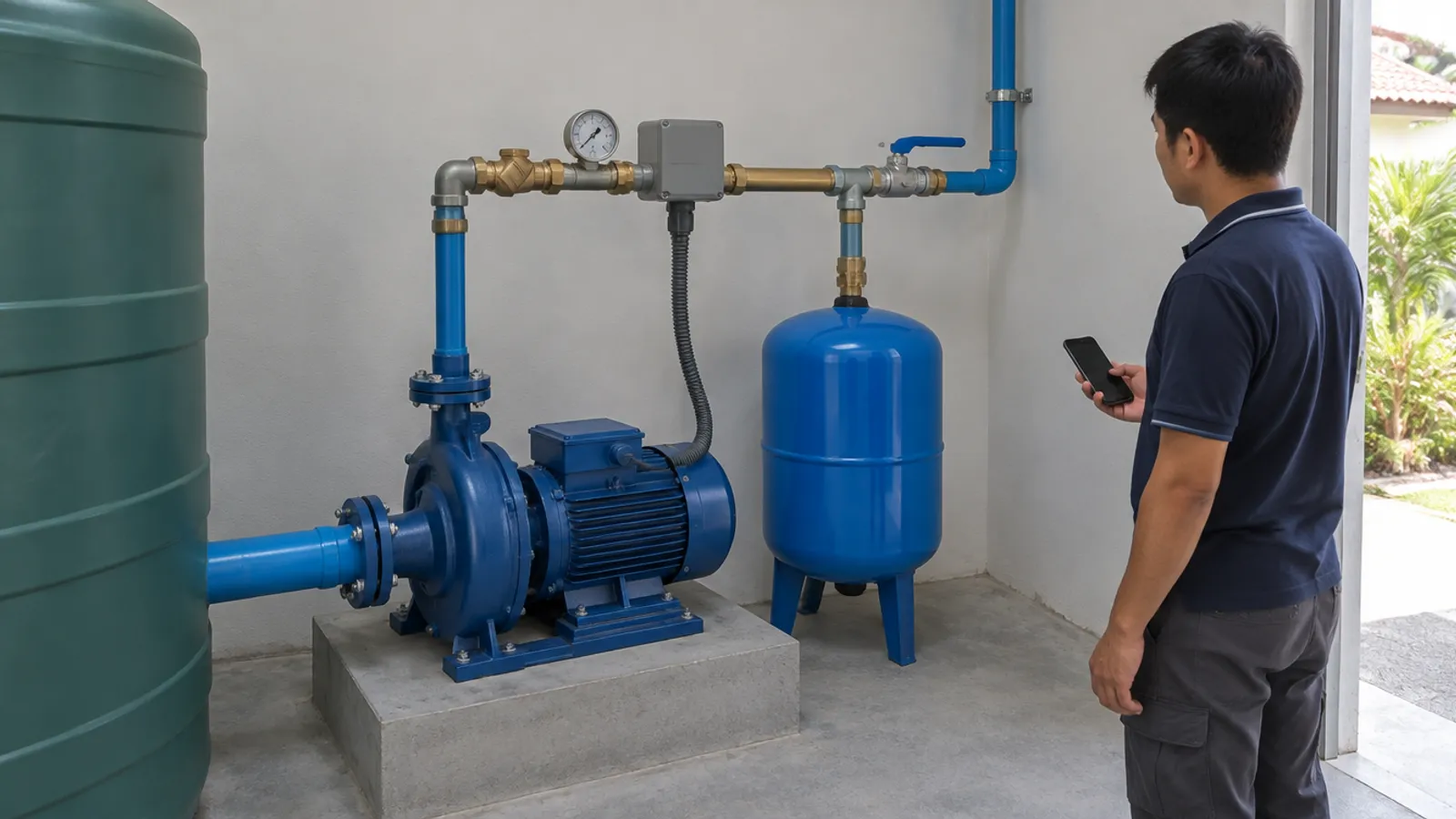
Dry-run protection is the one that matters most: a booster that keeps running on an empty tank destroys its seal and bearings in minutes. A float switch in the tank that cuts the pump, or a controller that senses the loss of flow and pressure, is not optional. Beyond that: overload protection sized to the motor, surge protection on an inverter set, a non-return valve on the discharge, isolation valves on both sides so the pump can be changed without draining the house, and a location out of the sun and rain with air around the motor. A pump that cooks in a tin box in April will not last.
The mistakes we are called out to undo
Sized by horsepower or by the house's floor area. The duty point is flow and head; a bigger motor at the wrong point short-cycles and never fixes the top floor.
The booster placed before the treatment train with no allowance for its pressure loss, so the furthest bathroom fades as the filters load.
A long, small-bore suction pipe from a distant or buried tank: the pump cavitates, loses prime and dies early.
No dry-run protection, and a tank that runs empty every dry season.
Irrigation and pool filling on the house pump, so the pump is oversized for the house and the showers drop when the sprinklers run.
No isolation valves or bypass, so a simple seal change means a villa without water for a day.
The duty point, switch settings and controller setpoint written nowhere, so the next technician starts from zero.
Commissioning
Commissioning a fixed-speed set: cut-in and cut-out are set at the switch, the vessel's air charge is checked against cut-in, and the gauge on the manifold is read with two showers running upstairs.
A new booster is set, not just switched on. On a fixed-speed set, the pressure switch cut-in and cut-out are adjusted to the system and the vessel's air charge is set just below cut-in. On a variable-speed set, the setpoint is chosen for the top floor rather than the plant room. Then the test that matters: two showers running on the highest floor while someone reads the pressure at the furthest outlet, and the motor current checked against the nameplate. The numbers, together with the settings, go on a label on the pump and in the villa's records, next to the well's. Our villa water system overview explains how that record fits with the rest of the plant.
If the top floor is weak, the pump cycles, or you are choosing a booster for a new build, our pump installation team works out the duty point from your outlets and your treatment, and specifies and commissions a set that holds it.
Common questions
Can the submersible well pump supply the house directly, without a booster?
It can be plumbed that way, and it usually works badly: the pump cycles on every tap, house pressure follows the water level in the bore, and the well is drawn down by small draws. A storage tank with its own booster pump lets the well pump run at the bore's rate and the house pump at the house's rate.
What water pressure should a villa have?
Around 2 bar at the highest shower head is comfortable; 3 bar is generous and makes rain showers work; above 4 bar at the outlets starts to stress flexible hoses and mixers. The pump is sized to deliver that at the top outlet with the realistic peak flow running, after pipe and filter losses.
Is a constant-pressure (variable-speed) booster worth it on the island?
For a large villa with several bathrooms, usually yes: steady pressure, quiet, soft starts and lower part-load energy. The conditions are surge and voltage protection in front of it and a brand with local service. For a small house with one or two bathrooms a well-set fixed-speed pump with a correctly charged vessel is hard to beat.
Why does the booster pump run when no tap is open?
Something is letting pressure out of the house side: a leaking non-return valve letting water back to the tank, a dripping tap or toilet fill valve, or a leak in the pipework. A pump that starts at intervals with everything closed is diagnosing a leak, not a pump fault.