Equipment
What size water tank does a villa on Koh Samui need?
The right tank is a buffer against the gaps in your supply — sized from how many people use the water and how long resupply really takes.
June 22, 2026 · 5 min read
Water Supply
In the dry months the garden is often the biggest water user on a villa, bigger than the household. A well can carry it, but only if the irrigation is planned as its own system rather than hung off the house supply.
October 7, 2026 · 9 min read
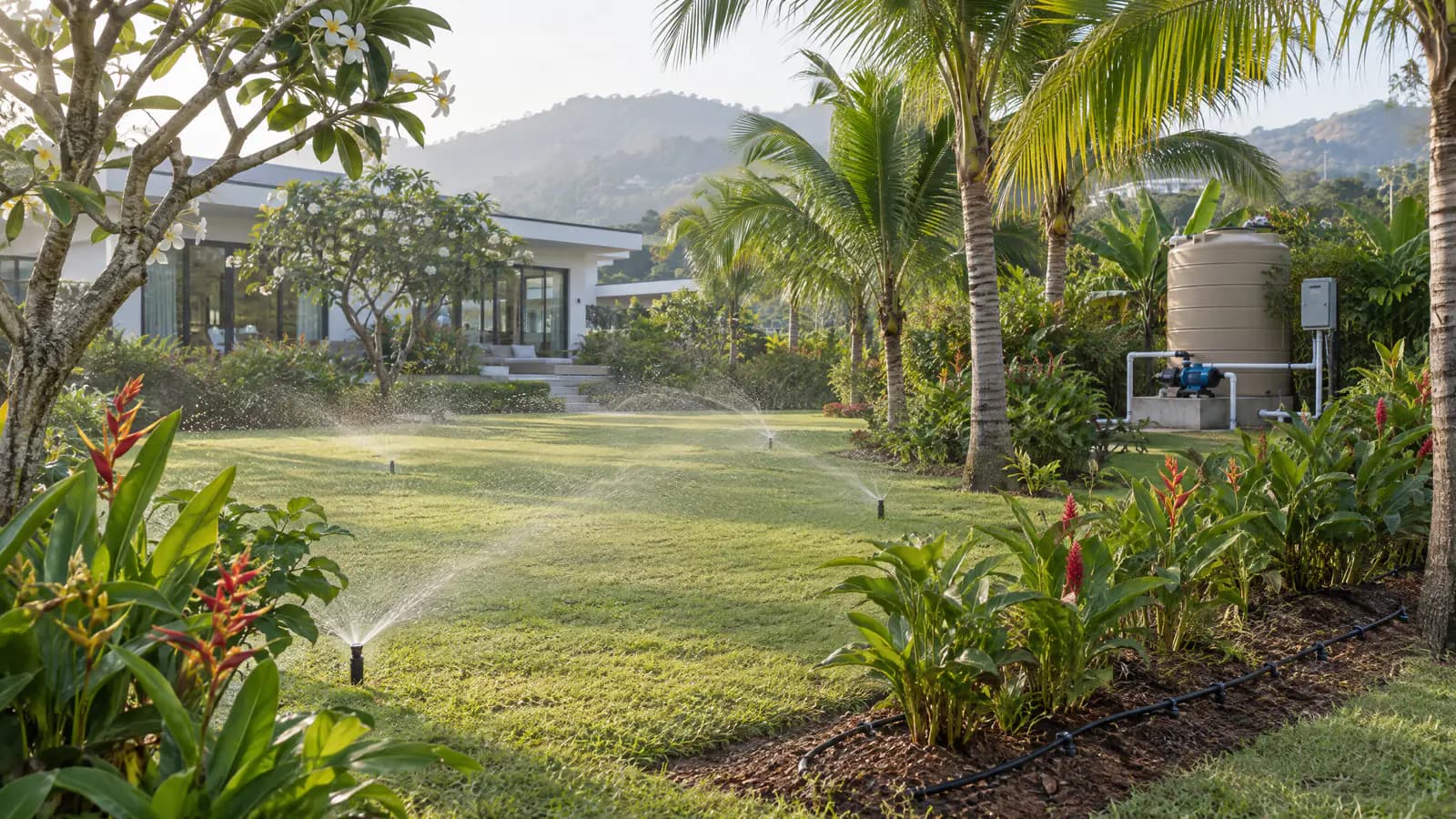
A green villa garden through a Samui dry season is a lot of water. Lawns, palms and flowering beds in sandy coastal soil can drink more each day than everyone living in the house, and that demand peaks exactly when rain stops and delivery trucks get scarce. A private well is the obvious source for garden irrigation, and often a good one. The problems start when the garden is simply connected to the house plumbing and left to fight the showers for water.
Irrigation demand is easier to estimate than most owners think, because of one useful fact: a millimetre of water spread over a square metre is one litre. The amount a garden needs per watering depends on the plants, the soil, the weather and the method. A gardener or irrigation designer can give a sensible figure for each zone. Multiply it by the area and you have litres.
As an illustration, 500 m² of lawn given 5 mm a day needs 2,500 litres a day, every day, before the beds and pots. Drip lines on mulched beds use far less per square metre than sprinklers on open lawn, because they put water at the roots instead of in the air and on the paths. Sandy soil near the beach drains fast and needs little and often; heavier soil inland holds water longer. The point isn't the exact figure. It is to know the garden's daily volume before deciding what the well, the pump and the tanks must supply.
The simplest installation tees the irrigation off the house pressure line. It works in a small garden. On a villa it causes four problems:
System comparison
Layout A hangs the garden off the house supply. Layout B gives it its own tank, pump and zone valves, fed from the same well.
Fills storage at a rate the well can sustain, in both layouts.
Raw water storage for the house.
Sized for the house's peak flow and steady tap pressure.
Showers, kitchen, laundry, pool top-up.
Shares the booster, the treated water and the tank. Simple, but the garden and the house compete.
Its own storage, filled from the well (or from overflow), so watering never drains the house supply.
Sized for the largest zone's flow and pressure, not for the house.
A screen or disc filter protects the emitters; a controller opens one zone at a time.
Lawn sprinklers and drip beds on separate zones, watered at night or early morning.
In layout B the well fills a separate irrigation tank at a steady, sustainable rate, just as it fills the domestic tank. Often a level control gives the house tank priority and sends water to the garden tank once the house is full. The irrigation pump then draws from its own tank, sized to the flow of the largest zone at the pressure its sprinklers or drippers need. Zones are split so that each one matches the pump, rather than asking one pump to water the whole garden at once.
Because the garden doesn't need drinking-quality water, irrigation can usually run on raw well water and skip the house treatment entirely. Raw doesn't mean unfiltered, though. A screen or disc filter at the valve manifold keeps sand and scale out of the emitters, and it needs cleaning on a schedule like any other filter.
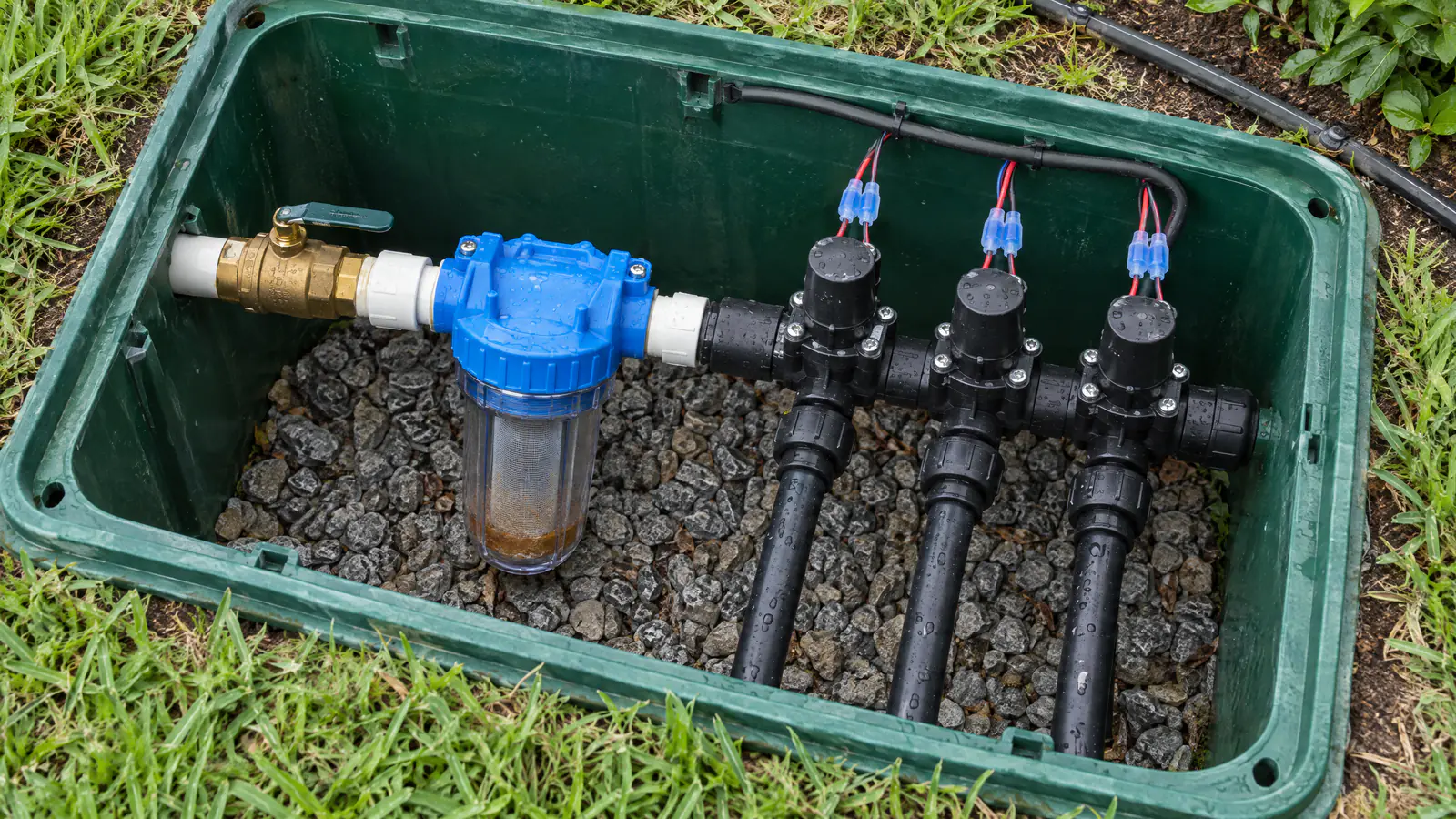
Drip irrigation is the most efficient way to water beds, and the most sensitive to well-water chemistry. Dissolved iron and manganese come out of solution when the water meets air at the emitter outlet, and the deposit builds up until the dripper slows and stops. One bed turns yellow while the next is fine, and the cause is a few millimetres of orange crust. See brown or orange well water for the chemistry behind it.
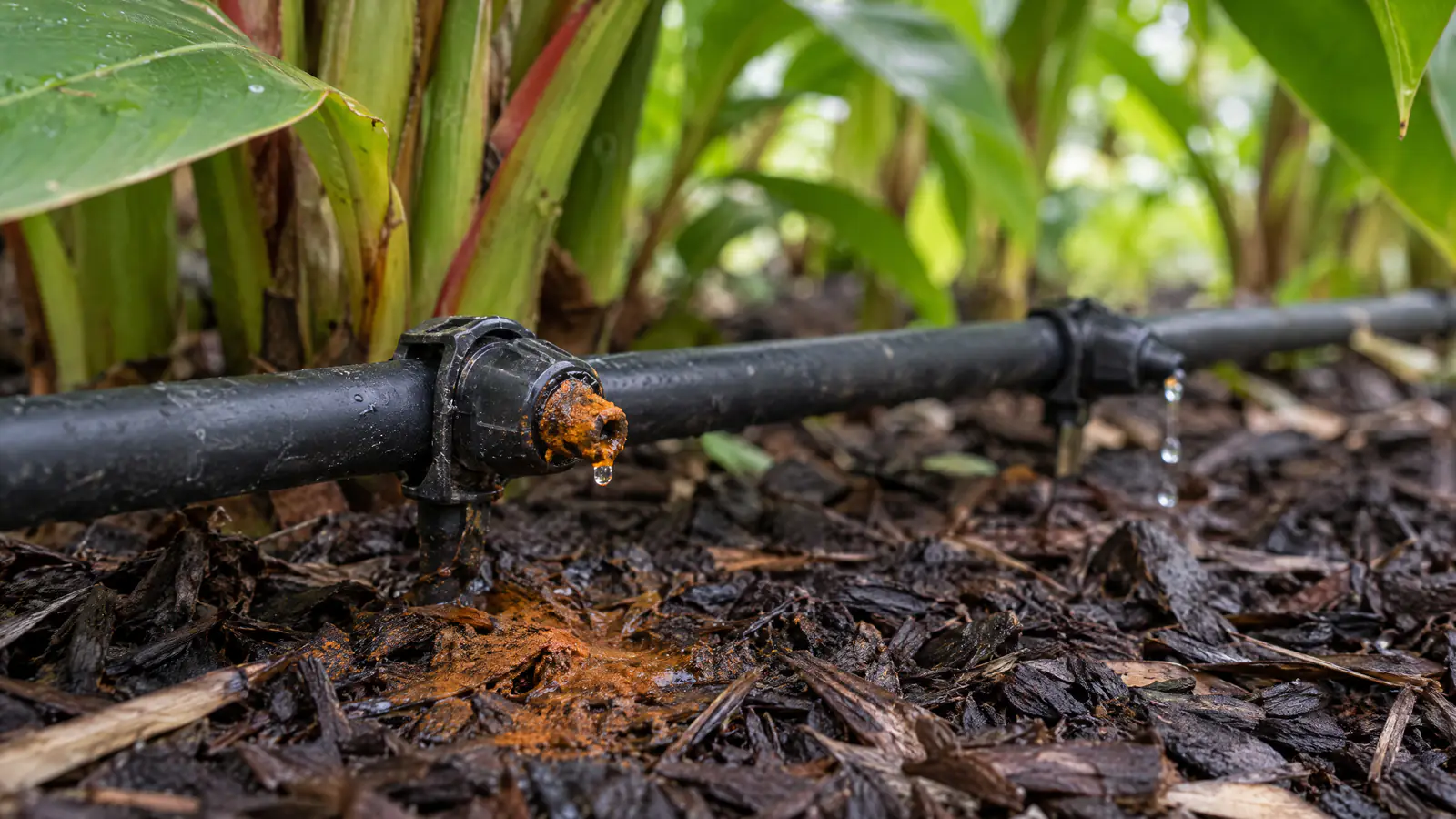
On iron-rich water there are two practical answers. One is to let the iron drop out before the irrigation pump: an aerated or well-vented irrigation tank gives the iron time to oxidise and settle, and the pump draws from above the sediment. The other is to filter it out with the right media. Either way, plan regular flushing of the drip line ends, and test the water before choosing drip over sprinklers.
Every well has a sustainable daily yield, and late in the dry season it is at its lowest. The garden's demand has to fit inside what is left after the house. If a test shows the well sustains a certain volume per day, the house takes its share first and irrigation gets the remainder, not the other way round. Our guide to how much water a well produces explains how that figure is measured. Why that figure drops in the dry months is explained in seasonal groundwater and deep wells.
Need to size the complete water system rather than individual components? Send us the property details: garden area and planting, number of bedrooms, pool, and how the villa is used. We'll design the well, storage, pumps and irrigation as one villa water system.
Equipment
The right tank is a buffer against the gaps in your supply — sized from how many people use the water and how long resupply really takes.
June 22, 2026 · 5 min read
Drilling
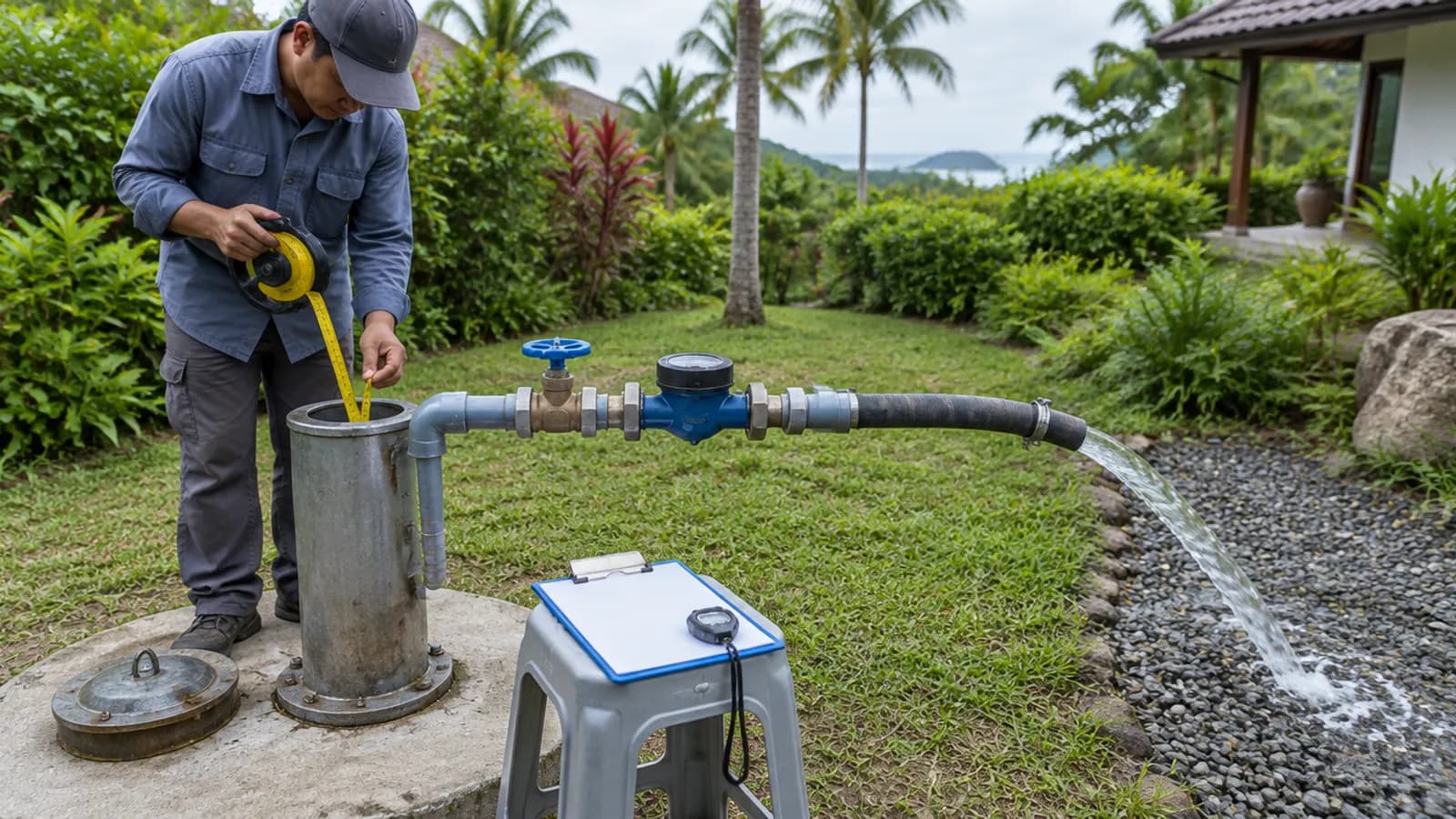
"The pump gave 40 litres a minute" sounds like an answer, but it describes the pump on one afternoon, not what the well can keep giving. Yield is read from the water level: how far it falls while pumping, whether it settles, and how it comes back afterwards.
July 10, 2026 · 9 min read
Water Supply
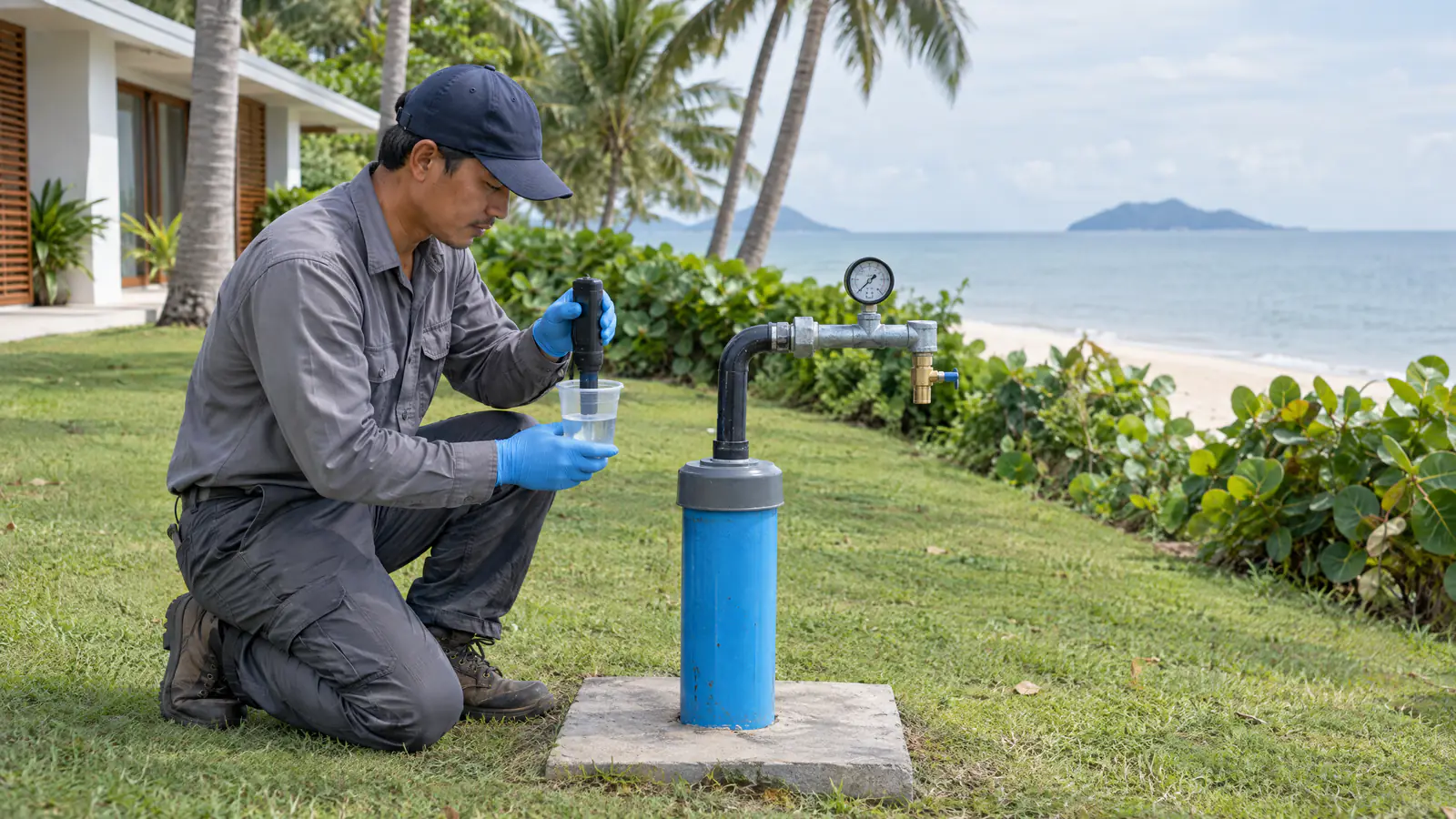
A well near the beach can run fresh for years and then turn brackish in a single dry season. The sea hasn't moved. What usually changed is how hard, how long and how deep the well is being pumped.
October 3, 2026 · 8 min read