Salty well water on Koh Samui: how saltwater intrusion reaches coastal wells
A well near the beach can run fresh for years and then turn brackish in a single dry season. The sea hasn't moved. What usually changed is how hard, how long and how deep the well is being pumped.
October 3, 2026 · 8 min read
Salty well water is one of the few water-quality problems on Koh Samui that the owner often causes, and that the owner can often reverse. Saltwater intrusion is the slow movement of seawater into fresh groundwater, and near the coast it is driven mostly by pumping. Wells on the flats behind Chaweng, Lamai, Bophut and Maenam beaches sit closest to the sea and feel it first. The good news is that a well turning brackish is usually telling you something specific about how it is being used, and the fix starts there rather than with a filter.
How fresh groundwater sits next to the sea
Rain that soaks into coastal sand and weathered rock forms a body of fresh groundwater. Fresh water is slightly lighter than seawater, so near the shore it floats on top of the salt water that has seeped in from the sea, in a layer that thins towards the beach. Between the two there is no sharp line, just a brackish mixing zone. In Samui's granite the picture is less tidy, because fractures can connect a well to seawater more directly, but the principle is the same: fresh water above, salt water below, and a balance between them that pumping can upset.
The balance is more sensitive than most owners expect. The textbook rule for idealised coastal aquifers, the Ghyben–Herzberg relation, puts the fresh–salt boundary roughly forty times as far below sea level as the water table stands above it. Real ground on the island is never that tidy, but the ratio explains the behaviour. Pull the water table down a little near the coast and the salt water underneath can rise a long way.
Cross-section
How seawater reaches a coastal well
Two wells on the same coastal plot. The difference between them is how hard each one is pumped and how close it sits to the sea.
1
Rain recharges the ground
The wet season refills the fresh groundwater. In the dry months that recharge stops while demand rises.
2
Fresh groundwater floats on seawater
Lighter fresh water forms a layer above the salt water and drains slowly towards the sea.
3
Seawater underneath
Denser salt water seeps inland under the land, deepest furthest from the shore.
4
Brackish mixing zone
Not a sharp line but a band of mixed water, which moves up and down with pumping, tides and seasons.
5
Inland well, pumped within its yield
A small dip in the water table around the well. The salt boundary stays well below the pump.
6
Shore-side well, over-pumped
A deep cone of drawdown. Salt water rises underneath it (upconing) until it reaches the pump intake.
7
The sea
Always the source of the salt. What changes is how much of it the well is allowed to draw.
Schematic, not to scale. In fractured granite, salt water can also arrive along fractures connected to the sea.
How a coastal well turns salty
A bigger pump. Replacing a failed pump with a more powerful one is the classic trigger. The well is asked for more water per hour than it gave before, and the drawdown deepens. Our guide to choosing a submersible pump explains why bigger is not better.
Long pumping runs. Irrigation timers that run the well for hours every night draw the water table down and keep it down.
The dry season. Recharge stops just as gardens and pools need the most water. Salinity that creeps up late in the dry season and eases after the rains is the textbook pattern. See preparing for the dry season.
Drilling too deep near the shore. Inland, a deeper well often means more reliable water. On the coast it can mean drilling closer to the salt boundary.
Many wells drawing on the same ground. A neighbouring resort's wells share the same fresh-water layer as yours.
Seawater from the surface. A storm surge or a flooded wellhead can let salt water straight down the bore if the seal is poor. That is a construction problem rather than intrusion, and the wellhead needs fixing.
Signs your well water is getting saltier
A brackish or flat taste. WHO guidance notes that chloride above roughly 250 mg/L tends to become noticeable by taste, but many people only notice well above that.
Garden plants scorched at the leaf edges, or lawn yellowing after irrigation in the dry season.
Fittings, pump parts and water heaters corroding faster than expected.
A pattern: worse late in the dry season, better after heavy rain.
Several of these signs overlap with hardness and other minerals, so taste and staining can't settle it. A conductivity reading can.
Measuring salinity: a handheld meter and a laboratory test
Measurement
How
What it tells you
Conductivity (EC) or TDS
Handheld meter, on site, in seconds
Total dissolved salts. Best used as a trend, at the same tap under the same conditions
Chloride
Laboratory
Confirms that the salt is seawater-type rather than other dissolved minerals
Sodium
Laboratory
Relevant for drinking-water taste and for irrigating salt-sensitive plants
Hardness
Laboratory or test kit
Separates a scale problem from a salt problem; they need different fixes
Fresh and brackish well water look identical. A conductivity reading at the same tap, under the same conditions, is what shows the trend.
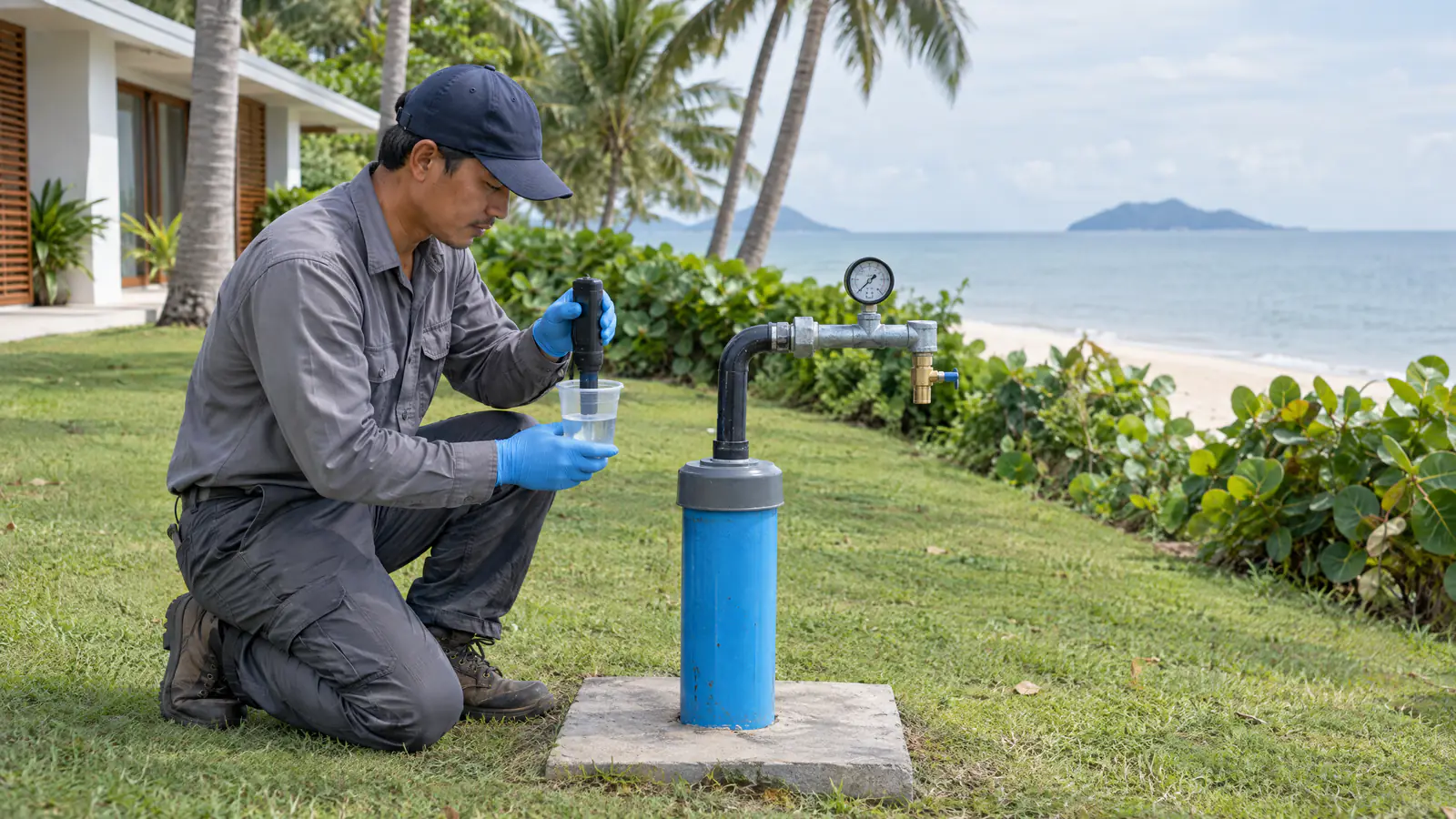
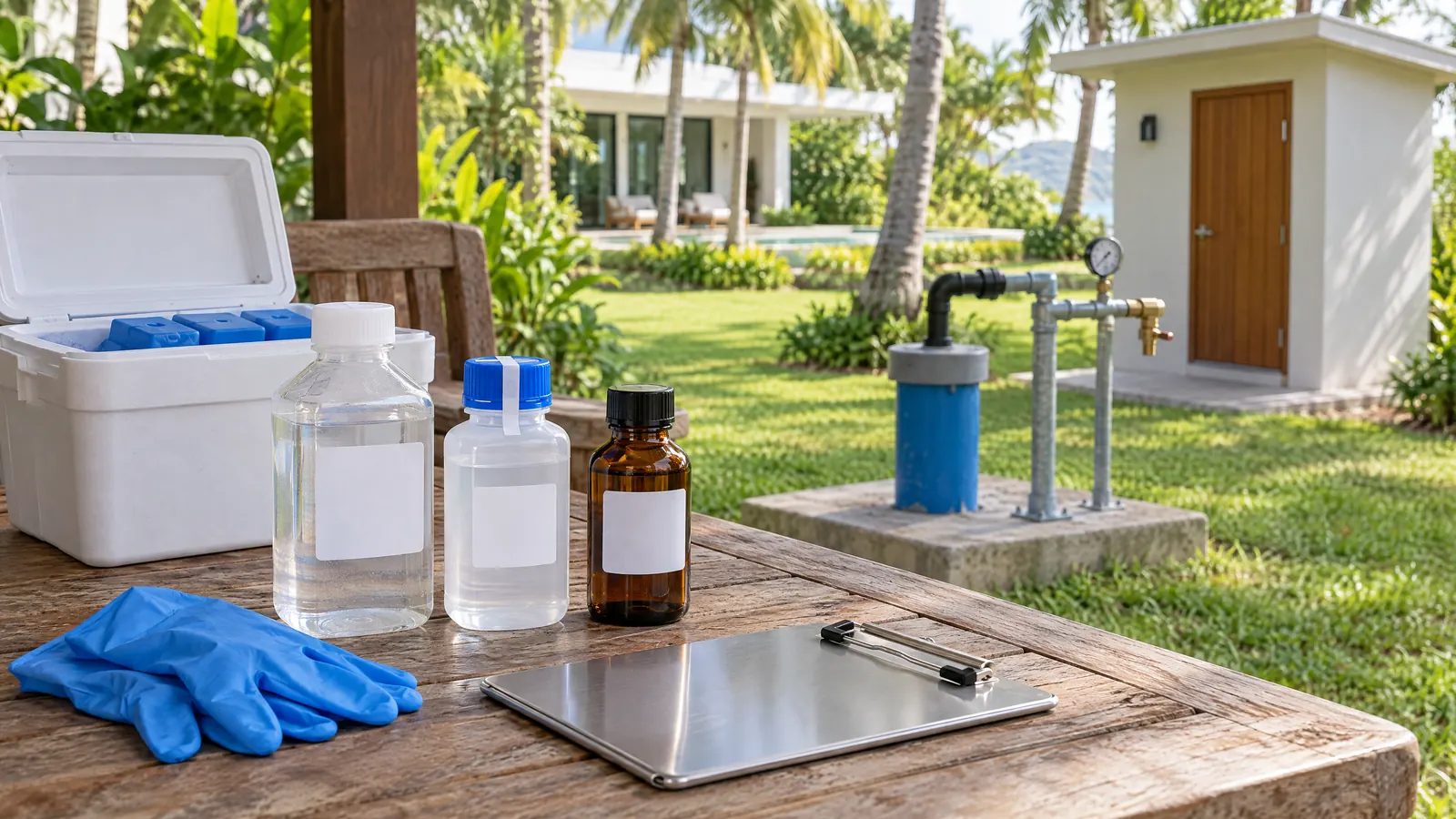
The handheld meter is the tool that catches intrusion early. Take a baseline when the well is new or healthy, then read it monthly through the dry season: same tap, close to the wellhead, after the pump has run for the same few minutes. Write the numbers down. A steady rise over weeks is the warning, whatever the absolute figure. When the trend moves, a laboratory test with chloride and sodium confirms what is happening.
What actually fixes a salty well
Treatment comes last on this list on purpose. Most salty coastal wells improve when the pumping changes, and treatment without that change just processes ever-saltier water.
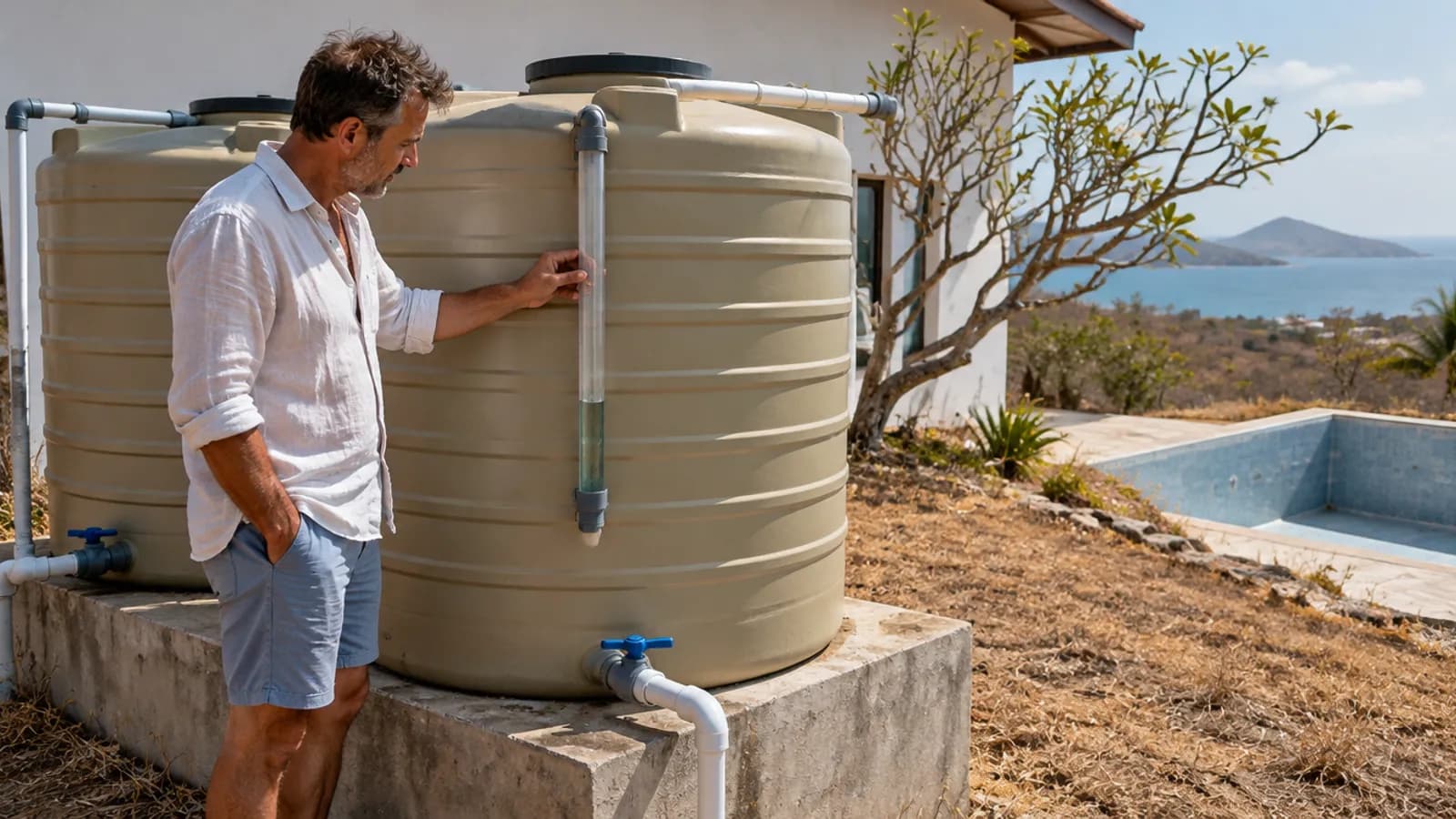
Pump gently, for longer. Fill a storage tank slowly over the day with a smaller pump or a restricted flow, and let the tank meet the peaks. The water table dips less, so the salt stays lower. Our guide to storage tank size covers how much buffer a villa needs.
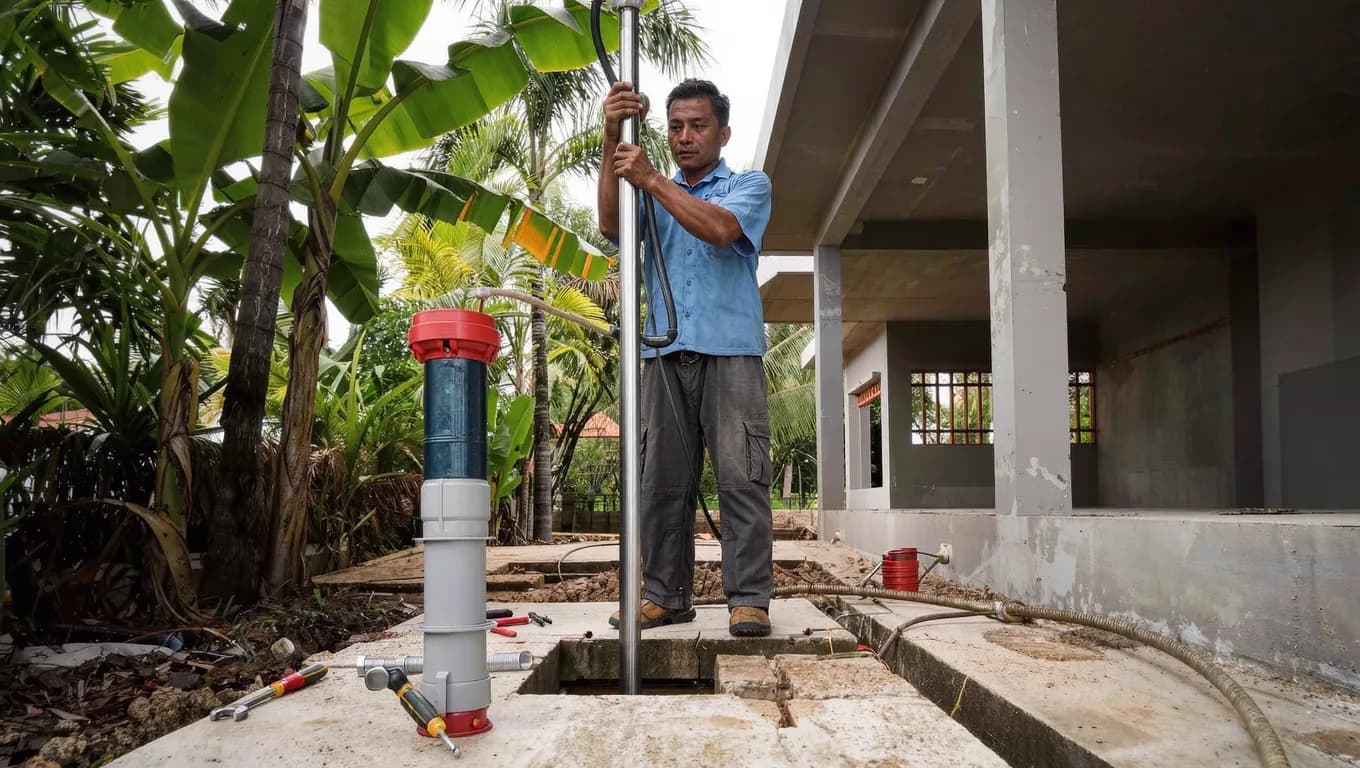
Raise the pump. Setting the intake higher, still safely below the lowest pumping level, draws from the fresher top of the layer.
Take the garden off the well in the dry months. Irrigation is usually the biggest single draw, and the least sensitive to water quality, so other sources can cover it. Our guide to watering a villa garden from a well shows how to separate it.
Set limits and watch them. A level or flow control that stops the pump before the water table falls too far, plus monthly conductivity readings, turns guesswork into a routine.
Treat drinking water where you drink it. Reverse osmosis removes salt effectively at a kitchen tap. Whole-house desalination is large, wasteful and rarely justified; the whole-house filtration design guide explains where RO belongs.
Move the well, as a last resort. A well that stays brackish after a wet season of gentle pumping may need replacing further inland or upslope, and the old bore should be sealed properly so it can't carry salt or surface water down.
Planning a new well near the coast
On a beachfront plot, choose the drilling point as far inland and as high as the plot allows. Drill to the water the property needs rather than as deep as possible, and size the pump to what the test pumping shows the well can sustain, with margin. Measure conductivity at intervals during the test itself: salinity climbing during a long test is an early sign the well is being drawn too hard. Seal the wellhead above the level that storms and high tides could flood. A baseline lab test then gives you something to compare against for years. Our guide to how much water a well will produce explains what the test should record.
Seeing salinity creep up in a coastal well? Contact us to talk through the well and how the property uses water. We can measure conductivity on site, review the pump and the pumping pattern, and plan the fix, whether that is a well and pump inspection, a pump change or a drinking-water RO stage.
Common questions
Will a salty well recover on its own?
Often, partly, if the pumping changes. Gentler pumping through a wet season lets fresh recharge push the salt boundary back down. If pumping stays the same, it usually doesn't recover.
Can an ordinary water filter remove salt?
No. Sediment, carbon and iron filters don't remove dissolved salt. Reverse osmosis does, which is why it is normally fitted at a drinking-water tap rather than for the whole house.
Should I drill deeper to get away from the salt?
Near the coast, usually not. Salt water lies beneath the fresh water, so going deeper can bring the well closer to it. Moving inland or upslope, and pumping more gently, are usually the better options.