What kind of treatment does your well-water problem point to?
Most villas do not need "a filter". They need the treatment that matches what is actually wrong with their water, and one or two common problems are not filtration problems at all. Start from what you notice, confirm it, and only then look at a category of equipment.
June 19, 2026 · 8 min read
People usually come to treatment from a symptom: a stained basin, a cloudy glass, a shower screen that will not come clean, a smell from the tap. Each of those points to a different cause, and each cause has its own kind of treatment. This guide goes from the symptom to the category of treatment worth looking into. It does not cover which tests a laboratory should run, which is in our guide to testing well water, or how the stages of a whole-house system are arranged and sized, which is in our guide to whole-house filtration design.
Symptom → confirm → treatment
From what you notice to the treatment to look at
Each row starts from something an owner sees, tastes or smells. The middle column is what confirms the cause; the last is the purchase people most often make that does not solve it.
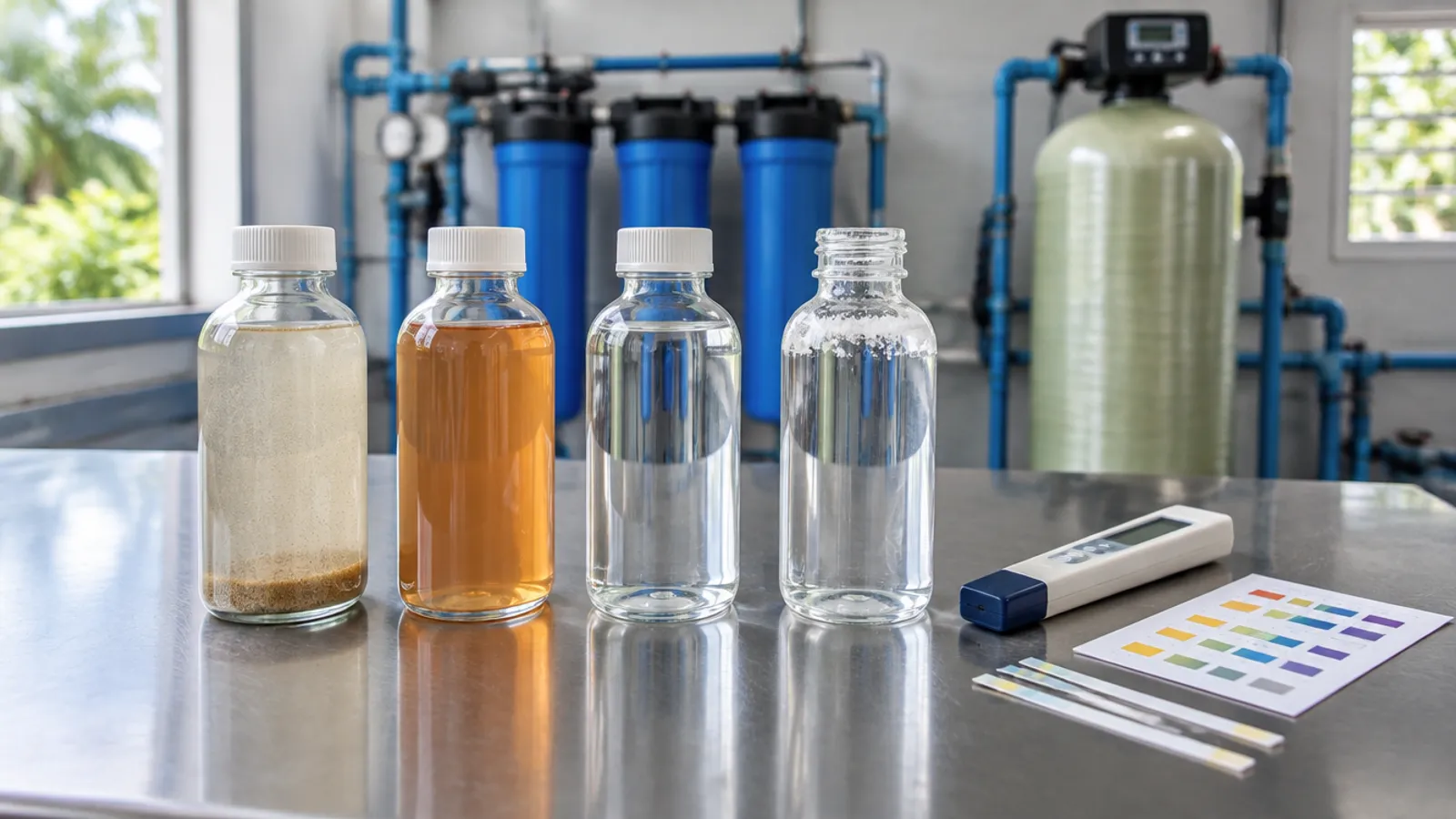
Sand, grit or cloudy water
Confirm with
A glass left to stand: grit settles in minutes; haze that clears from the bottom up is only air. A turbidity reading for fine particles.
Treatment category
Sediment control: a separator, cartridge or backwashing media. Persistent sand also calls for a look at the well.
Will not fix it
An ever finer cartridge on a well that is pumping sand: it clogs within days.
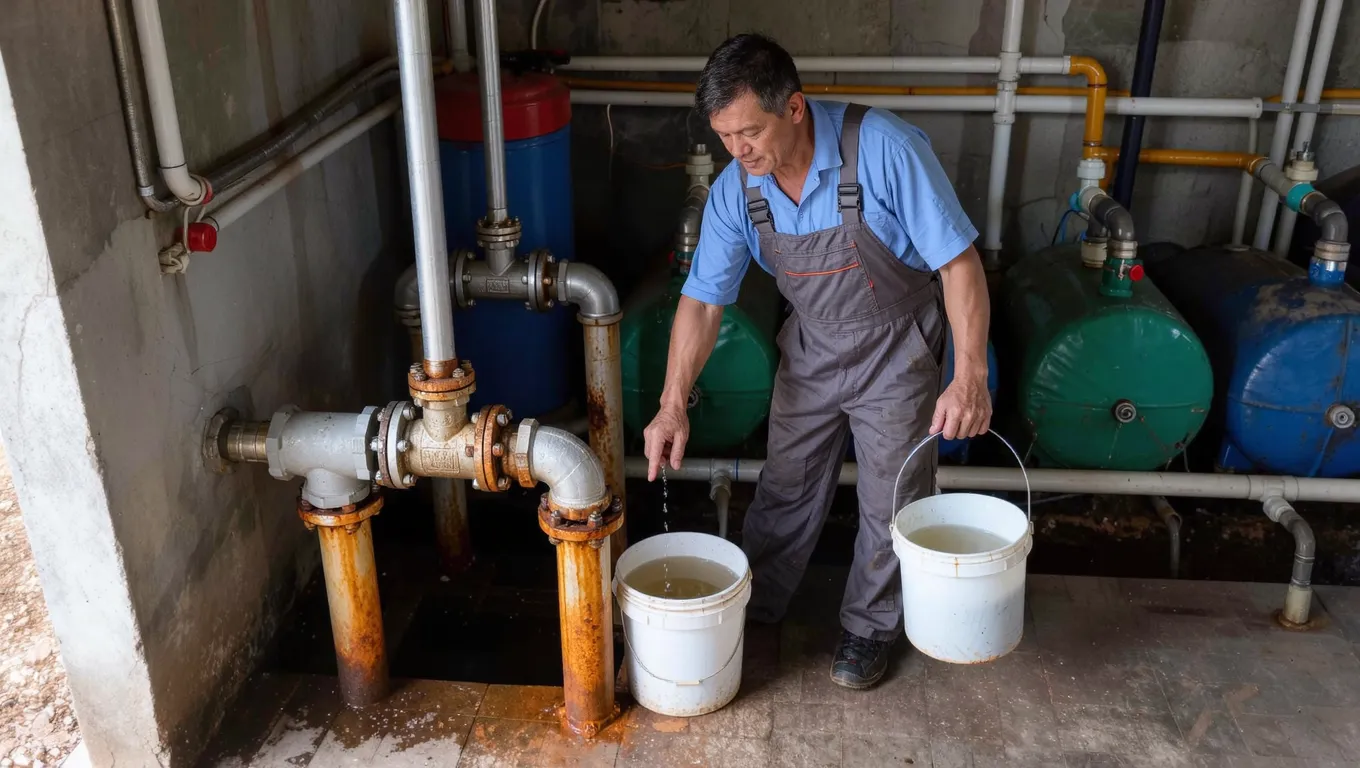
Orange, brown or black staining
Confirm with
A laboratory test for iron, manganese and pH. Water that leaves the tap clear and stains later carries dissolved iron.
Treatment category
Oxidation, then filtration through a media suited to the iron and manganese levels.
Will not fix it
Cartridges alone, which clog fast, or a softener used as the main fix.
White scale on glass, heaters and shower heads
Confirm with
A hardness test. Salty water also leaves white marks, so check conductivity as well near the coast.
Treatment category
Softening where scale is costing heaters, glass and fittings.
Will not fix it
Sediment or carbon filters, and devices that do not change the water's chemistry.
Earthy, musty or odd taste
Confirm with
Whether it is in cold water as well as hot, and a laboratory test if it is new or strong.
Treatment category
Activated carbon, where the cause is taste and odour compounds.
Will not fix it
Carbon does not remove bacteria, hardness or dissolved salts.
Rotten-egg smell
Confirm with
Whether it is in cold water or only from the water heater, where it usually starts inside the heater.
Treatment category
Oxidation followed by filtration; carbon only for faint traces. A heater-only smell is fixed at the heater.
Will not fix it
A sediment cartridge, which passes dissolved gases straight through.
Worry about bacteria (no visible sign)
Confirm with
A microbiological test: total coliforms and E. coli. Clear water proves nothing.
Treatment category
Disinfection, usually UV after filtration, together with a sound wellhead seal.
Will not fix it
Carbon, sediment filters and softeners. They are not disinfection.
Salty or brackish taste
Confirm with
Conductivity or TDS, and chloride.
Treatment category
Not ordinary filtration: reverse osmosis at a drinking point, and managing the source.
Will not fix it
Any sediment, carbon, media filter or softener. Dissolved salt passes through all of them.
Categories, not products. The right equipment and its size depend on the test results, the flow the villa needs, and where in the system it goes.
Why one filter cannot fix everything
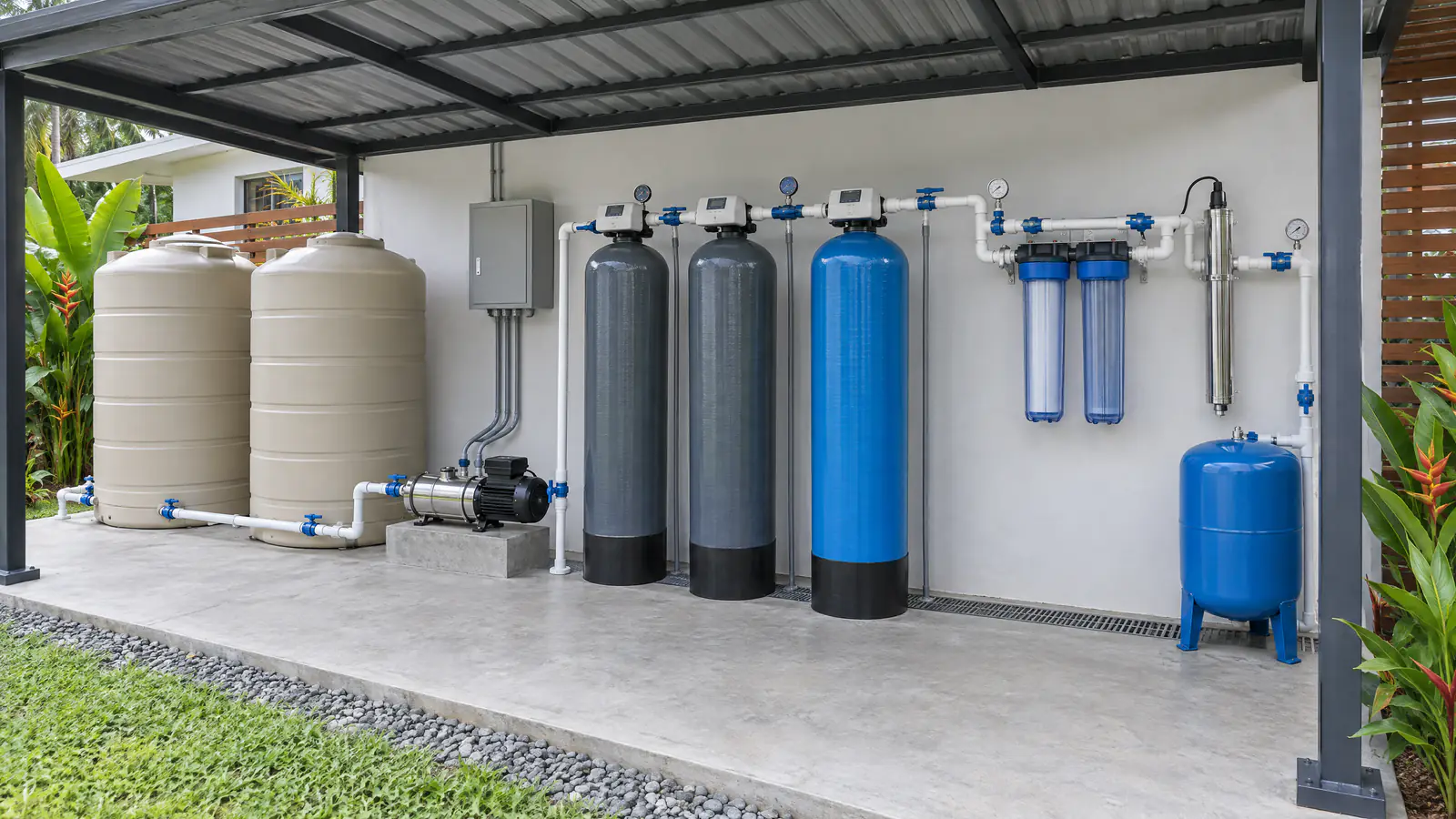
Treatment works by quite different processes. Sediment filters strain particles out. Iron removal changes dissolved iron into a solid and then strains that. A softener swaps hardness minerals for others. Carbon adsorbs taste and odour compounds. UV damages microorganisms so they cannot multiply. A membrane pushes water through pores fine enough to hold back dissolved salts. A single cartridge sold as an all-in-one does a little of one or two of these, for a small flow, until it is spent. That is why the first question is always what the water actually has in it.
Start from the symptom, then confirm it
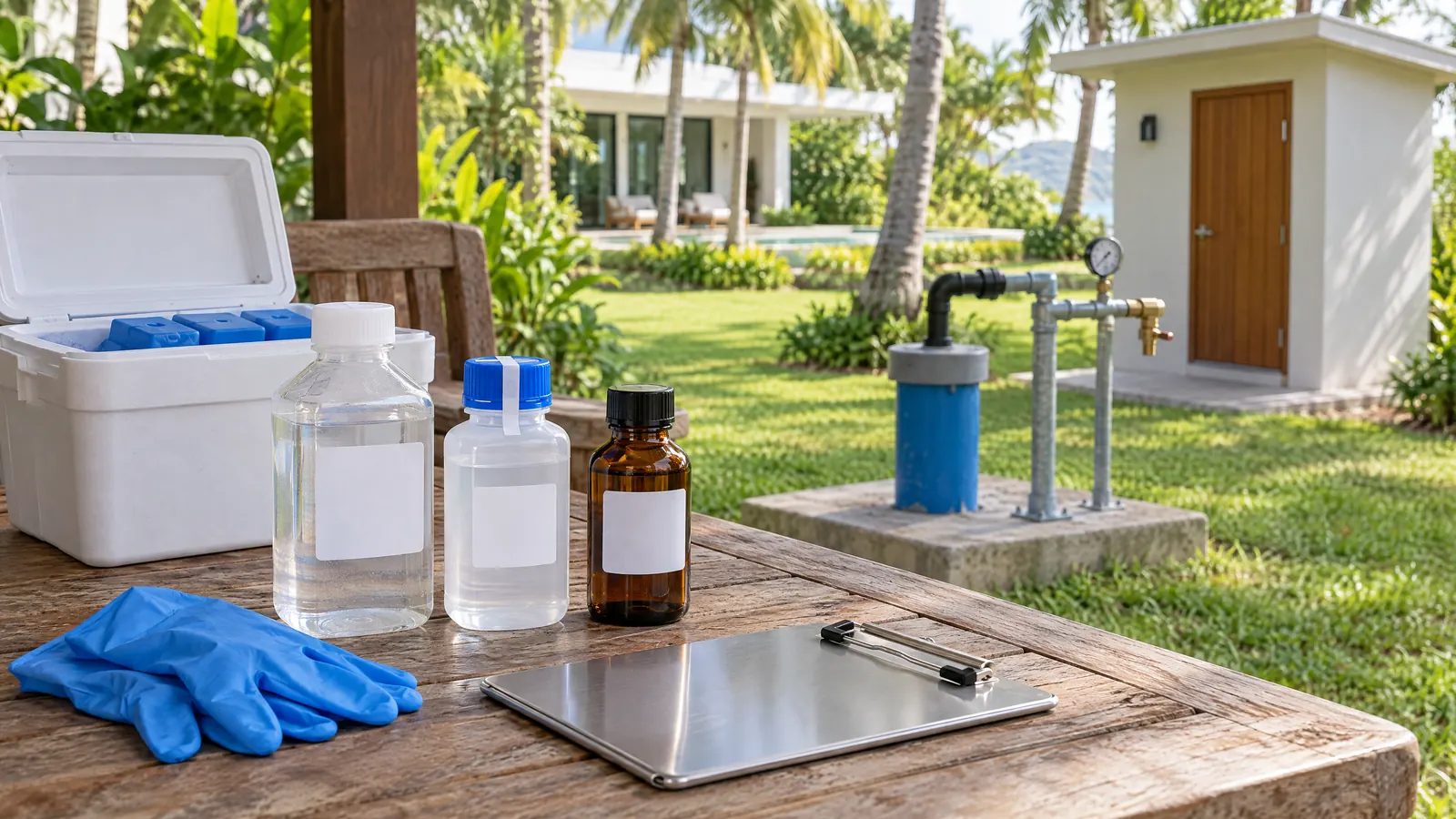
A few simple observations sort many problems before any test. Orange marks in the toilet cistern from water that looked clear at the tap point to dissolved iron. White crust on a kettle is hardness, but near the coast a white residue can also be salt. A smell that comes only from hot taps usually starts in the water heater, not the well. A cloudy glass that clears from the bottom up within a minute is air, not dirt. Note where, when and on which taps you see the problem, take photos, and then confirm with a test of the raw water before anything is installed. Our guides to brown or orange water, hard water and limescale and sand or cloudy water explain the causes behind the three most common symptoms.
Salt is not a filtration problem
This is the one to be clear about before spending money. Salt in well water is dissolved, so it passes straight through sediment filters, carbon, iron media and softeners. A softener even adds sodium as it removes hardness. The treatment that does remove dissolved salt is reverse osmosis, which is normally fitted at a drinking-water point, produces a stream of reject water and needs pre-treatment. For a coastal well whose salinity is rising, the more important work is at the source: how hard and how long the well is pumped, and whether it is in the right place. Our guide to salty well water covers that side.
Bacteria have no symptom
Water can be clear, odourless and pleasant to drink while carrying bacteria from the surface. The only way to know is a microbiological test. If it shows contamination, disinfection is the treatment category, usually ultraviolet light, which needs clear water ahead of it and leaves nothing in the water to protect the tank and pipes downstream. Disinfecting water from a well that lets surface water in treats the result and not the cause, so the wellhead seal and its surroundings should be checked too, as our guide to protecting a well from surface contamination explains.
When the problem is the well, not the water
Some symptoms are the well telling you something, and filtration only hides them. Sand that keeps coming after the first weeks, a sudden change in colour or taste after heavy rain, or saltiness that creeps up through the dry season all deserve a look at the well before more equipment goes in. An inspection of the well is the right first step in those cases.
Drinking water is a separate decision
Not every problem needs treating at every tap. Sediment, iron and manganese, hardness that damages heaters, and bacteria in water used for showering affect the whole house. Moderate salinity, nitrate or a taste you only notice in a glass may only matter where people drink, and are often handled at a single kitchen point. Choosing which problems belong where keeps the equipment smaller and the running costs lower.
More than one problem at once
Wells on the island often have two or three of these at once: iron with hardness, or sediment with iron and a bacteria risk. Then the order of treatment matters as much as the choice. Sediment comes out first to protect what follows, iron before a softener, and disinfection last on clear water. How those stages are arranged, sized and maintained is the subject of our guide to whole-house filtration design.
Before you buy anything
Describe the symptom: which taps, hot or cold, all the time or after rain, since when.
Photograph stains, deposits and a glass of the water left to stand.
Test the raw water from the well, before any existing filter.
Ask what each piece of equipment will not remove, as well as what it will.
Ask what it needs to keep working: cartridges, salt, backwash water and drainage, lamp changes.
If something is wrong with your well water, send our filtration team a description of what you notice, a few photos, and any test results you already have. We will tell you which tests are worth doing before recommending any equipment.
Common questions
Can one filter fix every well-water problem?
No. Sediment, iron, hardness, taste, bacteria and salt are removed by different processes. An all-in-one cartridge does a little of one or two of them for a small flow. Matching treatment to the actual problem is cheaper over time.
Should filters be chosen before testing the water?
No. Symptoms point in a direction, but only a test of the raw water confirms the cause and the levels, which decide the type and size of equipment. Buying first often means buying twice.
Why does my well water smell of rotten eggs?
Usually hydrogen sulphide. If the smell comes only from hot taps, it normally starts inside the water heater rather than the well. If cold water smells too, the gas is in the well water and is treated by oxidation and filtration.