Deep well drilling quotes on Koh Samui: what a complete quotation should include
Two quotes for the same villa can be far apart and both be honest. The gap is almost always in what each one includes, and that is something you can check line by line before you sign.
October 1, 2026 · 8 min read
A deep well drilling quote is easy to misread. One contractor sends a single figure for 'drilling', another sends two pages covering casing, testing, a named pump and the pipe to your tank, and the first one looks like the bargain. It often isn't, because the two documents describe different end results: a cased hole in the ground in one case, water arriving at your taps in the other. This guide walks through what a complete quotation for a villa well on Koh Samui should cover, why prices between neighbouring plots differ so much, and the questions that make two quotes comparable.
We don't publish a price list here, and we'd be wary of anyone who quotes a firm figure for an island well without seeing the plot. What we can show is what goes into the number, so you can tell whether a quote covers it.
Why two villas get very different quotes
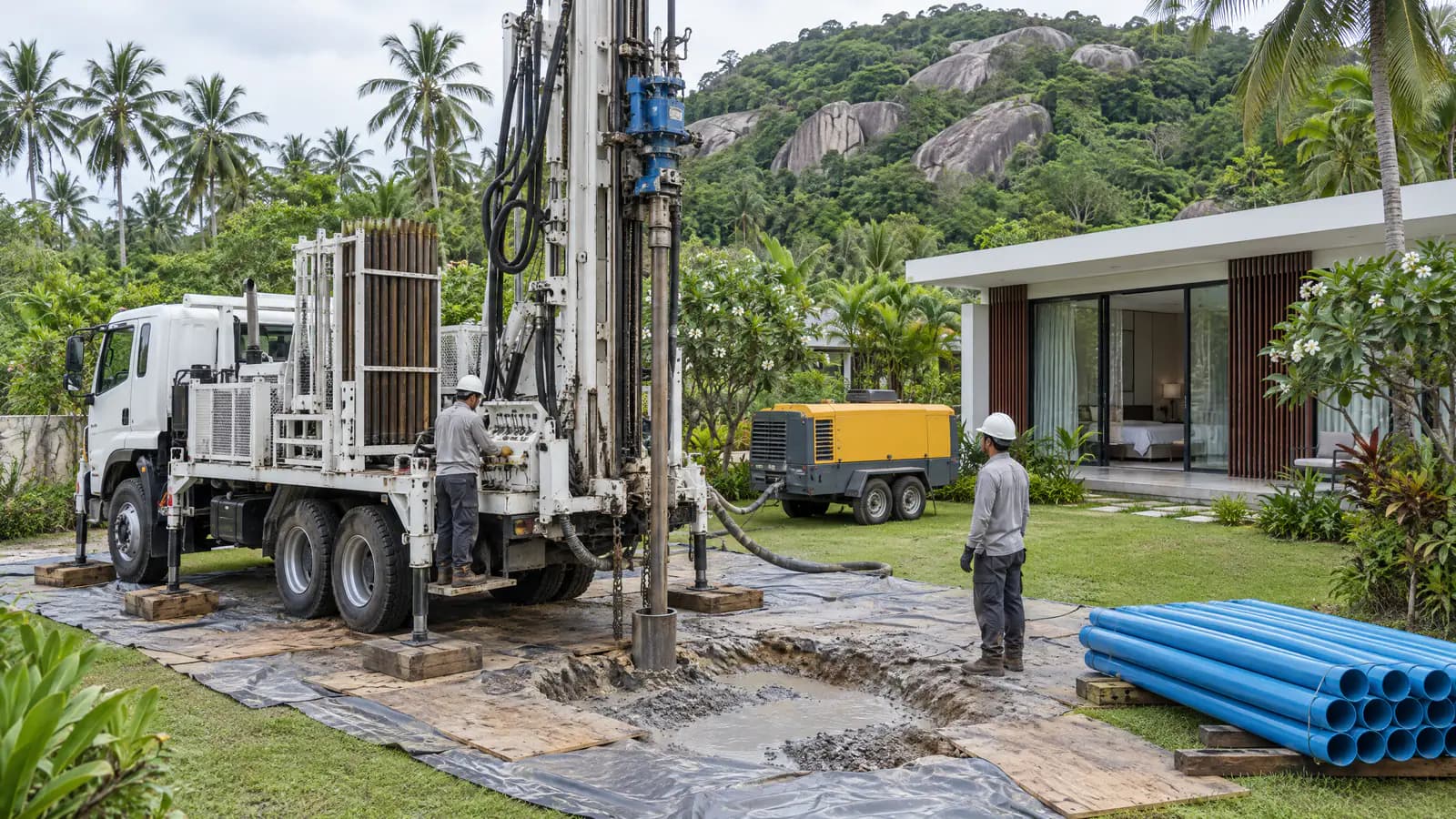
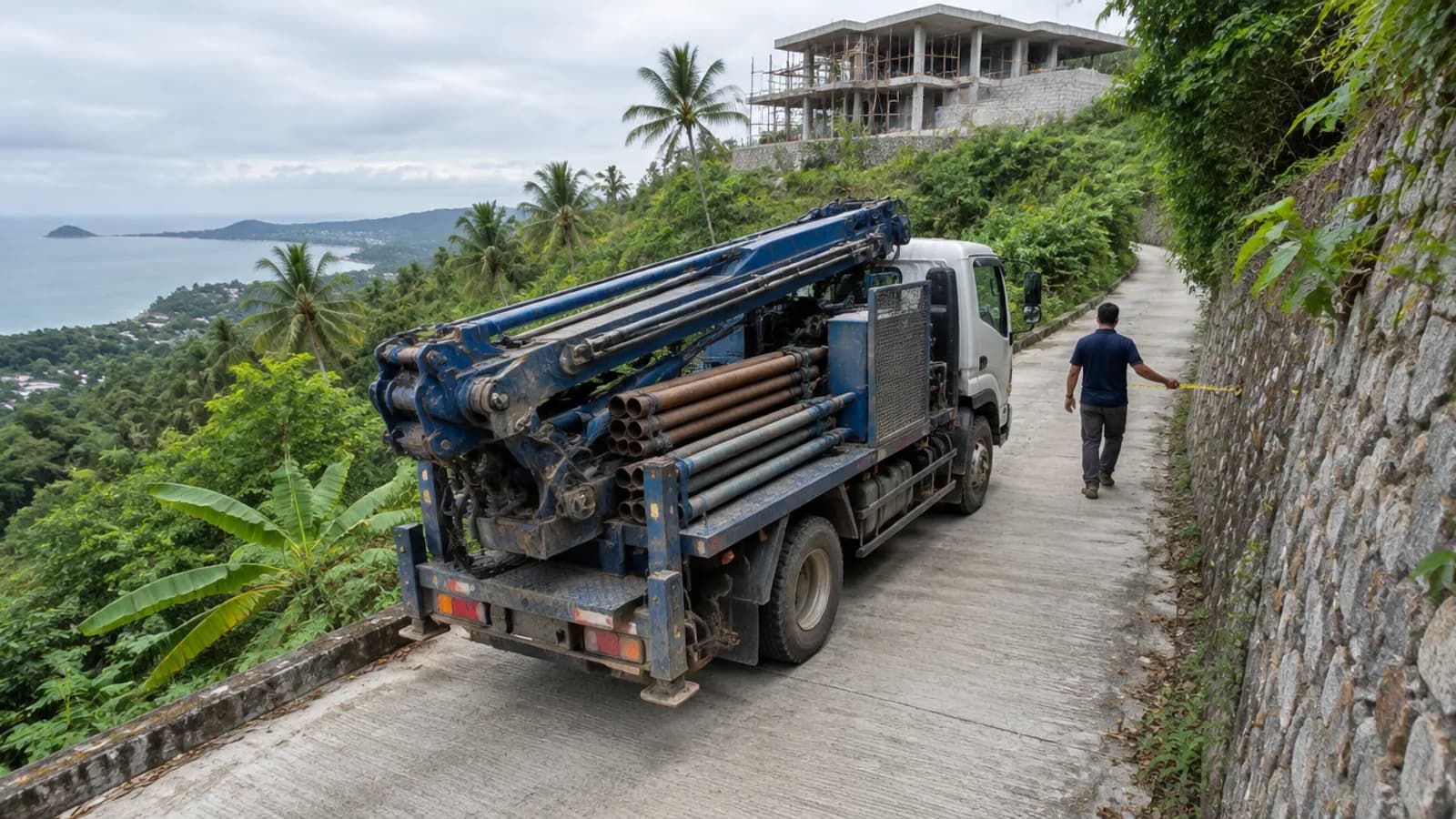
Picture two projects a short drive apart. The first is a house on the flat behind Maenam: a wide concrete driveway, soft weathered ground, a modest household demand and mains water as a fallback. The second is a five-bedroom pool villa on the hillside above Chaweng Noi: a steep, narrow soi, granite close to the surface, a garden to irrigate through the dry season, and the well expected to carry the whole property. Both owners ask for 'a well'. The second project needs a smaller rig or extra site preparation, likely more depth through harder rock, a stronger pump hung deeper, and more storage and pressure equipment at the top. Its quote will be higher, and it should be.
Depth, rock, access and casing are the main drivers, and they have their own article: what drives the cost of a well on Koh Samui. The rest of this page is about the paperwork: what a quote should spell out so you can see how those drivers were priced.
Access is priced, not assumed. A tight gate, a slope or a low cable decides which rig can reach the drilling point and how much preparation the day needs.
What a complete quotation should itemise
Anatomy of a quotation
Eight lines that make up the price of a villa well
The eight parts of a villa well that a full quotation prices. Each one moves with the conditions listed under it.
01
Survey, mobilisation and access
Getting the rig and compressor to the drilling point and set up level, including any site preparation.
Price moves with
Route and gate width
Slope and soft ground
Rig size that fits
02
Drilling to depth
The bore itself, usually priced per metre against an expected depth range, or as a total with a stated depth.
Price moves with
Final depth
Granite vs weathered rock
Bore diameter
03
Casing, screen and seal
The lining that keeps the bore open, the screened section that lets water in, and the seal that keeps surface water out.
Price moves with
Casing material
Diameter and length
Wellhead seal and pad
04
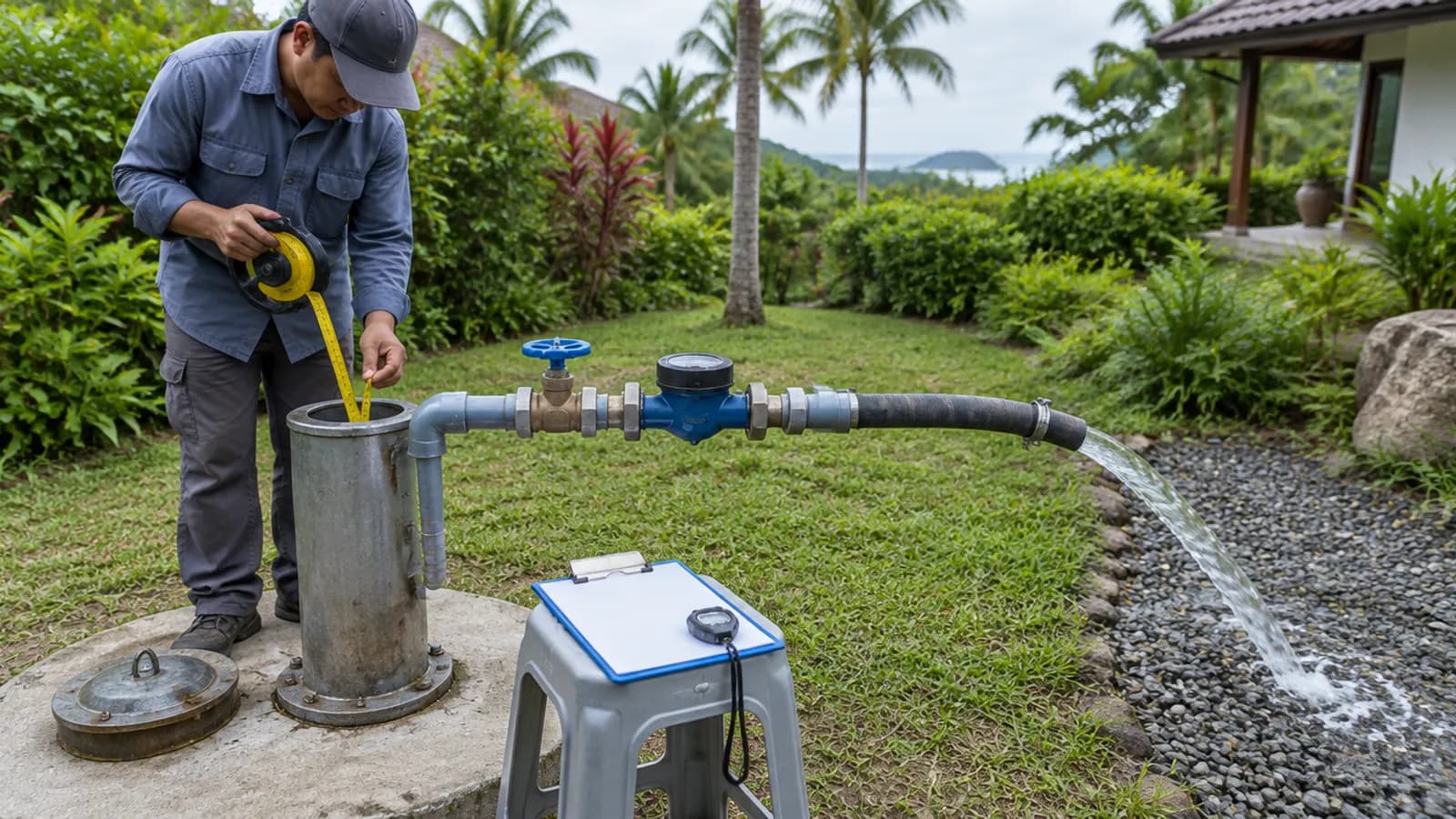
Development and yield test
Clearing drilling fines from the bore, then pumping at a steady rate to measure yield and drawdown.
Price moves with
How long the bore takes to clear
Test duration
05
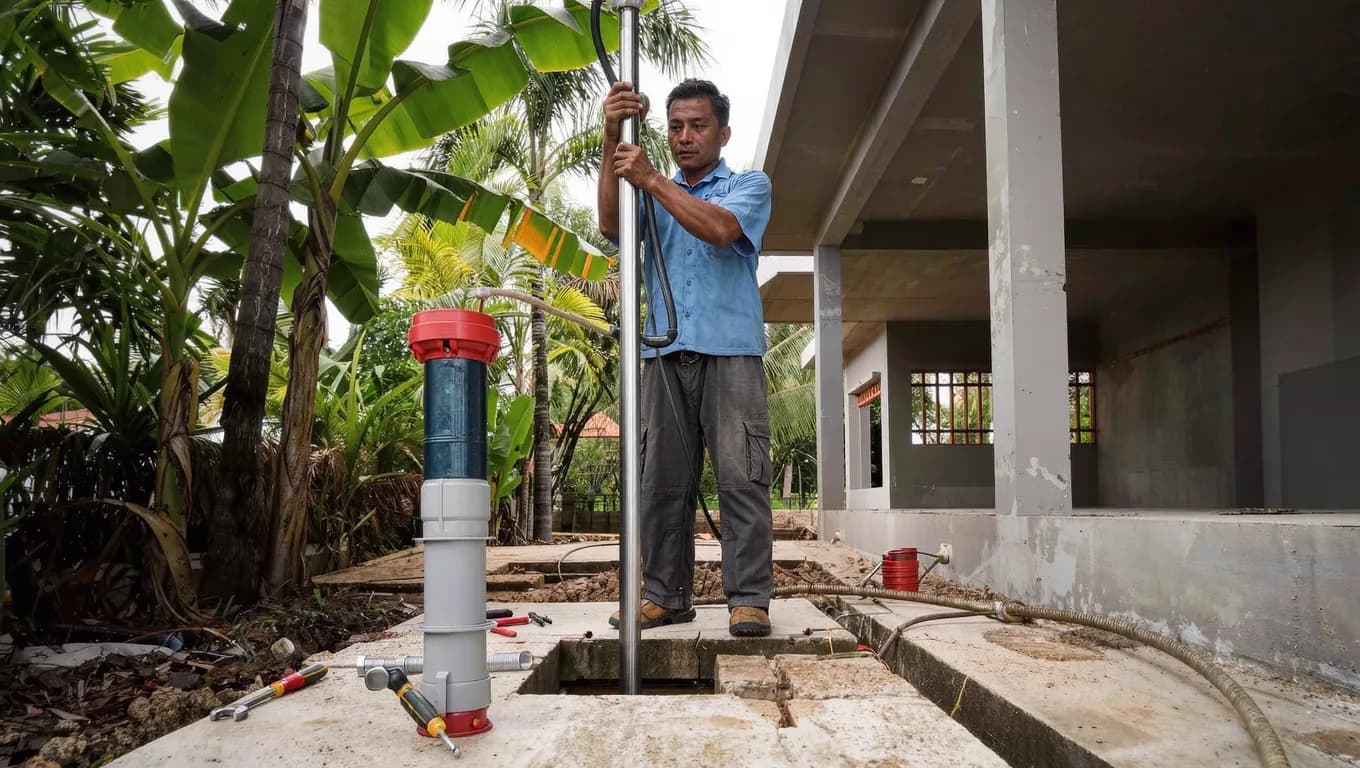
Submersible pump, cable and riser
A named pump model sized to the measured yield, hung at a stated depth on riser pipe with drop cable and safety rope.
Price moves with
Measured yield
Setting depth
Pressure needed at the house
06
Controls and electrical protection
Control box, dry-run and surge protection, and the cable run back to the property's electrical board.
Price moves with
Single or three-phase supply
Cable distance
Level controls
07
Storage, pressure and pipework
The line from wellhead to tank, the storage tank itself, and the pressure tank or booster set that feeds the house.
Price moves with
Tank volume
Pipe run length
Pressure equipment
08
Water test and treatment
A laboratory analysis of the new well, and treatment designed from its results if the water needs any.
Price moves with
Test parameters
What the results show
Whole-house or drinking point
Not every project needs every line. A good quotation still says which lines are included, which are excluded and which are provisional. Treatment is usually provisional, because it can only be sized after the water test.
Reading the lines where quotes usually differ
Depth: per metre, or one total?
Most island wells are quoted against an expected depth range, because nobody can see the fractures in the granite before drilling (our guide to well depths on Koh Samui explains why). A per-metre rate is transparent as long as the quote also states the expected range and what happens beyond it. A single total is fine too, provided it names the depth it covers. The quote to question is the one that says neither.
Casing: material, diameter and how far down
Casing is the part of the well you can't upgrade later without starting again, and it is the classic place for a low price to come from. A useful quote names the material, the diameter and roughly how much of the bore will be cased, plus how the top is sealed against surface water. A larger diameter costs more but leaves room for a bigger pump if demand grows. What casing, screen and seal actually do underground is explained in inside a deep well.
Development and test pumping: included or missing?
A bore that has not been developed sends fine sediment into the house and wears out its first pump. A bore that has not been test-pumped leaves the pump size to guesswork. Both cost time on site, and both are easy to leave off a quote to make it shorter. You want development included, a test of stated length, and yield and drawdown recorded in writing.
The pump: a model, not 'pump included'
'Pump included' tells you nothing about size, materials or how long it will last. A complete quote names the model and the setting depth, and the sizing should follow from the yield test rather than precede it. Some contractors quote the pump as provisional for that reason, which is honest. Our guide to choosing a submersible deep-well pump covers what the sizing should be based on.
From the wellhead to the house
Trenching, pipe to the tank, the tank, and the pressure equipment that feeds the taps are often quoted separately or by another trade. That is fine, as long as you know who is doing it. When nobody quotes the connection, the well is finished and the house still has no water. Tank sizing and pressure have their own guides on storage tank size and pressure tanks.
A drilling-only quote vs a complete system quote
Drilling-only quote
Complete system quote
What you have at the end
A cased hole
Water at the taps, with figures on paper
Casing and seal
Sometimes unspecified
Material, diameter, depth and seal stated
Development and yield test
Often missing
Included, with yield and drawdown recorded
Pump and controls
Separate purchase
Named model, setting depth, protection
Connection to tank and pressure
Another trade
Included or clearly excluded
Water test
Rarely
Included, with treatment advised from the results
If the system underperforms
Each trade points at the next
One contractor owns the result
A drilling-only price isn't dishonest. It just answers a different question. The missing lines come back later as separate purchases, often bought in a hurry, sized without test data, and installed by someone who never saw the well being drilled. Compare quotes on what you have at the end of each, not on the first number you see.
What a contractor needs from you for a useful estimate
You'll get a far better first estimate, and a shorter survey visit, if you send these with your enquiry:
The plot location as a map pin, and which area of the island it is in
Photos or a short video of the route in: the soi, the gate, the driveway and any overhead cables or low branches
Where you'd like the well, and where the tank or pump room will be
What the water is for: the house only, or also a pool, a garden or guest units
Bedrooms and typical occupancy, so demand can be estimated
Your current supply: mains, delivery trucks or an existing well, and how well it copes in the dry season
Anything known about wells on neighbouring plots: depth, yield, water quality
The electrical supply on site, single or three-phase, if you know it
Where the build stands, if the property is still under construction
Questions to ask a drilling contractor
What depth range do you expect on this plot, and how is drilling beyond it priced?
What casing material and diameter will you use, and how much of the bore will be cased?
How will the top of the well be sealed against surface water?
Is development included, and how will we know the water has cleared?
How long is the yield test, and will I receive yield and drawdown in writing?
What happens if the well is dry or low-yielding at the expected depth?
Which pump model, at what depth, and why that size?
What electrical protection is included against dry running and voltage spikes?
Is a laboratory water test included, and which parameters does it cover?
What warranty covers the workmanship and the pump, and who services the system afterwards?
Question 6 matters most. Groundwater on the island sits in fractures, not in a lake, and even a careful survey reduces the risk of a poor well without removing it. A contractor who explains in writing what happens in that case, whether that means drilling deeper within an agreed limit, moving to a second spot or a reduced charge, is one you can plan around.
Planning a new well? Send us your location and project details for an assessment: a few photos of the access and a note on what the water is for are enough to start. After a site survey we provide a fixed, itemised quotation for deep well drilling and everything up to the tank, with each line above either priced or clearly excluded.
Common questions
Is it better to choose a per-metre price or a fixed total?
Either can be fair. A per-metre rate shows exactly what you pay for, but needs a stated expected depth range and a rule for going beyond it. A fixed total gives certainty, but should state the depth it covers. Neither is fair without those details.
Can the well be drilled now and the pump installed later?
Yes, and it's common during construction. The well should still be developed, test-pumped and capped securely when it is drilled, so the pump can be sized from real figures when the time comes and nothing falls into the bore meanwhile.
Why is the treatment line often marked provisional?
Because treatment can only be designed after a laboratory test of the new well's water. A quote that specifies a full filtration package before the well exists is guessing. See how well water testing works.