Inside a deep well: casing, screen, seal and pump explained
Once the rig leaves, almost all of your well is out of sight: tens of metres of pipe, gravel and seal that decide whether it gives clean water for decades or sand within a few years. This is what should be down there, and why.
October 3, 2026 · 9 min read
Most owners only ever see the top 40 centimetres of their deep well: a capped pipe on a concrete pad. Everything that decides how well it works is below that. The lining that stops the bore collapsing, the screen that lets water in and keeps sand out, the seal that keeps surface water from running down the outside, and the pump hanging at a carefully chosen depth inside. This guide takes a finished well from the top down. Knowing what each part does makes a quotation readable and a contractor's choices easier to question. The days on site are covered separately, in what happens on your property during drilling.
Cross-section
Anatomy of a finished deep well
A typical cased and screened well in Samui ground. Real wells vary with depth, rock and design; the parts are the same.
1
Well cap and concrete pad
Seal the top against rain, run-off, insects and debris, and slope water away from the casing.
2
Grout seal
Cement or bentonite filling the gap between casing and borehole near the surface, so surface water can't run down the outside.
3
Casing
The pipe lining the bore through soft and broken ground so it can't collapse.
4
Static water level
Where the water stands when the pump is off.
5
Riser pipe, cable and safety rope
Carry water up, power down, and hold the pump if anything fails.
6
Submersible pump
Set in plain casing, below the lowest pumping level and above the screen.
7
Pumping level
How far the water drops while the pump runs. Measured in the yield test.
8
Screen
Slotted casing set against the water-bearing zones, letting water in while holding back the formation.
9
Gravel pack
Clean, graded gravel around the screen that acts as a natural filter.
10
Water-bearing fractures
Cracks and weathered zones in the granite that actually carry the water.
11
Sump and end cap
A short closed length below the screen where settled fines collect, away from the pump.
Schematic, not to scale. In sound granite some wells are left as open hole below the casing; in weathered or broken ground the full depth is cased and screened.
The borehole and the ground it passes through
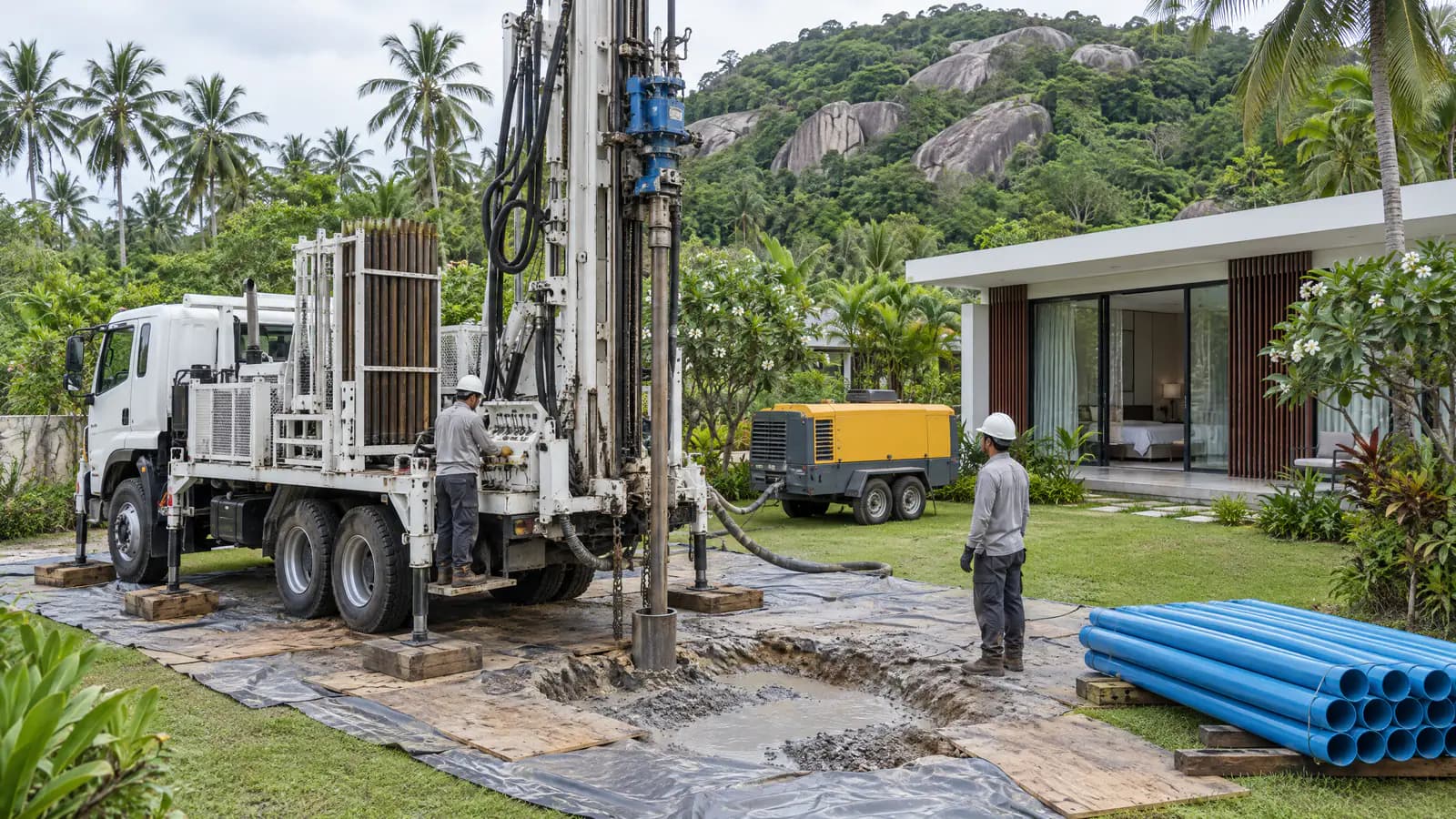
A typical Samui bore passes three kinds of ground: topsoil or sand, then weathered granite that is soft and can cave in, then harder granite where water moves through fractures. The driller logs the cuttings as the bore deepens, noting each change of rock and each point where water comes in. That log is the most useful document a well has, because every later decision builds on it: where the screen goes, how deep the pump hangs, why the well behaves the way it does. Depth varies a lot across the island; see how deep wells go on Koh Samui.
Casing: the lining that keeps the well open
Casing is the pipe that lines the bore. On Samui it is usually PVC made for wells: it doesn't corrode, it is light enough to handle in long strings, and it comes in pressure classes chosen for the depth. Steel is stronger but can corrode in some water. The lengths are joined as they go down and kept central in the bore so the seal and gravel can surround them evenly. Casing is the part of a well that can't be upgraded later without drilling again, which is why it deserves a line of its own in any drilling quotation.
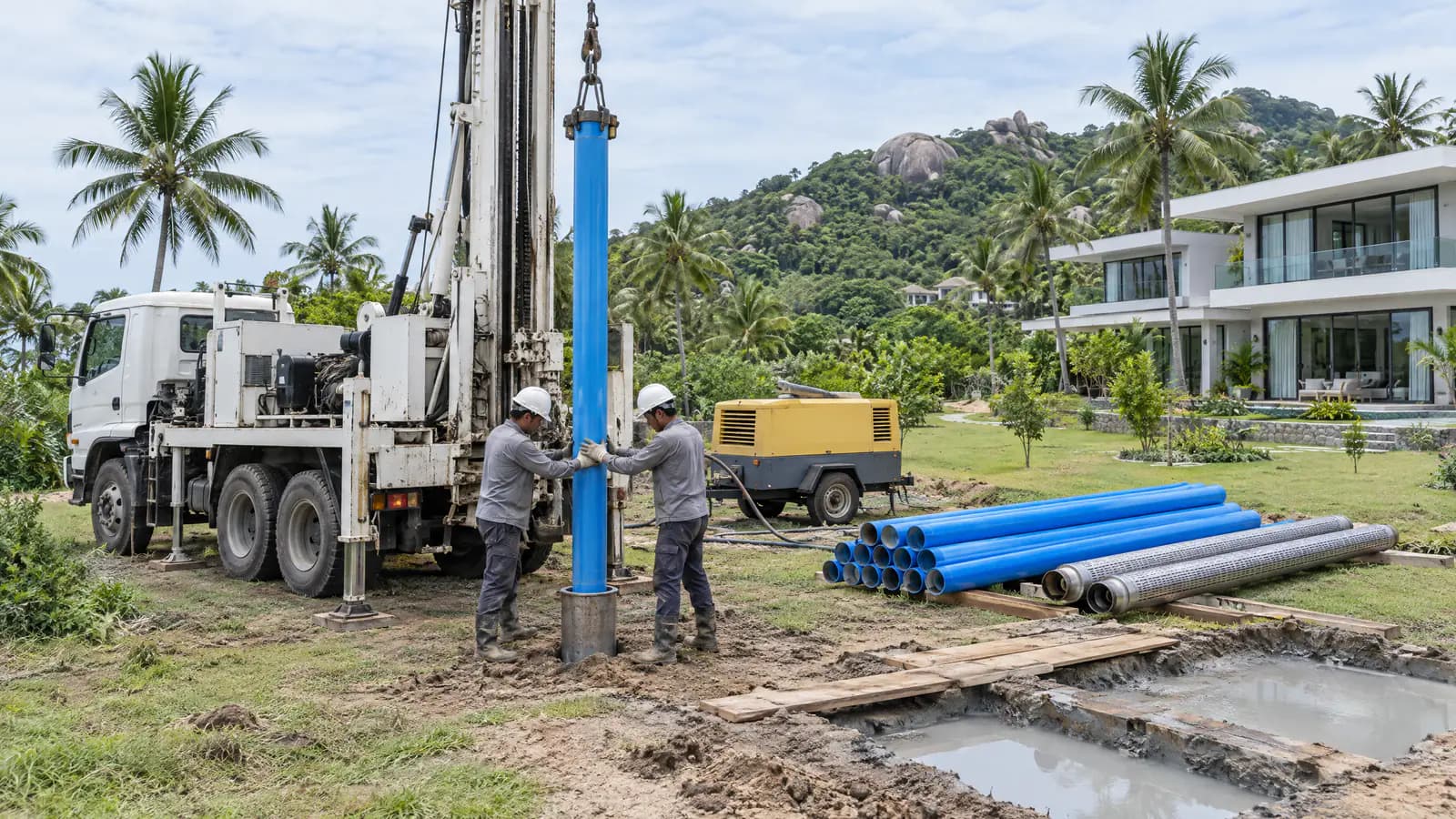
Casing going in: each length hangs from the rig and is guided down the bore by hand. Screens and further casing wait on the timber behind.
Screen: where the water gets in
The screen is casing with precise slots, placed against the water-bearing zones the driller found. The slot size is a balance. Too wide and fine sand comes through with the water; too narrow and the well can't deliver what the ground offers. Screens are positioned from the drilling log, not at a standard depth, which is one reason two wells on neighbouring plots end up built differently. In solid granite, some wells are left as open rock below the casing because the rock can't collapse. In weathered or broken ground, screen and casing run to the bottom.
Slotted screen, plain casing, end cap and gravel pack ready to go in. The slots and the gravel work together to let water in and keep the formation out.
Gravel pack and the grout seal
Around the screen, the gap between casing and borehole is filled with clean, rounded, graded gravel. This gravel pack holds the surrounding ground in place and filters it, so the screen sees water rather than silt. Above the water zones, near the surface, the gap is filled with a grout seal of cement or bentonite. It is a small part of the job with a big effect. Without it, rain and run-off can travel straight down the outside of the casing into the water, which is why cloudiness after storms often points at the seal (see sand or cloudy water from a deep well). The concrete pad and a proper cap finish the top. Keeping the top of an existing well protected is covered in protecting a deep well from surface contamination.
Development: cleaning the well before it is used
Drilling leaves fine material in the gravel pack and the surrounding ground. Development pumps and surges the well until the water runs clear and the formation around the screen settles into a stable natural filter. A well that skips this sheds silt into the house for months and wears out its first pump early. The yield test that follows records how much water the well sustains and how far the level drops, which sets everything about the pump. Our guide to how much water a well will produce covers what that test should record.
Where the pump sits
The pump hangs inside the casing on its riser pipe. Its depth is chosen from the test, not by lowering it as far as it will go. It should sit below the lowest level the water falls to while pumping, with margin for the dry season, and above the screen and the sump so it isn't drawing in settled fines. A submersible motor is cooled by water flowing past it. Where a pump must sit below the screen or in open rock, a flow sleeve keeps that cooling flow moving.
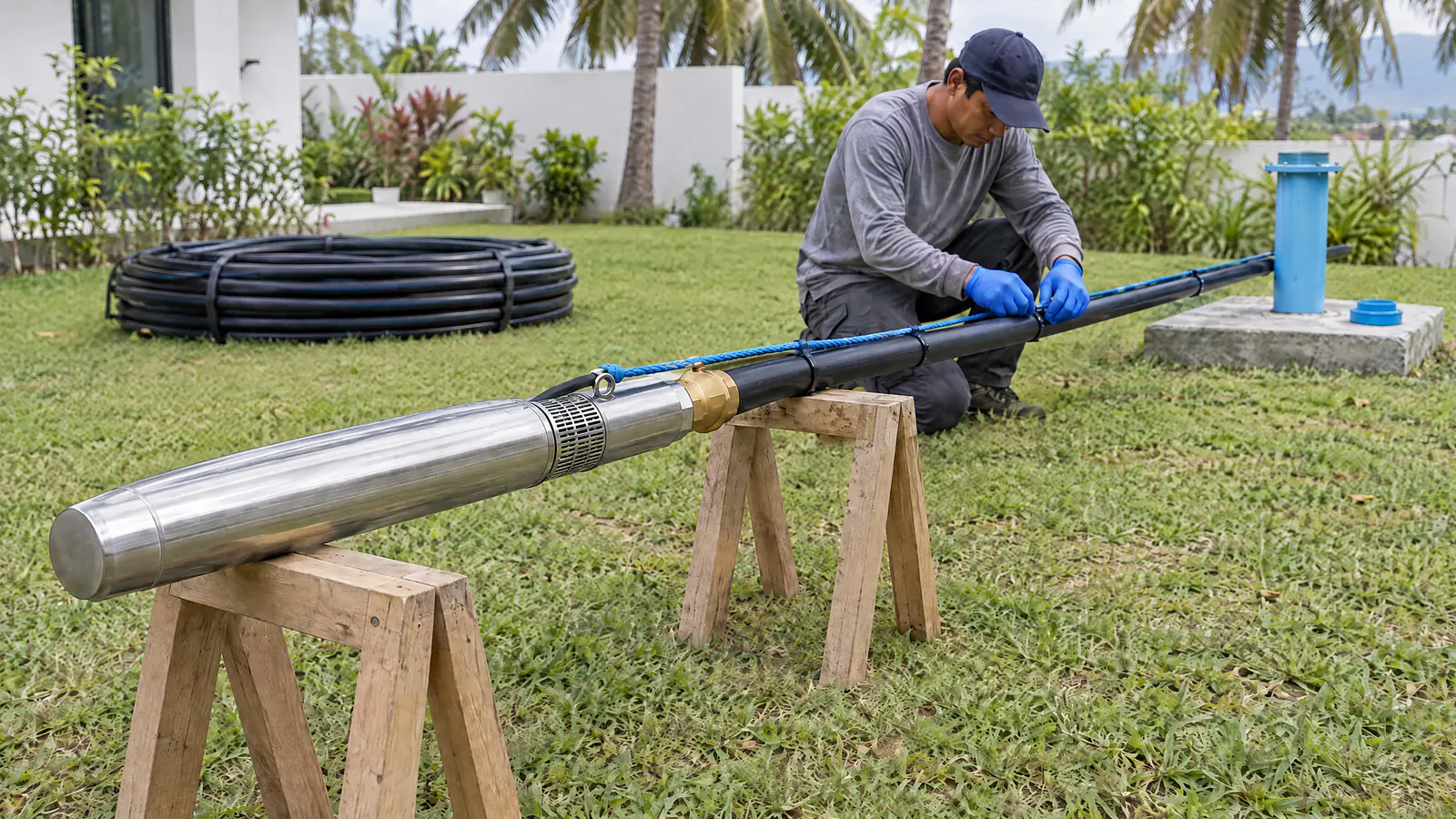
Before it goes down: the cable fixed to the riser at regular intervals, a check valve at the discharge, and a safety rope tied to the pump.
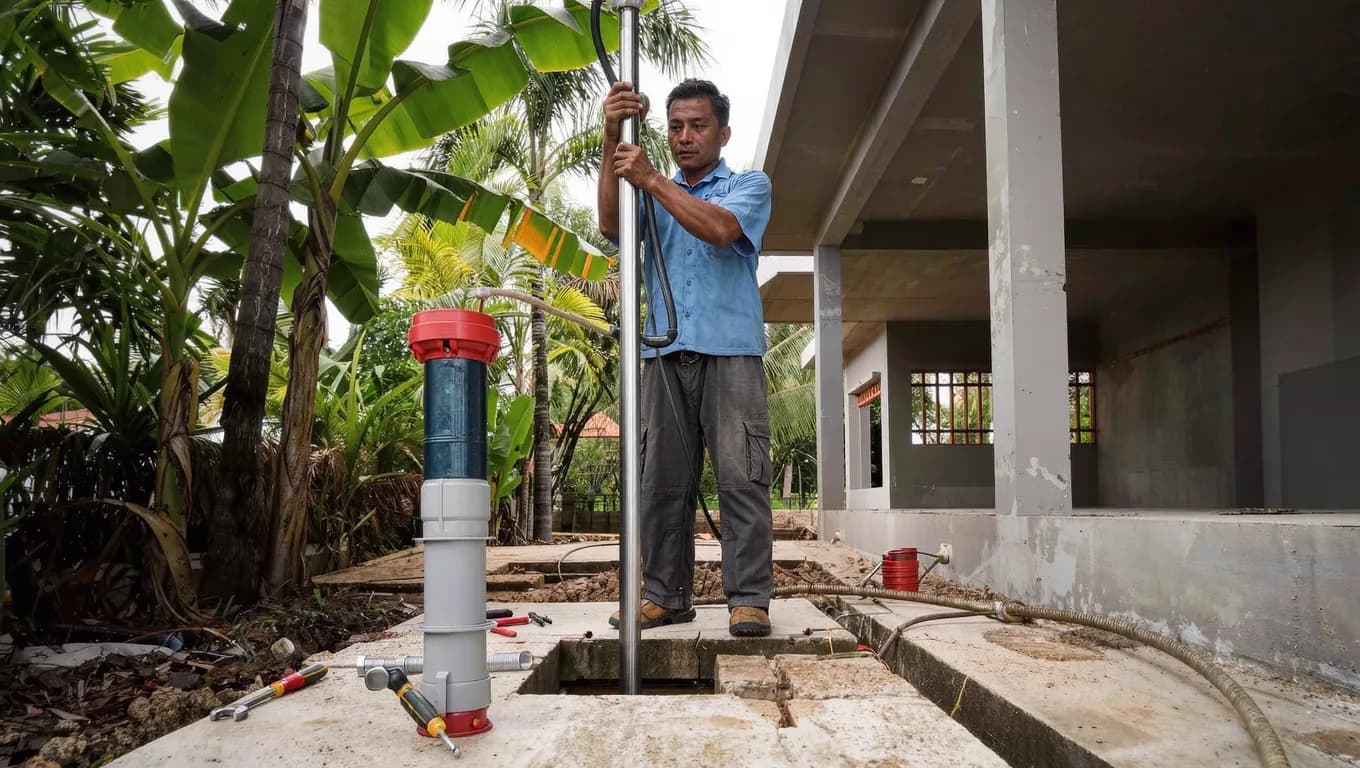
Above it run the riser pipe, the drop cable with a properly sealed waterproof joint, and a safety rope tied to the pump so it can always be recovered. A check valve at the pump keeps the column full when it stops. Sizing the pump itself, flow and head against the well and the house, is covered in choosing a submersible pump.
4-inch or 6-inch: choosing the bore diameter
4-inch casing
6-inch casing
Pump that fits
3-inch pumps comfortably; 4-inch pumps with very little clearance
4-inch pumps with room for the cable, a flow sleeve or a larger pump later
Typical use
Households with modest demand on a well with modest yield
Villas with pool and garden, multi-unit properties, resorts
Drilling and casing cost
Lower
Higher: a larger bore and more material
Servicing
Tight; a pump can jam during removal
Easier to pull the pump and to inspect by camera
Later options
Limited if demand grows
Room to upgrade the pump
Sizes are nominal; the inside diameter depends on the casing's wall thickness. The practical question is what pump the well will need, and whether there is room for it, its cable and a margin to get it out again in ten years. For a villa with a pool or a garden to water, the larger bore usually earns its cost back in flexibility.
What to ask for in writing
The drilling log: depth, the ground at each depth, and where water came in
Casing material, diameter, pressure class and total length
Screen positions and slot size, gravel pack interval and grout seal depth
Static water level, yield and drawdown from the test
Pump model, setting depth, cable size and riser material
Those few pages are what any future technician needs, and they are what a buyer will ask about if the villa is ever sold. Our guide to borehole maintenance explains how they are used over a well's life.
Want the casing, screen and pump specified for your plot rather than a standard package? Send us your project location and site details so we can review access and requirements. After a survey we specify the casing, screen, seal and pump for the plot and put each one in the deep well drilling quotation.
Common questions
Can well casing be repaired or replaced later?
Some damage can be repaired, for example by sleeving a short section with a smaller liner, but that reduces the diameter. Replacing casing usually means drilling a new well. That is why casing is worth getting right the first time.
Why not leave the whole well uncased in hard granite?
The upper part of almost every Samui bore passes soil and weathered rock that can collapse, and it is where surface water must be sealed out. Below that, sound granite can sometimes be left open; weathered or broken rock can't.
Does the pump have to sit at the bottom of the well?
No, and it usually shouldn't. It hangs below the lowest pumping level with a margin, but above the screen and the sump so it doesn't draw in settled sediment.