What actually changes the cost of drilling a well on Koh Samui
There is no honest average price for a villa well on the island, because the bill is built from parts that change plot by plot. This guide takes the cost apart: which parts are fixed, which grow with every metre, which can only be confirmed once the bore is going down, and which of them you can influence before the rig arrives.
July 1, 2026 · 9 min read
Owners usually ask for a number before anything else, and the honest answer is a structure rather than a figure. A well is paid for in three kinds of money: a fixed part that covers getting the rig to the plot and set up, a part that grows with depth, and a part for everything that turns a hole into a water supply. The first is decided mostly by the road to your plot. The second is decided by the rock under it, which nobody sees until the bit is in it. The third is decided by how deep the water ends up standing and how far the wellhead is from the house. Knowing which part a line belongs to tells you how much it can still move.
Three kinds of cost in one well
Fixed costs are the same whether the well ends at forty metres or a hundred: the survey, moving the rig and its support truck to the island site, setting up, the wellhead and its seal, and the paperwork at the end. Per-metre costs are the drilling itself and the casing that lines the unstable part of the hole; they scale with depth and with how hard the ground is. System costs are the pump, the cable and pipe that hang it, the controls and protection, and the connection to storage and the house. Those depend less on how deep the bore is than on where the water level settles, because that sets the pump depth and the head it must lift against.
Cost structure
What changes the final cost of a well
Six groups of cost, in the order they are decided. The first and last are known before drilling; the middle ones firm up as the bore goes down.
1Site
2Depth
3Bore
4Pump
5System
6Access
/
Fixed, per metre, or provisional
Every line in a drilling price is one of the three. A clear quote says which, and what happens when a provisional line turns out larger or smaller.
01 · Site
Site and survey
Where the drilling point can go, its distance from septic and drainage, and what the ground looks like at the surface.
02 · Depth
Depth and geology
How deep the bore must go to reach water that holds up under pumping, and how hard the rock is on the way.
03 · Bore
Bore and casing
Bore diameter, casing material and how many metres of casing the loose ground needs.
04 · Pump
Pump and electrical
Pump size and setting depth, the cable and riser that reach it, the control panel and its protection.
05 · System
Connection to the villa
The run from the wellhead to the tank and pump room, storage, pressure equipment and any treatment the test calls for.
06 · Access
Access and mobilisation
Getting the rig onto the plot: road width, slope, pad cutting, and how long setting up takes.
Known before drilling
Site, access, mobilisation, casing specification, the wellhead, the connection route and the pump and controls package.
Confirmed as the bore goes down
Final depth, casing length, development time and the pump setting depth, priced per metre or as a stated provisional line.
No figures are given here on purpose: rates change with the rig, the season and the site, and a number without the site behind it is not useful.
Access is decided before the rig moves
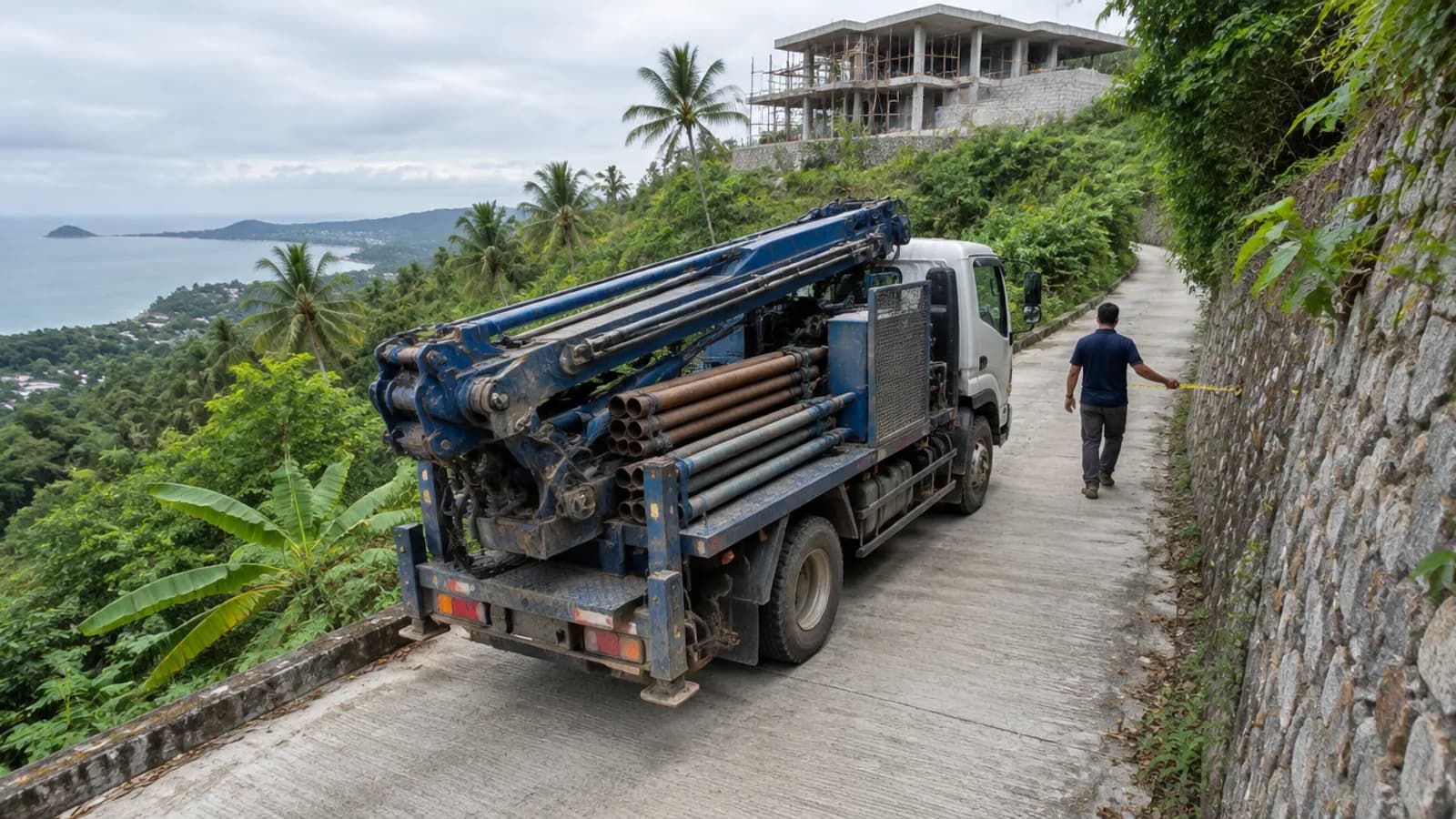
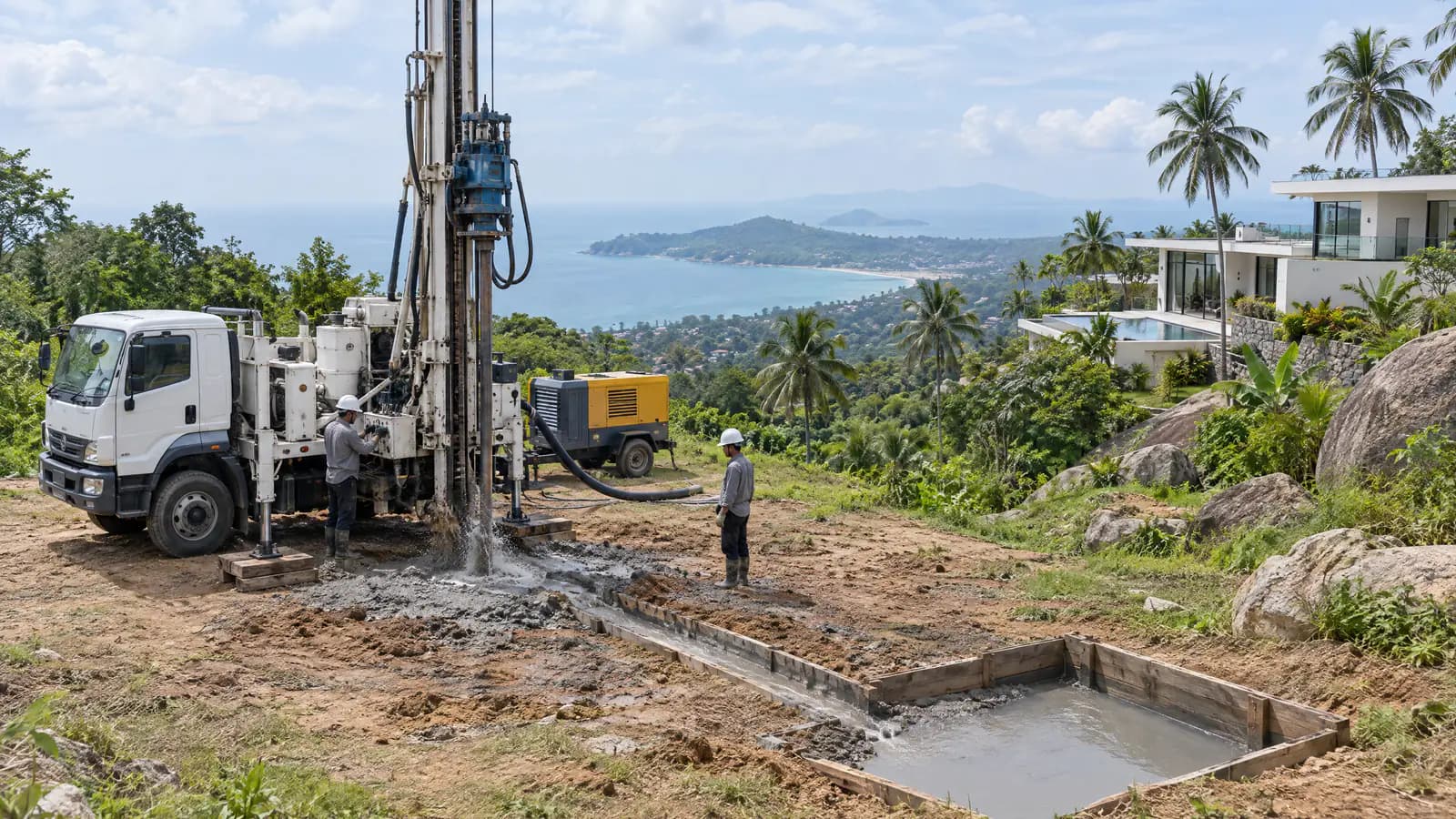
On a flat plot by a main road, mobilisation is a short line. On a Samui hillside it can be the line that surprises people most. A truck-mounted rig needs a road wide enough for the truck and firm enough for its weight, corners it can turn, overhead clearance under cables and branches, and a level pad at the drilling point big enough for the rig, the rods and a pit for the cuttings and water. When the soi is too narrow or too steep, the options are cutting and levelling a pad, widening a corner, bringing in a smaller tracked rig that drills more slowly and has less depth capacity, or choosing a different drilling point that the rig can actually reach. Each of those is time, and time on a rig is the most expensive unit in the job.
Choosing the drilling point is a cost decision as much as a technical one: a level pad the rig can reach, clear of the septic tank and drainage, can save a day of site work.
Much of this is in the owner's hands. A pad cut while an excavator is already on site for the villa costs a fraction of one cut for the rig alone. Moving the drilling point a few metres to where the rig can stand on firm ground is often possible without changing the well. Our guide to preparing a site for drilling covers the route, the space and the timing in detail.
Depth and geology: the part nobody can price exactly
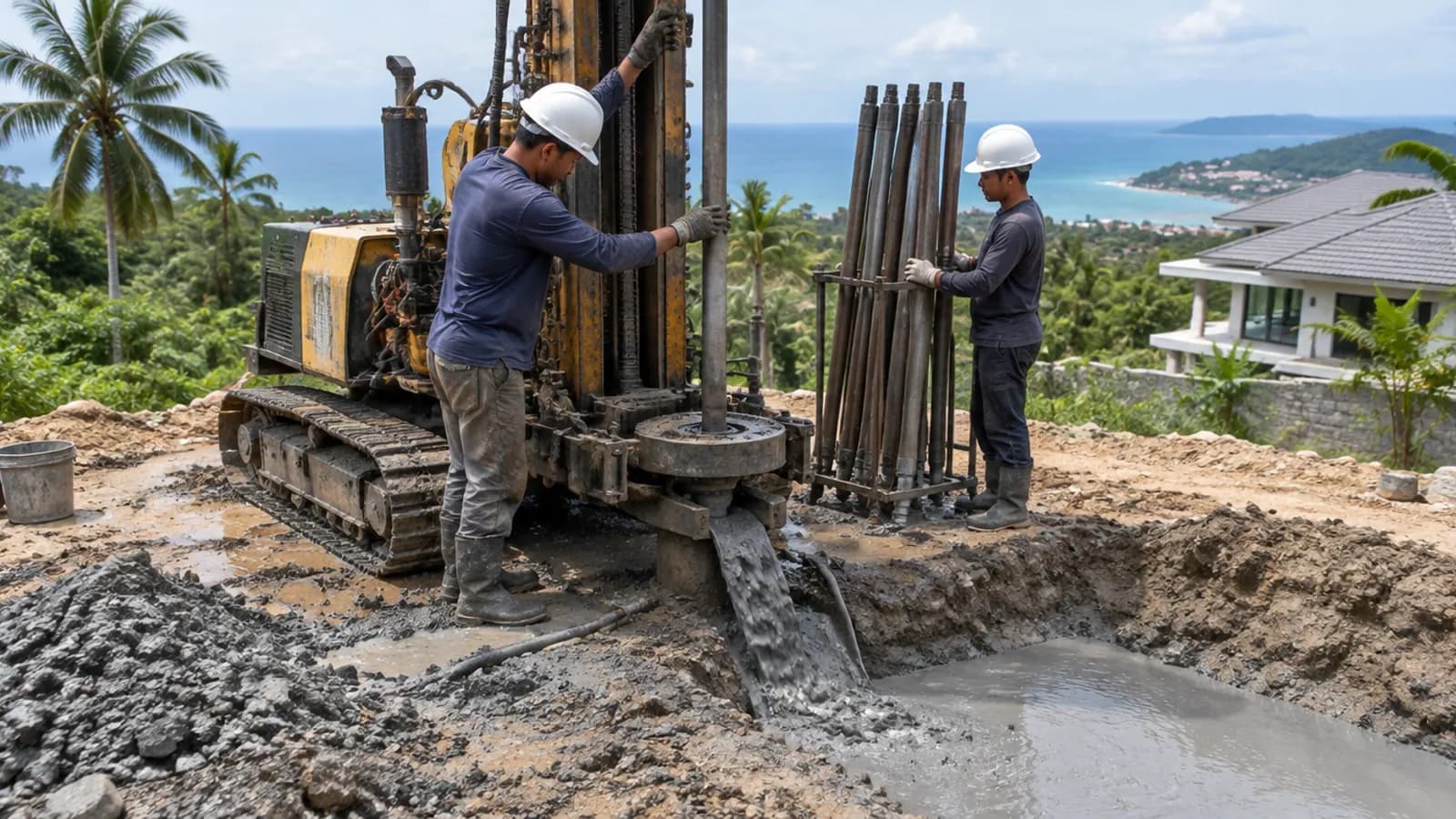
Under most Samui plots the drill passes through soil and clay, then weathered granite that crumbles and can collapse into the hole, then harder rock where water sits in fractures. How thick each layer is, how hard the rock is and where the useful fractures are vary over short distances. Weathered ground drills quickly but needs casing; hard granite needs no casing but wears bits and drills slowly. The depth at which the bore meets water that holds up under pumping is found while drilling, not on a map. That is why the depth part of any honest price is either a rate per metre within an expected range or a depth band with a stated rate beyond it. Our guide to how deep wells are on Koh Samui explains how that decision is made at the rig.
Bore diameter and casing follow what the well must do
A wider bore costs more per metre to drill and needs larger casing, but it leaves room for a larger pump, for a pump that has to sit deep, and for future work inside the well. A villa that only needs household water can often use a smaller bore than a development or a property that will run a pool and a garden from the same well. Casing is priced by the metre and by material; how many metres it takes depends on how deep the loose ground goes, which is again only certain once drilled. What should be fixed in advance is the specification: diameter, material and how the top is sealed. Our guide to what is inside a deep well explains each part and why it matters.
After the hole: development, testing and the pump
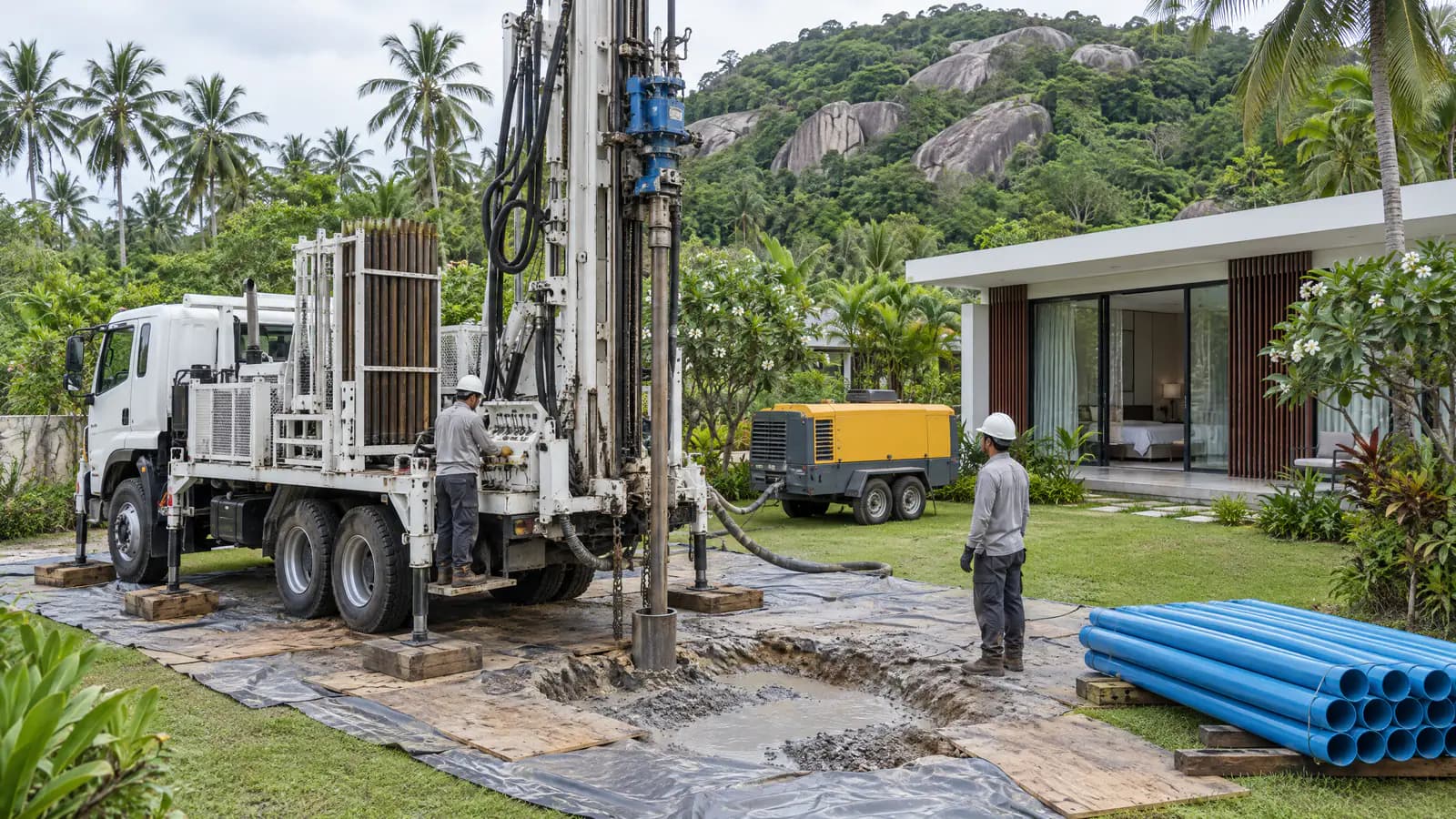
A freshly drilled well is full of fine cuttings and needs developing until the water runs clean; on some bores that takes an hour, on others most of a day. A proper yield test then pumps the well for hours while the water level is measured, and its result is what sizes the pump. A deep pumping level means a deeper pump setting, more cable and riser pipe, and a pump with more head. A long cable run on a single-phase supply may need a larger cable to keep voltage at the motor within range. The control panel and its protection, especially against dry running and voltage swings, are a modest line that protects the most expensive one. Our guides to choosing a submersible pump and to electrical protection cover both.
From the wellhead to the villa
The well is usually not where the pump room is. On a sloping plot the pipe and cable from the wellhead may need trenching across terraces or under paving, and the wellhead itself needs a protected finish. Storage, a pressure pump and any treatment the water test calls for are their own lines. A quote for drilling alone and a quote for a working water supply can therefore differ by more than the drilling itself, which is the most common reason two prices for the same plot look far apart.
Cost driver
Why it moves the price
Known before drilling?
Access and mobilisation
Road width, slope and pad work decide the rig, the set-up time and any site work
Yes, from the survey
Drilling depth
Charged per metre or by depth band; hard rock drills slower
As a range only
Casing length
Loose ground must be cased; its depth varies plot to plot
As a range only
Bore diameter and casing material
A wider bore and heavier casing cost more per metre
Yes, as a specification
Development and yield test
Hours of rig and pump time until the water clears and the test ends
Duration agreed; actual time varies
Pump, cable and riser
Set by the pumping level and the head to the tank
Package yes, setting depth after the test
Control panel and protection
Dry-run, overload and surge protection for the pump
Yes
Connection to storage and house
Trench length, tank, pressure pump, treatment
Yes, once the layout is agreed
Two plots on the same hill
Take two villas a few hundred metres apart. The first sits on a flat garden plot beside a paved road: the rig drives in, weathered ground is thin, water is struck at a moderate depth and the wellhead is ten metres from the pump room. The second sits high on the same hill at the end of a narrow concrete soi: a pad has to be cut, a smaller rig is needed, the weathered layer is thick and needs more casing, the water stands much further below the wellhead so the pump sits deeper on more cable, and the pipe run to the plant room crosses three terraces. Neither quote is wrong; they are pricing two different jobs. The comparison that matters is not between the two villas but between two quotes for the same one, and our guide to comparing drilling quotes goes through that line by line.
What keeps the cost predictable
Send photos or a short video of the route in, from the main road to the drilling point. Access is the line most often underestimated.
Keep the drilling point flexible within the plot until the survey: a few metres can be the difference between a pad cut and no pad at all.
Plan drilling while earthworks are still happening, not after the landscaping is finished.
Agree in advance how depth beyond the expected range is charged, and what happens if a bore is dry or weak.
Decide whether you are buying a hole or a working water supply, and ask for the quote on that basis.
If you are planning a well, send the drilling team the plot location, a few photos of the access and what the property is: a single villa, a development or a resort. We will review what will affect the scope and visit the site before putting a price on it.
Common questions
Can you quote a well before knowing the final depth?
Yes, with the depth part stated as a range or a rate per metre. Everything decided by the site, such as access, set-up, casing specification, the wellhead and the pump and controls package, can be fixed in advance. Depth, casing length and development time are confirmed as the bore goes down, at the agreed rates.
Why can two nearby wells cost different amounts?
Because they are different jobs. Access, the thickness of weathered ground that needs casing, the depth of useful water, the pump setting depth and the distance from the wellhead to the house can all change within a few hundred metres on a hillside.
Does the pump normally come in the drilling quote?
Not always. Some quotes cover only the hole; others cover a working supply with the pump, cable, controls and connection. Ask which one you are looking at. The pump can only be sized properly after the yield test, so a complete quote usually names the package and confirms the setting depth after testing.