Buying a villa with a well on Koh Samui: what to check before you sign
"Own deep well" in a listing can mean a reliable borehole with ten years of records, or a hole in the garden with a tired pump and no history. A few days of checks before you commit tell you which, and what it will cost to live with.
October 7, 2026 · 9 min read
A private well adds real value to a villa on an island where mains water is unreliable and delivery trucks run short every April. It can also hide some of the most expensive surprises a buyer can inherit: a pump near the end of its life, water that stains every fitting, a well that runs dry with the villa full of guests. Unlike the roof or the pool, almost none of it is visible on a viewing. Here is what to establish before buying a villa with an existing well, and how to turn the findings into terms of the deal.
Start with the paperwork
Ask the seller for everything that exists about the well, the same way you'd ask for building permits:
The drilling log: depth, ground layers and where water came in
The test pumping report from when the well was finished: yield and drawdown
Previous water tests, with dates and the laboratory's name
Pump model, setting depth and installation date, plus any later replacements
Service records for the pump, controls, tanks and any filtration
Few villas on the island have all of these, and missing paperwork isn't a reason to walk away. It is a reason to measure rather than trust. Where documents do exist, they give the inspection something to compare against: a well that sustained a given flow when new and struggles at half that today is telling you something. Our guide to borehole maintenance explains why these two or three documents matter for the rest of a well's life.
What a pre-purchase well inspection measures
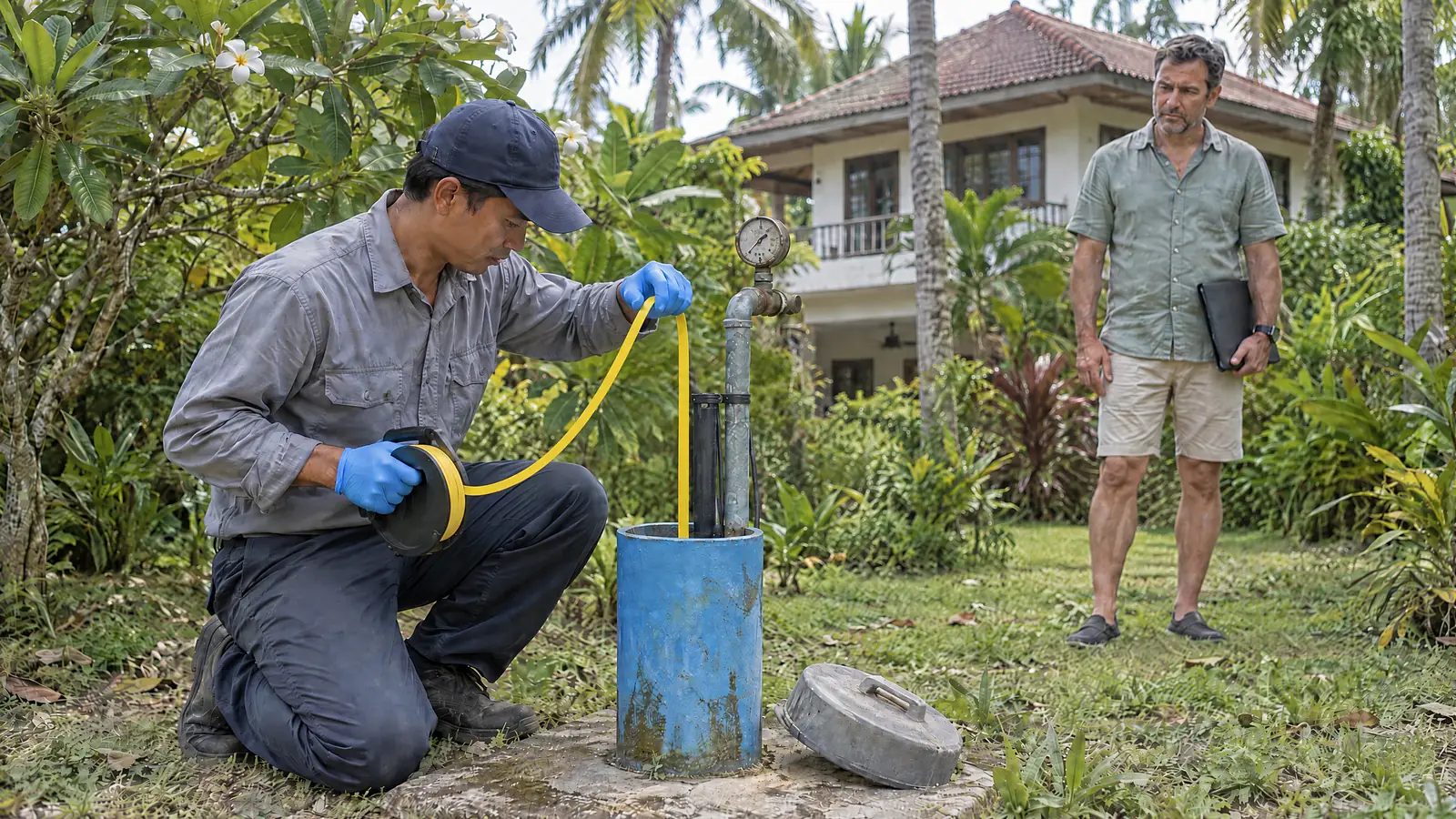
Static water level and total depth, measured with a dip meter and a sounding line, then compared with the drilling log.
A pumping test at the villa's real demand rate, held for hours rather than minutes, recording how far the level falls and how fast it recovers afterwards. A well can look strong for twenty minutes and fade after two hours; see how a well's yield is measured.
The pump's running current against its nameplate, and an insulation test on the motor and cable. Both show the motor's condition without pulling it.
The control panel and its protection: what is fitted, how it is set, and whether anything has been bypassed.
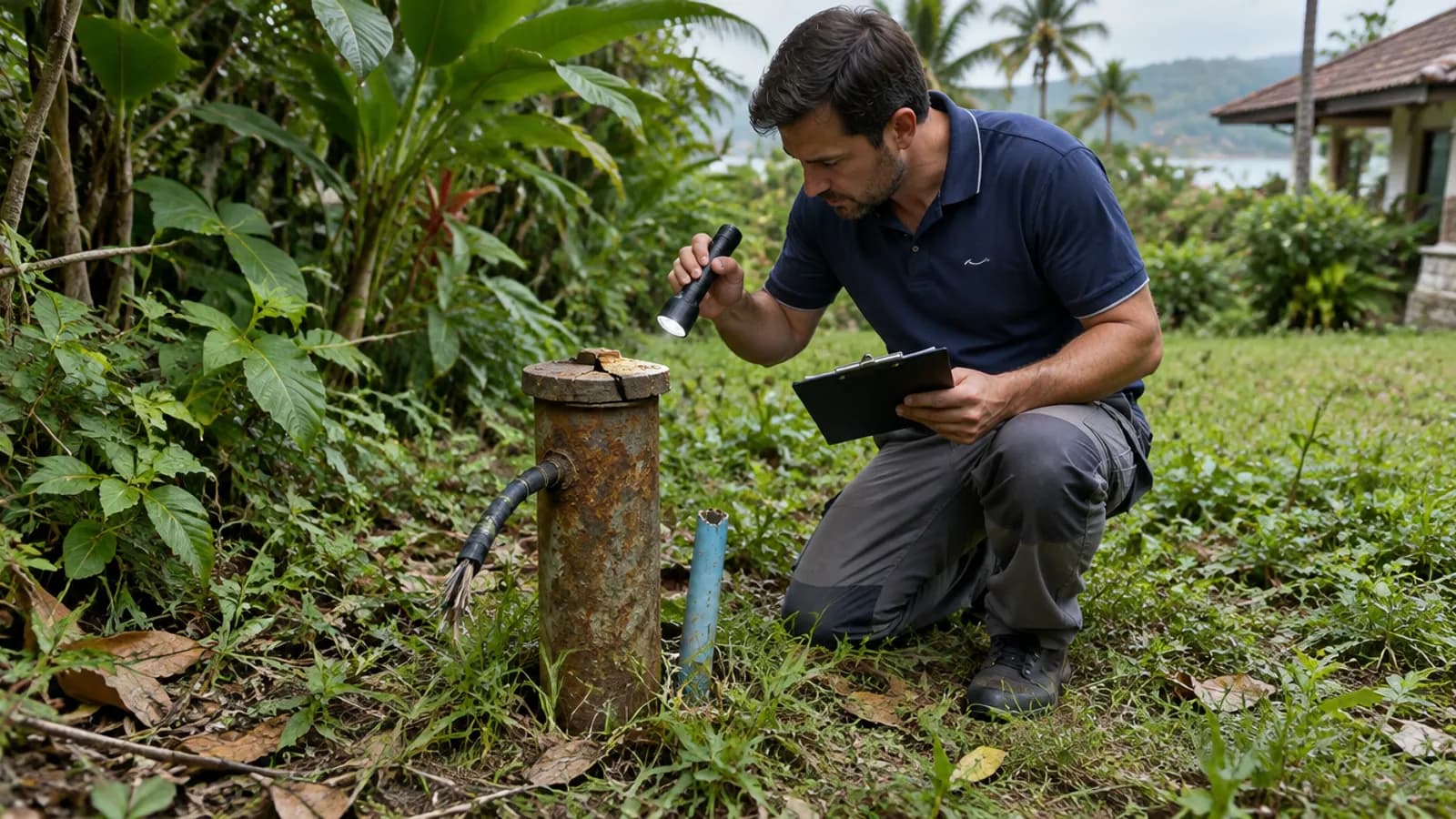
The wellhead: whether it is sealed, raised above flooding and accessible, not buried under a terrace.
Tanks, pressure system and any filtration, the parts the house actually lives on.
Where the seller agrees, pulling the pump adds two things. You see the pump's real condition, and the bore can be checked with a downhole camera for casing damage or a fouled screen. It turns an estimate into an observation, and it is worth asking for on any well that will supply the whole property.
Timing matters too. A pumping test late in the wet season flatters a well. If the purchase timeline allows, test in the dry months, or treat wet-season results with caution. On beachfront plots, ask for a conductivity reading as well: a coastal well can be fresh in October and brackish in April.
Due diligence
Five questions that decide what an existing well is worth
Work through them in order. Each answer either confirms the well or puts a cost on the table.
1
Are the well's records available?
Drilling log, test pumping report, earlier water tests, pump details.
If yes
Compare today's measurements with the originals. Any decline shows up immediately.
If no
The inspection becomes the baseline. Measure depth, level, yield and water quality from scratch.
2
Does the well sustain the villa's demand?
A long pumping test at the property's real rate, with drawdown and recovery recorded.
If yes
Yield is adequate. Note the season the test was done in.
If no
Price in more storage, a smaller pump run for longer, reduced irrigation, or a second well.
3
Is the water suitable for its intended use?
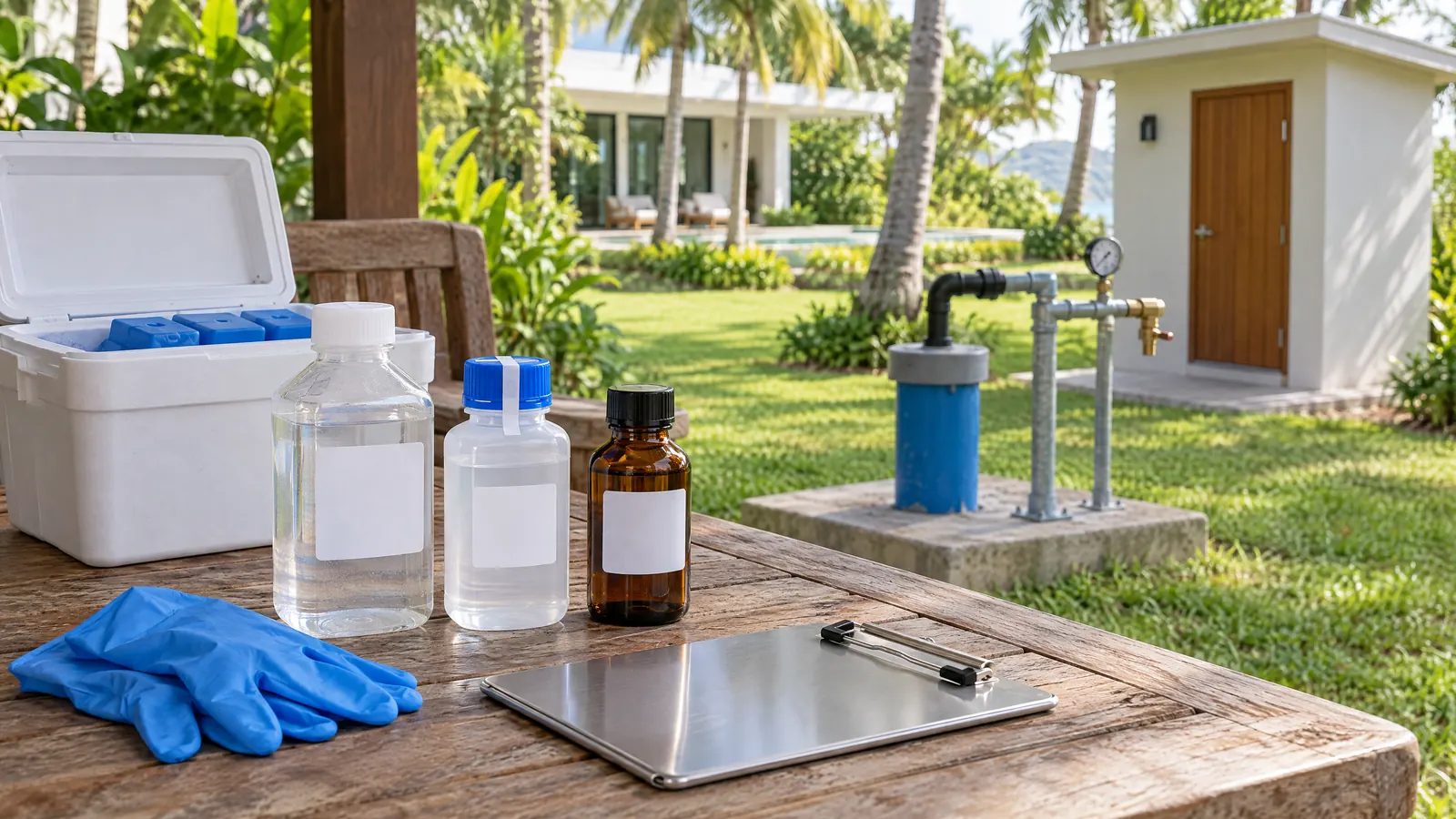
Laboratory analysis of raw water: microbiology, iron and manganese, hardness, salinity.
If yes
Keep the treatment that exists and maintain it on schedule.
Is the wellhead sealed, accessible and properly registered?
Cap, pad and seal against surface water; space to pull the pump; any paperwork the well needs.
If yes
No action beyond normal maintenance.
If no
Reseal or raise the wellhead, clear access, and sort out the paperwork before completion.
Where the answers lead
Keep and service
The well performs and the equipment is sound. Budget for routine maintenance only.
Repair or rehabilitate
The well is good but the equipment, treatment or wellhead needs work. These are costs you can quote before signing.
Plan a new well
The bore itself has failed or can't meet demand. Treat the existing well as a bonus, not as the water supply.
The order matters: there is little point pricing a new pump for a well that can't sustain the villa's demand.
Reading the pump's condition
A pump pulled for inspection tells its own history: iron deposits on the motor, silt packed into the intake, a cloudy sample. Each points to something to investigate in the well itself.
A pump that has been sitting in iron-rich water will show it. So will one that has been pumping sand: worn impellers, silt packed into the intake, a current draw that no longer matches the nameplate. None of this has to kill a deal. A pump is replaceable, and its condition is evidence about the well it came from. Silt in the intake raises questions about the screen and the pumping rate. Heavy deposits mean the water analysis should cover iron and manganese properly. A brand-new pump in an old well is worth a question too: it may have been fitted to fix a symptom just before the sale.
A brackish taste or white crust in a well near the beach.
A pump that starts and stops every few seconds when one tap runs.
Delivery truck receipts from the dry season on a villa that supposedly runs on its well.
A wellhead under a terrace, deck or new paving, where nobody can pull the pump without breaking something.
A seller who will allow a viewing but not a pumping test.
Neighbouring wells known to have failed or turned salty in recent years.
Turning findings into terms of the deal
An inspection report is only useful if it ends in numbers. Get written quotations for whatever it identifies (pump, controls, treatment, tank capacity, wellhead work, rehabilitation or a replacement well) before the price is final. Those figures can go into the offer, into a retention, or into a condition that the seller completes the work. Our guide to comparing well drilling quotations covers what a complete quote for a new well should include, if it comes to that.
Check what you are actually buying, too. Some "wells" are shallow hand-dug rings that dry up every April, and some boreholes were abandoned when the pump failed. An unused bore that will not be brought back into service should be properly sealed, so it can't carry surface water into the ground water. Our article on what's inside a deep well explains what a sound borehole should contain.
If the plot also has an old bore nobody uses, treat it as part of the inspection; our guide to unused and abandoned wells explains why an open bore is a liability and what closing it properly involves.
Buying a property with a well? Ask us to inspect and test it before you commit. We'll measure what the well delivers, analyse the water, check the pump and controls, and give you a written well inspection report with costed recommendations you can take into the negotiation.
Common questions
How long does a pre-purchase well inspection take?
The site work is usually a day: measurements, a pumping test of several hours and sampling. Laboratory water results follow a few days later. Plan it into the purchase timeline early rather than in the last week.
Can I rely on a recent water test the seller already has?
Use it as background, not as the answer. Check the date, the laboratory, where the sample was taken (before or after filtration) and which parameters were tested. A raw sample taken during your own inspection is the one to rely on.
Is a villa with a well always worth more than one on mains water?
Only if the well performs. A well that sustains the property, with sound equipment and records, adds real value on the island. One that needs a new pump, treatment and a second well adds cost, not value.