Is a private well worth it for your Koh Samui property?
A well is not better or worse than mains water in general. It is worth drilling when it solves a real problem for this property, at a cost and with responsibilities the owner accepts. Six questions decide it: what mains water is available, how much the property needs, how much reliability matters, whether a well can be drilled here, what the water will need, and who will look after it.
June 28, 2026 · 9 min read
Owners usually frame this as a comparison: which is cheaper, which is cleaner, which is more reliable. In practice the answer depends far more on the property than on the sources. A small house on a road with a dependable connection and a large rental villa with a pool, a planted garden and no mains nearby are asking different questions. What follows is a way to work through the decision for one property, before anyone quotes for drilling.
Start with what mains water is actually available
The first question is not about the well at all. It is whether the plot has a usable alternative, and how good it is. General impressions of mains supply on the island are not much help here, because experience varies from one road to the next. What matters is this connection, at this plot.
Is there a connection on the road, and what would it take to bring it to the plot?
How dependable is it? Ask neighbours, and look at the property's own history if it has one: interruptions, low-pressure weeks, the months when problems cluster.
Is the flow enough? A weak connection can still keep a tank full if it runs all day, but it will not fill one quickly after an interruption.
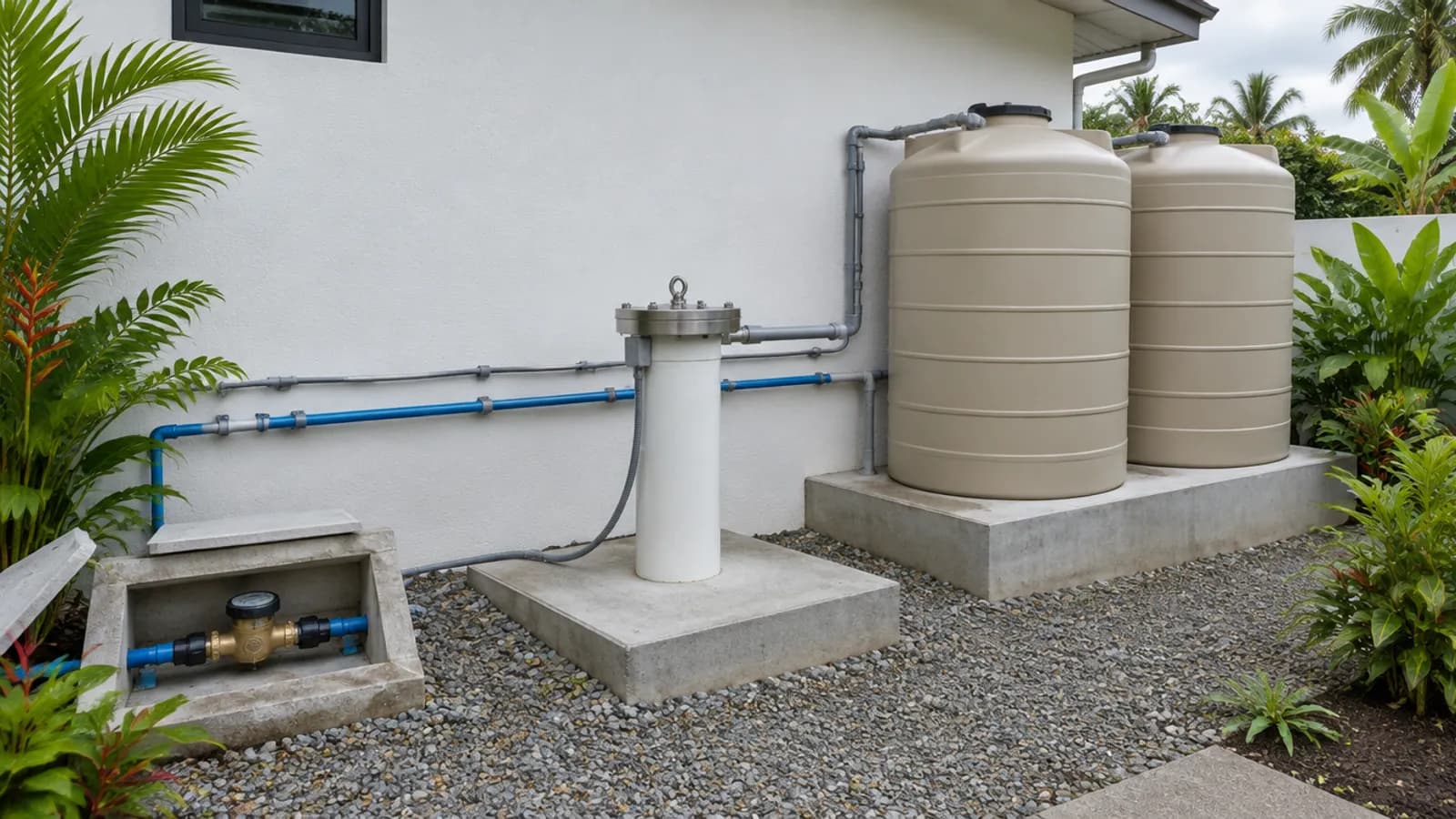
Will storage be needed anyway? Almost every villa on mains still has a tank and a pressure pump, so those costs do not disappear by choosing mains.
How much water the property needs, and when
The size and pattern of demand change the answer more than anything else. A couple living quietly use a fraction of what a full rental villa uses in high season, and a pool or a large irrigated garden can outweigh everything used indoors. Demand that peaks in the dry months is the hardest to supply from any single source.
The number of bedrooms and bathrooms, and realistic peak occupancy
Whether the property is let, and in which months it is full
A pool, its first fill and its daily top-up
Irrigation, which can justify a well on its own because garden water does not need drinking-water treatment
Staff quarters, laundry and outdoor wash-down
For irrigation in particular, see garden irrigation from a well, which covers when a well is a good source for the garden and when it is not.
Primary source, backup, or neither
A well does not have to replace mains water to be worth having. It can be the main source with mains as the fallback, the fallback behind mains, or a source for a single use such as the garden. The question is how much a day without water would cost. For an owner-occupied home, an occasional interruption with a decent reserve in the tank may be acceptable. For a rental villa, a dry day can mean refunds and reviews, and two independent sources start to look like insurance.
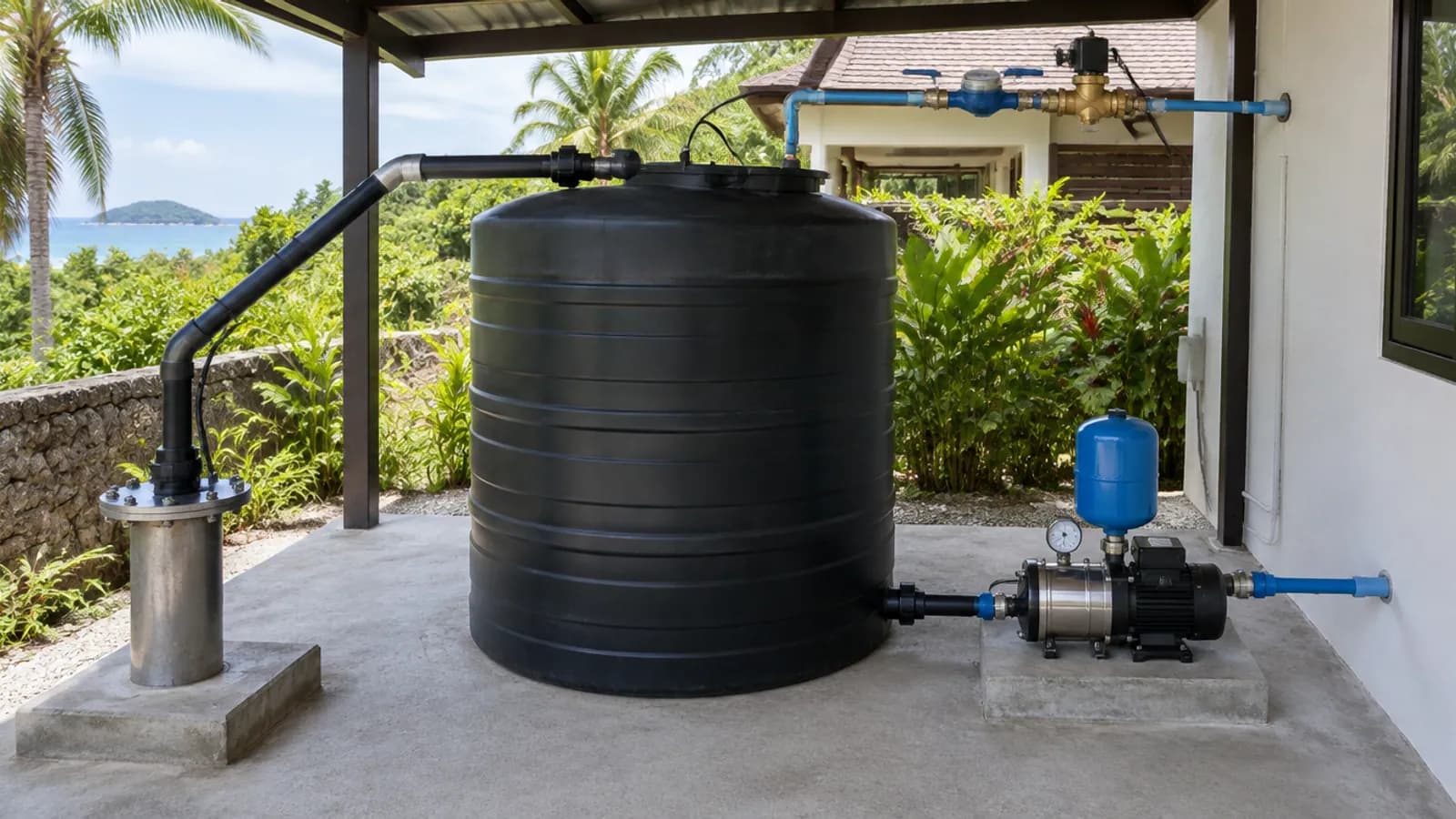
If the answer is both, the two sources should meet in the storage tank, each with its own protected inlet, with level control deciding which refills first. How to arrange that is the subject of running a well alongside mains water.
Can a well be drilled here at all?
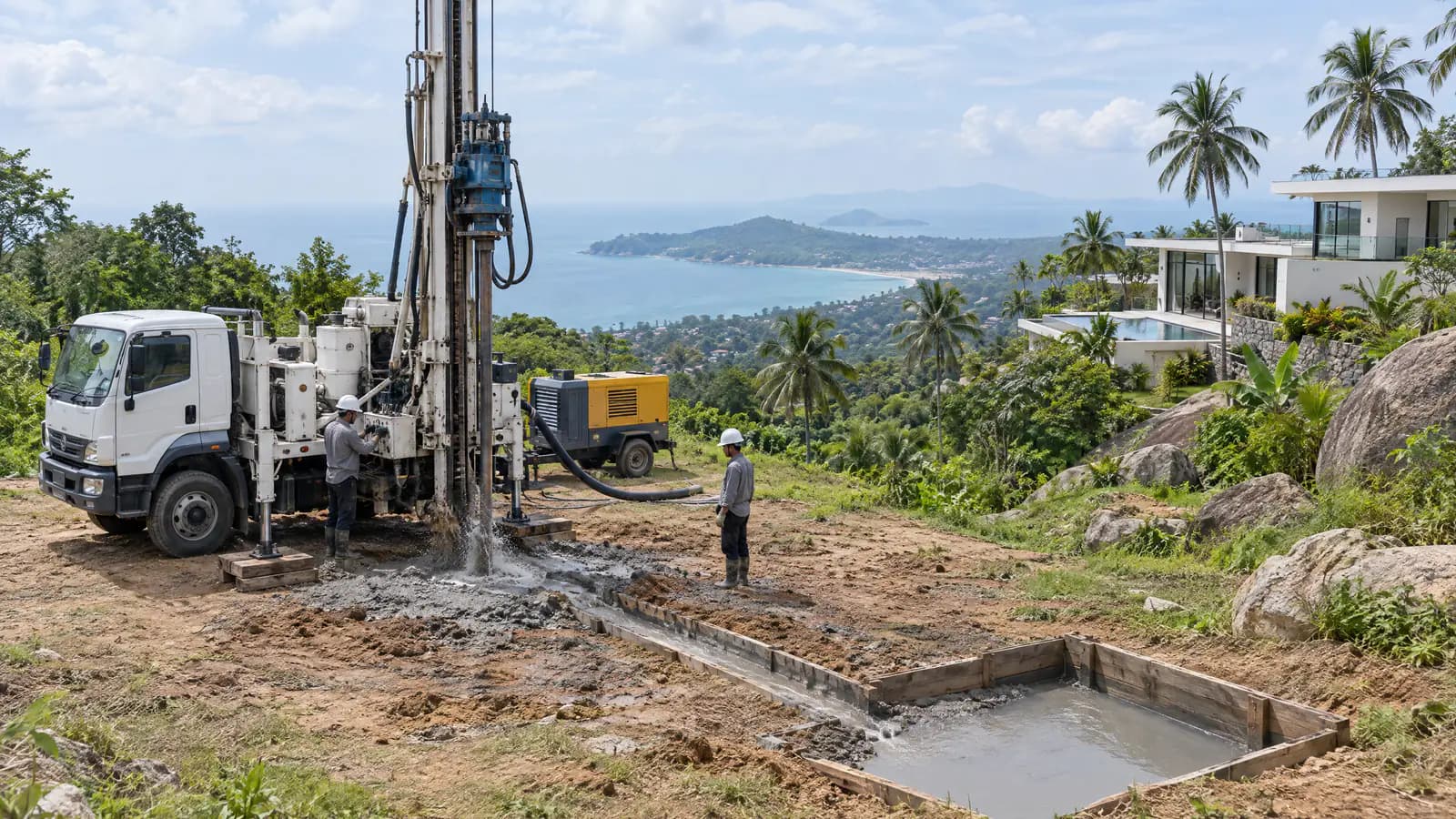
A well only makes sense if the site allows one. Three things have to line up: physical access, a suitable position, and ground that gives water.
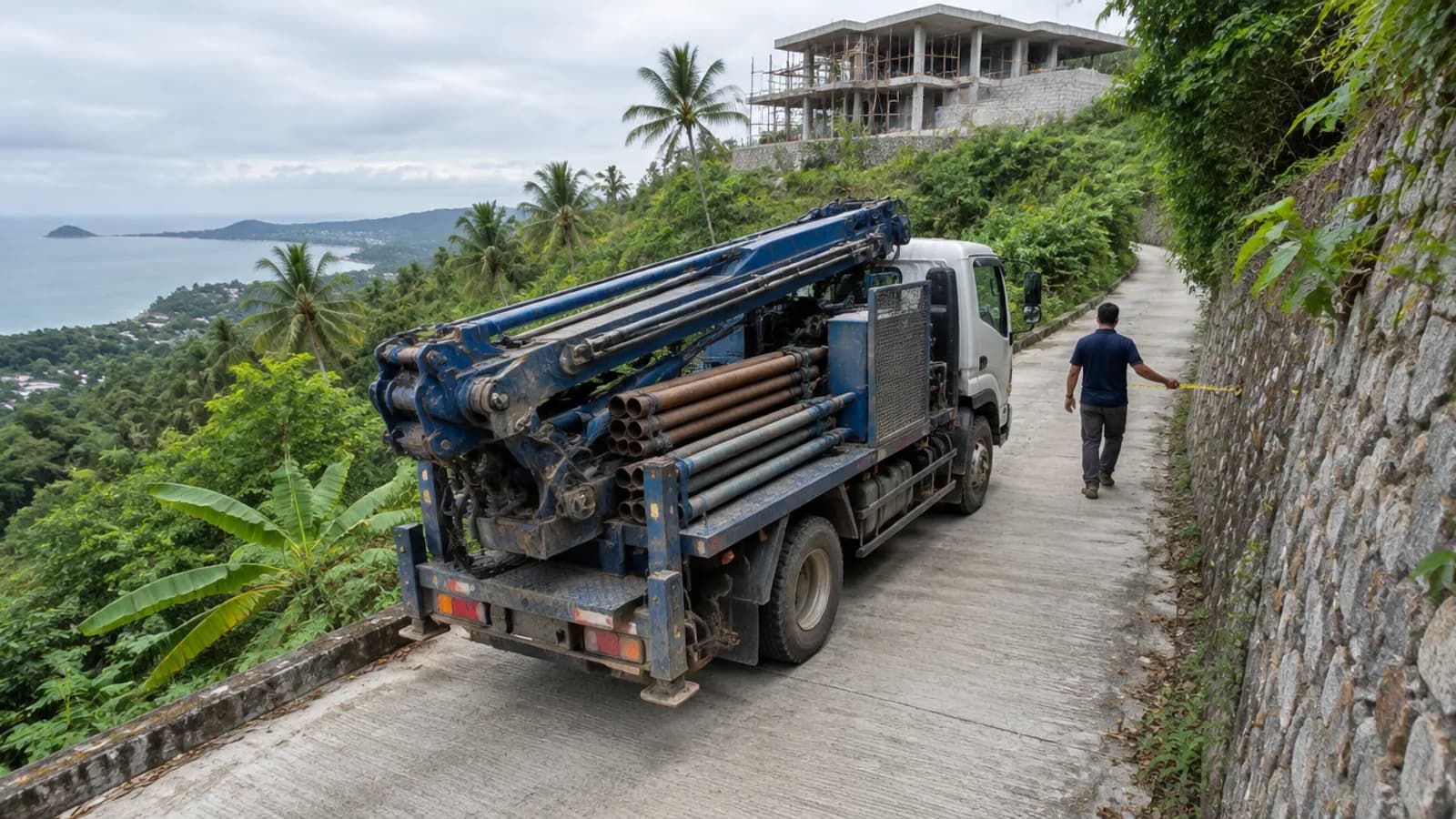
Access. A drilling rig and its support vehicle have to reach the spot. Narrow, steep or soft access can rule out a location or add cost. See preparing a property for well drilling.
Position. The wellhead needs to be clear of septic tanks and drainage, protected from surface water, and left with open space above it so the pump can be lifted out in future.
Ground. How deep the water is and how much the bore will give are only known once it is drilled and tested. Nearby wells are a useful hint, not a promise. How deep wells on Koh Samui go explains why.
Cost follows from these same factors, chiefly depth, access and what has to be installed after the hole. What affects the cost of drilling a well breaks that down.
Water quality: neither source is automatically better
Groundwater on the island varies from bore to bore. Some wells give water that needs little more than sediment filtration; others need iron and manganese removal, softening, disinfection or a salinity check. Mains water has its own path to the tap, usually through the property's storage tank, which has to be kept clean. The only fair comparison is a laboratory test of the well water once it exists, and a treatment budget that follows from it. Until then, assume some treatment may be needed for drinking water. See testing well water before choosing treatment.
What owning a well involves
A well is equipment the owner is responsible for. Choosing mains does not remove every responsibility either. The table sets out who looks after what in each case.
With a private well
With mains water only
Source equipment
Submersible pump, cable, controls and protection, replaced or repaired over the years
The connection up to the meter is not the owner's equipment
Power
The pump needs electricity, and stops in a power cut unless backed up
None for the supply itself
Water quality
Testing, and treatment where the test calls for it, with its own servicing
Keeping the storage tank clean; treatment only if wanted
Storage and pressure
Tank, pressure pump and controls
Usually the same: tank, pressure pump and controls
When supply stops
A fault the owner arranges to have fixed
An interruption the owner waits out on stored water
Is it mainly about saving money?
Sometimes, but often not. Whether a well costs less per cubic metre than mains depends on the drilling cost, the pump's energy use, treatment, maintenance and the local tariff, and those differ from property to property. Many owners who drill are buying reliability and control rather than cheaper water. If cost is the main reason, it deserves real figures for this site, not a general rule.
Decision aid
Mains, a well, or both?
A way to organise the decision, not an engineering calculation. Each answer points in a direction; the site survey and the figures settle it.
1
Does a dependable mains connection reach the plot?
Judged from this connection and its history, not from general reports.
If yes
Mains can carry the household. The question becomes whether a backup or a second source is worth it.
If no
If a well can be drilled, it is likely to be the main source.
2
Is demand large or seasonal?
A pool, a large garden, many bathrooms, or a rental villa that fills up in the dry months.
If yes
Heavy or peaky demand strengthens the case for a well, at least for the garden and pool.
If no
Modest, steady demand is easier to meet from one source with storage.
3
Would a day without water be a serious problem?
Guests, staff, a business, or an owner who is often away.
If yes
Redundancy matters: two sources feeding one tank.
If no
One source with a sensible reserve in the tank may be enough.
4
Can a rig reach a suitable spot?
Clear of septic systems and drainage, with open space above for lifting the pump later.
If yes
Drilling is practical, though depth and yield still have to be proven.
If no
A well may not be realistic here. Plan around mains and storage.
5
Will you test, treat and maintain it?
A laboratory test, treatment where it is needed, and a pump that needs servicing.
If yes
The ongoing side of a well is covered.
If no
Mains with good storage avoids most of that responsibility.
Likely direction
Mains with storage
Dependable mains, modest demand, and an owner who prefers not to run equipment.
Private well as the main source
No dependable mains, a site that can be drilled, and an owner ready to maintain it.
Both, feeding one tank
Mains available, but demand or the cost of a dry day justifies a second source.
Whether a well yields enough water, and of what quality, is only known after drilling and testing.
Likely outcomes
A private well may make sense when…
There is no dependable mains connection, or bringing one to the plot is impractical
Demand is high or concentrated in the dry months: a pool, a large garden, a full rental villa
The site gives a rig access to a suitable, protected position
The owner accepts testing, possible treatment and pump maintenance as part of owning the property
Mains may be enough when…
A connection reaches the plot and has a good record at this property or its neighbours
Demand is modest and steady, with little irrigation and no large pool
A storage tank with a sensible reserve covers the occasional interruption
The site is hard to drill, or the owner would rather not maintain a pump and treatment
Both may be best when…
Mains is available but not dependable enough for how the property is used
A day without water would cost more than a second source
The garden or pool can run on well water while the house keeps mains as its main supply
Each source can refill the same tank through its own protected inlet
What helps the conversation
The decision is quicker with a few facts to hand: the plot's location and access, whether mains water reaches it and how it has behaved, the planned or current occupancy, and whether there is a pool or a large garden. If a well already exists on a neighbouring plot, anything known about its depth or water helps too.
Does a villa need a well if mains water is available?
Not necessarily. If the connection is dependable, demand is modest and the tank holds a sensible reserve, mains water can be enough. A well becomes worth considering when demand is large or seasonal, or when a day without water would be costly.
Is drilling a well mainly about saving money?
Often it is more about reliability and control. Whether a well is cheaper per cubic metre depends on drilling cost, energy, treatment, maintenance and the local tariff, so it needs real figures for the property.
Can a villa keep both mains and well water?
Yes. Both sources should fill the same storage tank, each through its own protected inlet, with level control deciding which refills first. They should not be joined directly in the pipework.